
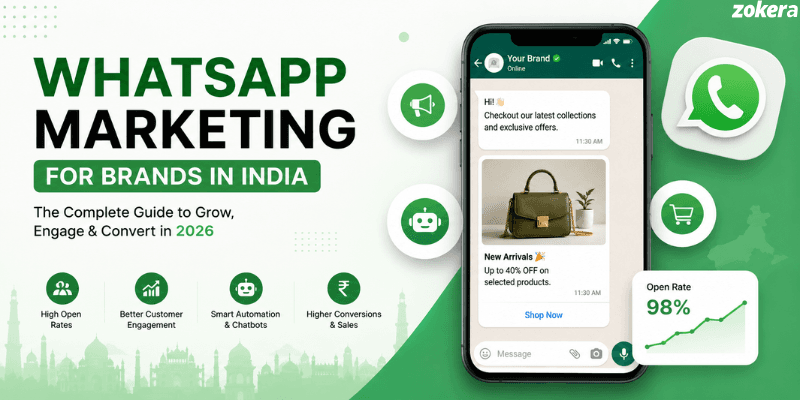
WhatsApp marketing for brands in India is no longer optional. With over 535 million active users, India is the world's largest WhatsApp market, and every brand ignoring this channel is leaving serious money on the table. Email open rates sit at 20%. WhatsApp hits 98%. Your customers are already on it, chatting with family, paying through UPI, and discovering products. This guide gives you the complete, practical strategy to run WhatsApp marketing in India in 2026 and actually see results.
Why WhatsApp Marketing Works Differently in India
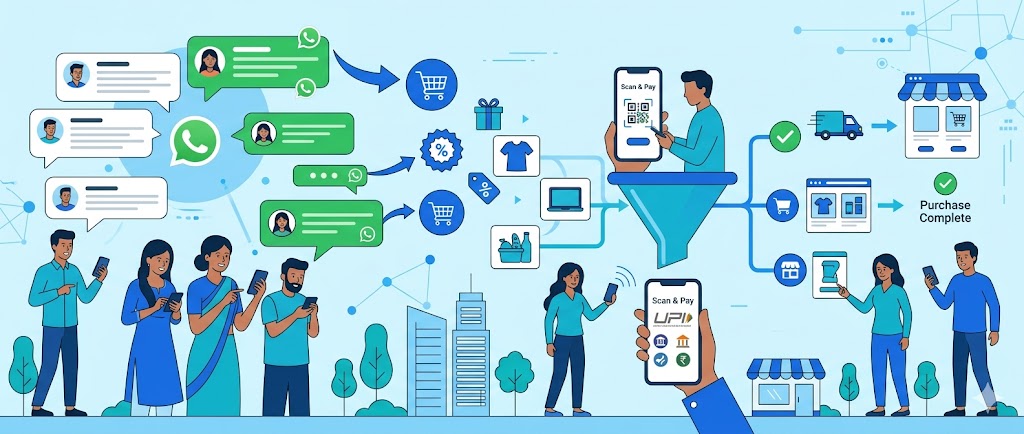
India is not just another country on WhatsApp's user map. India is the world's largest WhatsApp market, with over 500 million active users, and your customers are chatting with family, sharing content, making UPI payments, and increasingly discovering, evaluating, and buying products all within the same app.
That last part matters. In India, WhatsApp is not a secondary channel. It is where buying decisions happen.
A few numbers that put this in perspective:
WhatsApp marketing globally now delivers a 98% open rate and up to 150x ROI compared to traditional marketing channels. Indian D2C brands specifically report a 200 to 300% ROI lift from WhatsApp marketing compared to traditional channels.
The median time-to-purchase from a WhatsApp message is 47 minutes, compared to 14.8 hours for email. In a market where impulse-driven, mobile-first shopping is the norm, that gap is everything.
Three structural trends unique to the 2026 Indian market amplify this channel advantage: rising customer acquisition costs on Meta and Google (CPMs have increased significantly), UPI and WhatsApp Pay integration, creating frictionless purchase journeys, and Tier 2 and Tier 3 city penetration, where WhatsApp is the primary digital communication channel for hundreds of millions of Indians.
WhatsApp Business App vs WhatsApp Business API: Which One Does Your Brand Need?
This is the first decision every brand needs to make before building a WhatsApp marketing strategy.
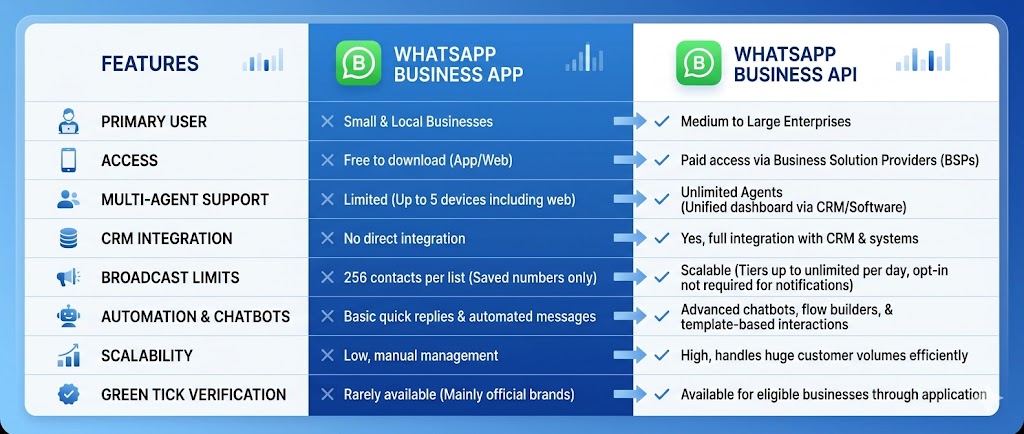
Meta offers two products for businesses to communicate through WhatsApp: the WhatsApp Business App and the WhatsApp Business API. Same brand, completely different capabilities. The app is free and designed for freelancers and micro-businesses. The API is the enterprise layer that enables automation, CRM integration, and multi-agent support at scale.
WhatsApp Business App — Good for Getting Started
The free app works fine if you have fewer than 500 customers to manage. You get basic automation features like greeting messages, away messages, and quick replies. It supports up to 5 devices and manually managed broadcast lists of up to 256 contacts, in which all recipients must have your number saved.
The problems start when you try to grow. If you have 5,000 customers, you are running broadcasts in 20 rounds manually. And if a second agent tries to log in, the first gets disconnected.
WhatsApp Business API — Built for Scale
The API removes every limitation the app has. Unlike the WhatsApp Business app, which caps at 256 broadcast contacts and one device, the WhatsApp Business API supports unlimited opted-in broadcasts, multi-agent live chat, and full automation.
To access the API, you need a Business Solution Provider (BSP). A BSP is a Meta-approved company that helps businesses set up and use the WhatsApp Business API through a platform or dashboard.
Popular BSPs for Indian brands in 2026 include AiSensy, Interakt, Gupshup, and Zoko. Each has different pricing structures and feature sets, and the right choice depends on your business size, budget, and the complexity of your automation needs.
The API has a two-layer cost model: Meta charges per conversation, with the first 1,000 service conversations per month free, and the BSP provider adds their fee, either a fixed monthly fee, per-conversation surcharge, or a mixed model.
WhatsApp Business App vs WhatsApp Business API Comparison
| Feature | WhatsApp Business App | WhatsApp Business API |
|---|---|---|
| Cost | Free | Paid (Meta + BSP charges) |
| Best For | Small businesses and freelancers | Growing brands and enterprises |
| Broadcast Limit | Up to 256 contacts per list | Unlimited opted-in broadcasts |
| Automation | Basic automation | Advanced automation and workflows |
| Multi-Agent Support | Limited | Yes |
| CRM Integration | No | Yes |
| Chatbot Support | Limited | Full chatbot integration |
| Scalability | Low | High |
| Customer Volume | Under 500 customers | Thousands of customers |
| Setup Complexity | Easy | Requires a BSP |
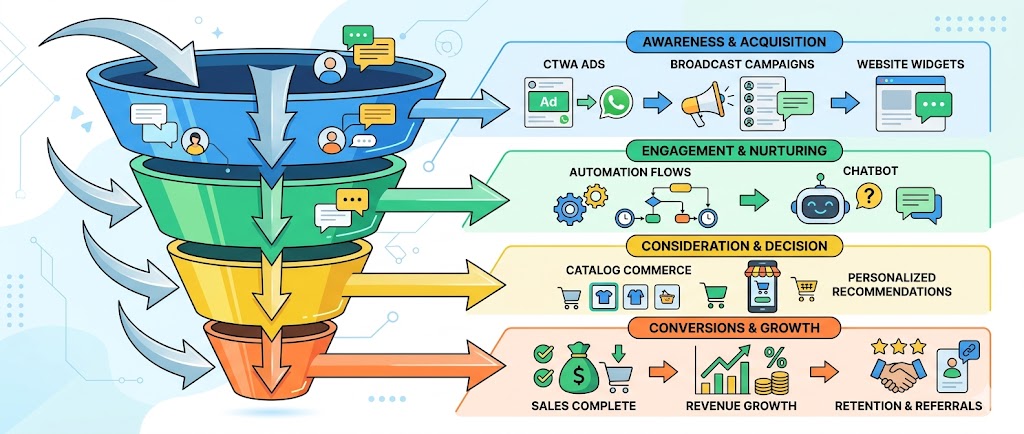
The 5 WhatsApp Marketing Strategies That Actually Drive Revenue
1. Broadcast Campaigns to Opted-In Lists
This is the WhatsApp equivalent of email marketing but far more effective. Send promotional messages, new product announcements, seasonal offers, and exclusive deals directly to your customer list.
The keyword here is opt-in. Sending broadcasts to people who have not explicitly consented is a policy violation that will get your account suspended. Build your list properly, and the results are significant.
Click-through rates on promotional WhatsApp content typically land in the 45 to 60% range. Compare that to a 2 to 3% CTR from a display ad, and the ROI difference becomes obvious.
2. Automated Flows for Lead Nurturing
Automation flows are pre-built message sequences triggered by specific customer actions. Someone clicks your Click-to-WhatsApp ad, messages you, and gets an instant response with product details, a discount code, and a payment link without a single human being involved.
Around 57% of new leads for brands using WhatsApp automation now come through automated WhatsApp flows rather than traditional channels.
Common automated flows worth setting up:
Welcome flow: Triggered when someone messages you for the first time
Cart abandonment recovery: Re-engage customers who added to the cart but did not purchase
Post-purchase flow: Order confirmation, delivery updates, review request
Re-engagement flow: Win back inactive customers with a relevant offer
Cart abandonment rates in Indian e-commerce average 60 to 80%. For D2C brands on Shopify or WooCommerce, integrating WhatsApp abandoned cart recovery is one of the fastest ROI improvements available.
3. Click-to-WhatsApp Ads (CTWA)
CTWA ads run on Facebook and Instagram and send users directly into a WhatsApp conversation when clicked. No landing page, no form, no friction.
CTWA ad spend grew 82% year-over-year between Q1 2025 and Q1 2026 globally. Average click-through rates on CTWA ads range from 3 to 6%, roughly 2 to 3 times standard click-to-website ads. And 35 to 55% of CTWA clicks actually result in a conversation with the brand.
The cost advantage is significant for Indian brands specifically. CTWA ads deliver 30 to 50% lower cost-per-acquisition than standard click-to-website campaigns for D2C brands, with average cost per conversation in India ranging from approximately $0.95.
4. WhatsApp Catalog and In-Chat Commerce
In 2026, low-cost WhatsApp marketing in India is no longer just about sending bulk messages; it is about conversational commerce.
The WhatsApp catalog feature lets customers browse your products, ask questions, and place orders without ever leaving the app. When combined with WhatsApp Pay and UPI, the entire purchase journey, discovery, selection, and payment happen in one conversation.
This matters especially for Tier 2 and Tier 3 city customers who may not be comfortable navigating a full e-commerce website but are very comfortable on WhatsApp.
5. WhatsApp Status for Organic Brand Awareness
WhatsApp Status is a zero-cost, often underused channel for brand content. Users spend roughly 32% of their WhatsApp time passively consuming Status updates. For brands, the Status feature is now a high-visibility engagement channel for organic awareness campaigns that feel native to a user's daily routine.
Use Status for flash sale announcements, behind-the-scenes content, user-generated content reposts, and limited-time offers. Unlike broadcast messages, Status reaches everyone who has your number saved without triggering spam filters.
WhatsApp AI Chatbots: The 2026 Standard for Indian Brands
Properly designed WhatsApp chatbots handle 60 to 80% of incoming customer inquiries without human intervention. 67% of customers say they trust chatbot-based support on WhatsApp for routine queries when the chatbot is well-designed.
For Indian brands dealing with high inquiry volumes, especially in fashion, beauty, electronics, and food delivery, a WhatsApp chatbot is no longer a "nice to have." It is the infrastructure that makes scaling possible without proportionally scaling your support team.
Businesses using chatbots and workflows on WhatsApp reduce customer service workload by up to 54%.
What a good WhatsApp chatbot handles in 2026:
Product recommendations based on customer responses
Order status queries
Return and refund initiation
FAQ resolution
Lead qualification before handoff to a human agent
Payment link generation
The chatbot should have a clear escalation path to a human agent. Customers who need complex support or are ready to make a high-value purchase should always be able to reach a real person quickly.
WhatsApp Compliance Rules Every Indian Brand Must Know in 2026
This section is not optional reading. Getting compliance wrong means account suspension, and rebuilding a suspended WhatsApp Business account is painful.
Opt-In is Mandatory
In 2026, WhatsApp will enforce stricter opt-in and compliance rules across the WhatsApp Business Platform. Every business must clearly collect consent, explain message types, and provide easy opt-out options to stay compliant with WhatsApp policies and local regulations.
Unsolicited broadcasts to purchased lists violate WhatsApp Terms of Service and result in account suspension.
DPDP Act Compliance for Indian Brands
India's Digital Personal Data Protection Act adds another layer on top of Meta's policies. Under DPDP best practices, a separate opt-in is required for transactional messages and promotional messages. A customer may consent to transactional communications but opt out of marketing. Approximately 60 to 70% of customers who consent to transactional WhatsApp messages will not consent to promotional messages.
Build your opt-in flows with this in mind. Two separate checkboxes at checkout, one for order updates, one for marketing offers, are both compliant and the honest way to build your list.
Practical Compliance Checklist
Never message anyone who has not opted in
Every marketing message must include a clear opt-out option (Reply STOP)
Keep records of consent with timestamp, source, and type
Do not purchase or scrape contact lists
Get Meta template messages approved before sending
Monitor your opt-out rate, the industry benchmark for well-managed D2C WhatsApp lists in
India has a below 1% opt-out per broadcast. Above 2% signals a relevance or frequency problem.
How to Build Your WhatsApp Marketing Strategy Step by Step
Step 1: Choose Your Setup
Start with the WhatsApp Business App if you have fewer than 500 customers and a limited budget. Move to the API as soon as you are ready to run broadcast campaigns at scale or need multiple team members managing conversations.
Step 2: Build Your Opt-In List
Every contact on your list must have given explicit consent. Build your opt-in list through:
Website pop-ups and exit-intent forms
Checkout page WhatsApp opt-in checkboxes
CTWA ads on Facebook and Instagram
QR codes on packaging, invoices, and retail locations
Keyword opt-ins (text "DEALS" to your number)
Step 3: Segment Your Audience
Not everyone on your list should get the same message. Segment by purchase history, location, product interest, and engagement level. 72% of users report higher brand engagement when they receive tailored WhatsApp messages.
Step 4: Create Your Core Automation Flows
Before you run a single broadcast campaign, set up your automation foundations: welcome flow, cart abandonment recovery, order confirmation, and re-engagement sequence. These run 24/7 and generate ROI without ongoing effort.
Step 5: Plan Your Broadcast Content Calendar
Treat your WhatsApp broadcast schedule like your email calendar. Plan content around product launches, seasonal sales, restocks, and customer milestones. Aim for 2 to 4 broadcasts per week, maximum for most D2C brands; more than that, and opt-out rates climb.
Step 6: Track the Right Metrics
The numbers that matter for WhatsApp marketing in India:
Open rate (benchmark: 90%+)
Click-through rate (benchmark: 45 to 60%)
Conversion rate per campaign
Opt-out rate per broadcast (keep below 1%)
Revenue attributed to WhatsApp
Response time (target: under 5 minutes for human-handled queries)
WhatsApp Marketing ROI by Industry in India
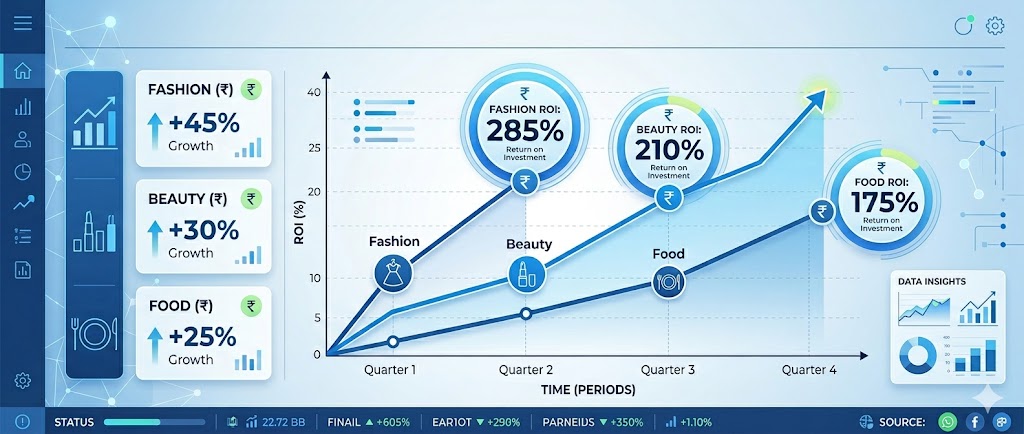
Performance varies significantly by vertical. Beauty and cosmetics brands see the highest WhatsApp marketing ROI at an average of $58 per $1 spent, driven by repeat purchase patterns. Fashion and apparel averages $34 per $1 spent, with peak performance during sale windows. Food, beverages, and groceries average $29 per $1 spent, with the highest message send frequency.
Regardless of vertical, the principle is the same: the more personalized and timely the message, the higher the conversion.
Common WhatsApp Marketing Mistakes to Avoid
Messaging without opt-in: This gets accounts banned. No exceptions.
Sending too frequently: More messages do not mean more revenue. It means more opt-outs.
Generic broadcast content: Sending the same message to everyone ignores segmentation. Personalize based on purchase history and behavior.
No clear CTA: Every message needs one action for the customer to take. Do not leave them guessing.
Ignoring response time: WhatsApp marketing works on immediacy. A lead that does not get a response within an hour often goes cold.
Skipping template approval: Businesses in India that follow Meta's template policy and formatting rules consistently avoid rejections and scale faster. Trial-and-error template submissions weaken account trust.
Conclusion
WhatsApp marketing for brands in India has become one of the most effective ways to engage customers, drive conversions, and build long-term relationships. With high open rates, powerful automation, and growing adoption across Tier 1, Tier 2, and Tier 3 cities, WhatsApp offers brands a direct channel to reach customers where they are most active. By focusing on opt-in communication, audience segmentation, automation, and compliance, businesses of all sizes can turn WhatsApp into a reliable growth and revenue channel in 2026 and beyond.
ALSO READ:
- How to Earn Money from WhatsApp in 2026
- WhatsApp Automation for Small Business Income in 2026
- Shoppable Links on Instagram Reels
- How to Convert Instagram Followers into Customers in 2026
- How Instagram Influencers Can Monetize Using Zokera (2026)
- How to Earn Money from Instagram Broadcast Channels in 2026
- How to Earn Money from Instagram Reels
Frequently Asked Questions (FAQs)
Q1.What is WhatsApp marketing for brands?
WhatsApp marketing is the use of the WhatsApp Business App or API to send promotional messages, automate customer communication, and drive sales through direct, personalized conversations.
Q2. Is WhatsApp marketing legal in India in 2026?
Yes, when done with proper opt-in consent. Messaging customers who have explicitly opted in is fully legal under India's DPDP Act. Unsolicited bulk messaging violates Meta's policies and India's data protection law.
Q3. What is the open rate for WhatsApp marketing in India?
WhatsApp messages in India achieve open rates of 90 to 98%, compared to 20 to 25% for email marketing.
Q4. Do I need the WhatsApp Business API or the free app?
The free WhatsApp Business App works for small businesses with under 500 contacts. For running large broadcast campaigns, automation flows, and multi-agent support, the API is necessary.
Q5. What is a BSP in WhatsApp marketing?
A BSP (Business Solution Provider) is a Meta-approved company that gives you access to the WhatsApp Business API. Examples in India include AiSensy, Interakt, and Gupshup.
Q6. How do I build a WhatsApp contact list legally?
Through website opt-in forms, checkout page checkboxes, Click-to-WhatsApp ads, QR codes, and keyword opt-ins. Never purchase or scrape contact lists. India's DPDP Act requires explicit consent for every contact.
Q7. What is a Click-to-WhatsApp ad?
A CTWA ad runs on Facebook or Instagram and sends users directly into a WhatsApp conversation when clicked, skipping landing pages and forms entirely.
Q8. How often should brands send WhatsApp broadcasts?
Two to four times per week is a common benchmark for D2C brands. Sending too frequently increases opt-out rates. Monitor weekly and adjust based on engagement.
Q9. What happens if I message people without opt-in on WhatsApp?
Meta can restrict or permanently suspend your WhatsApp Business account. Full WhatsApp Business Policy details are available on WhatsApp's official site.
Q10. Can small businesses use WhatsApp marketing in India?
Absolutely. The free WhatsApp Business App is a strong starting point. Many small businesses in India use WhatsApp as their primary sales and support channel with zero paid tools.
Comments (0)
Be the first to comment.