

You earn every month. You save a little. But that money sits in your bank account doing almost nothing. Sound familiar? Most beginners in India face this exact problem. They know they should invest, but do not know where to start. The good news is that in 2026, you can start investing with just Rs. 500 a month, from your phone, without any finance degree. This guide covers the best investment options for beginners in India in simple language so you can take your first real step today.
Why 2026 Is Actually a Great Time to Start Investing

Here is a hard truth. If your savings account gives 3% interest and inflation in India is running at 5-6%, your money is silently losing value every single year. According to RBI data, consumer price inflation has remained consistently above savings account interest rates for several years now.
But 2026 also brings a real opportunity:
You can start a SIP with Rs. 100 per month on apps like Groww or Zerodha
PPF accounts can be opened online in under 10 minutes at most major banks
SEBI has made mutual fund investing simpler and more transparent for retail investors
Budget 2026 maintained Section 80C deductions up to Rs. 1.5 lakh, giving tax-saving investment options more value than ever
The point is simple. Waiting for the "right time" to invest is itself the wrong decision. The right time is when you understand where to put your money.
Before You Start: 3 Things Every Beginner Must Get Right
1. Be Clear About Your Goal
Are you investing in building an emergency fund? Save for a house? Retirement plan? Your goal decides everything else, including how long to stay invested and how much risk you can handle. A person saving for a down payment in 2 years needs a completely different plan than someone building a retirement corpus over 25 years.
2. Understand Risk Honestly
Every investment involves some trade-off between safety and returns. PPF gives you a guaranteed 7.1% with zero risk. A good SIP in an equity mutual fund can give 12-14% over the long term, but will have bad months and bad years in between. Neither is wrong. What is wrong is taking more risk than you can handle emotionally or financially.
3. Build the Habit Before Chasing Returns
Most beginners obsess over which fund gives the best returns. The more important question is: can you invest consistently every month without missing? Starting with Rs. 500 per month and staying consistent for 10 years beats starting with Rs. 5,000 and stopping after 6 months every single time.
Quick Comparison: Best Investment Options for Beginners in India 2026
| Investment Option | Min. Amount | Risk | Expected Returns | Best For |
|---|---|---|---|---|
| SIP in Mutual Funds | Rs. 100/month | Low to High | 10-14% p.a.* | Long-term wealth creation |
| PPF | Rs. 500/year | Zero | 7.1% p.a. | Safe + tax-free returns |
| Fixed Deposit | Rs. 1,000 | Zero | 6.5-8% p.a. | Short-term parking |
| ELSS Mutual Funds | Rs. 500/month | Moderate | 10-14% p.a.* | Tax saving + growth |
| Index Funds | Rs. 100/month | Moderate | 10-12% p.a.* | Passive, low-cost investing |
| NPS | Rs. 500/month | Low to Moderate | 8-10% p.a.* | Retirement planning |
| Recurring Deposit | Rs. 100/month | Zero | 5.5-7.5% p.a. | First-time investors |
| Sovereign Gold Bonds | 1 gram | Low | 2.5% interest + gold price | Gold without hassle |
*Returns are historical estimates. Market-linked investments are subject to risk. Past performance does not guarantee future returns.
Top 8 Investment Options for Beginners in India 2026
1. SIP in Mutual Funds: Best for Long-Term Wealth Creation
A Systematic Investment Plan (SIP) is the most beginner-friendly way to enter the stock market. You invest a fixed amount every month, and it automatically goes into a mutual fund of your choice. No need to track markets. No need to time your entry.
Why it works for beginners:
Rupee cost averaging means you buy more units when markets are low and fewer when they are high, which reduces overall risk over time
You can start with just Rs. 100 per month
SEBI-regulated, fully transparent, and easy to track via apps
Best type for beginners: Large-cap funds or Nifty 50 Index Funds. These tracks established, stable companies and are far less volatile than mid-cap or small-cap funds.
For a detailed mutual fund comparison, the AMFI India website is the most reliable free resource for beginners.
2. PPF (Public Provident Fund): Best for Zero-Risk Long-Term Savings
PPF is a government-backed scheme that gives you guaranteed, tax-free returns with complete capital protection. The only catch is the 15-year lock-in period, which is actually a feature, not a bug. It stops you from withdrawing impulsively and forces long-term discipline.
Key details:
Current interest rate: 7.1% per annum (reviewed every quarter by the government)
Investment limit: Rs. 500 to Rs. 2 lakh per year (increased from Rs. 1.5 lakh in Budget 2026)
Full tax exemption at all three stages: investment, interest earned, and maturity
Partial withdrawals allowed from Year 7 onwards for emergencies
PPF falls under the EEE (Exempt-Exempt-Exempt) tax category, which means you save tax under Section 80C while earning completely tax-free returns. No other investment in India combines safety + tax benefit + guaranteed returns this cleanly.
3. Fixed Deposit: Best for Your Emergency Fund
FDs are the most familiar investment in India and for good reason. You get guaranteed returns, your principal is safe, and you can break it before maturity if needed. The problem is that most people keep all their money in FDs and wonder why their wealth is not growing.
The right way to use FDs:
Use FDs only for your emergency fund (3 to 6 months of expenses)
Do not use FDs for long-term goals because returns barely beat inflation after tax
Spread large amounts across multiple banks since DICGC insures only up to Rs. 5 lakh per depositor per bank
FDs are not a wealth-building tool. They are a safety net.
4. ELSS Mutual Funds: Best for Tax Saving with Growth Potential
ELSS (Equity Linked Savings Scheme) is the most overlooked investment option for beginners in India. Most people only think of PPF or FD when they want to save tax under Section 80C. But ELSS gives you the shortest lock-in period of all 80C options (just 3 years) while also giving equity-level returns over the long term.
Why ELSS beats other 80C options for young investors:
Only 3-year lock-in vs 15 years for PPF and 5 years for tax-saver FD
Historical returns of 10-14% CAGR over long periods, far ahead of PPF
Can be started as a SIP for as low as Rs. 500 per month
Long-term capital gains above Rs. 1.25 lakh are taxed at only 12.5% (post Budget 2024)
If you are under 35 and investing for tax savings, ELSS should be your first. 1.5 lakh before you even think about PPF.
5. Index Funds: Best for Passive, Low-Cost Investing
An index fund simply copies a market index like the Nifty 50 or Sensex. It does not have a fund manager making active stock picks. This means lower costs and, over long periods, returns that match or beat most actively managed funds.
Why index funds are perfect for beginners:
Expense ratios as low as 0.1-0.2% vs 1-2% for active funds
No risk of a bad fund manager making wrong calls
Transparent: you always know exactly which stocks you own
Nifty 50 has delivered roughly 12% CAGR over the last 20 years
According to SEBI guidelines, index funds are regulated just like any other mutual fund, giving investors full protection and transparency.
6. NPS (National Pension System): Best for Retirement Planning
NPS is a government-backed retirement scheme regulated by PFRDA. It is one of the most cost-effective long-term investment options in India with fund management charges as low as 0.09%.
The big tax advantage most people miss:
Section 80C deduction up to Rs. 1.5 lakh
Additional Rs. 50,000 deduction under Section 80CCD(1B) that no other investment gives you
That is a total of Rs. 2 lakh in tax deductions from NPS alone
If you are in the 30% tax bracket, investing Rs. 2 lakh in NPS saves you Rs. 60,000 in taxes every year. The downside is that 40% of the corpus is locked until age 60 and must be used to buy an annuity.
7. Recurring Deposit: Best Starting Point for Absolute Beginners
If you have never invested before and the whole concept feels scary, start here. An RD is just a fixed deposit that you fund monthly. You commit Rs. 500 or Rs. 1,000 every month, and it earns guaranteed interest. Available at every bank and post office in India.
It will not make you rich. But it will build the habit of putting money aside every month before you spend it, which is the most valuable financial skill a beginner can develop.
8. Sovereign Gold Bonds: Best Way to Invest in Gold
Sovereign Gold Bonds (SGBs) are issued by the Reserve Bank of India on behalf of the Government of India. They are the smartest way to invest in gold if you believe in gold as an asset class.
Why SGBs beat physical gold completely:
You earn an extra 2.5% annual interest on top of gold price appreciation
No storage cost, no making charges, no risk of theft
Zero capital gains tax if you hold till maturity (8 years)
Can be bought and sold on the stock exchange if you need to exit early
The only downside: SGBs are issued in limited tranches. Check the RBI website for the latest tranche dates and pricing.
Real Example: How to Build Your First Portfolio with Rs. 5,000/Month
This is what most competitors miss. Here is a simple, real beginner portfolio for someone earning Rs. 25,000-30,000 a month:
| Where to Put It | Amount | Why |
|---|---|---|
| Emergency Fund (FD/RD) | Rs. 1,500 | Until you have 3 months of expenses saved |
| ELSS SIP (tax saving) | Rs. 1,000 | 80C benefit + equity growth, 3-year lock-in |
| Nifty 50 Index Fund SIP | Rs. 1,500 | Core long-term wealth building |
| PPF (yearly total Rs. 6,000) | Rs. 500 | Safe, zero-risk, tax-free compounding |
| Liquid Fund or RD | Rs. 500 | Short-term goal saving |
Total: Rs. 5,000/month
This portfolio covers tax saving, emergency fund, long-term growth, and short-term goals all at once. No single point of failure.
The Power of Starting Early: A Simple Compounding Example
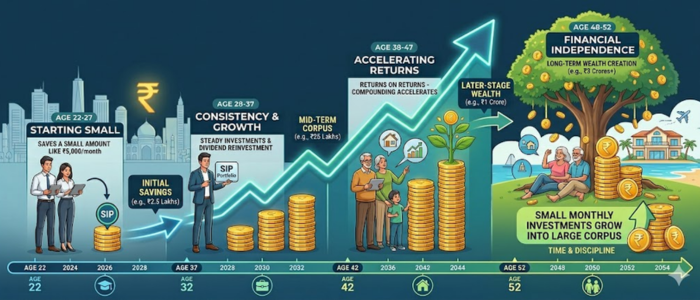
This is not a theory. This is math that changes how you think about money.
If you invest just Rs. 500 per month in a Nifty 50 Index Fund starting at age 22 and earn 12% average annual returns:
After 10 years: approximately Rs. 1.16 lakh invested, corpus around Rs. 1.15 lakh (breakeven phase, compounding just starting)
After 20 years: approximately Rs. 2.4 lakh invested, corpus around Rs. 4.99 lakh
After 30 years: approximately Rs. 3.6 lakh invested, corpus around Rs. 17.6 lakh
Rs. 500 a month. Started at 22. Corpus of Rs. 17+ lakh at 52. That is compounding. And that is why starting today with a small amount beats waiting to start with a big amount.
Step-by-Step: How to Start Investing in India Today
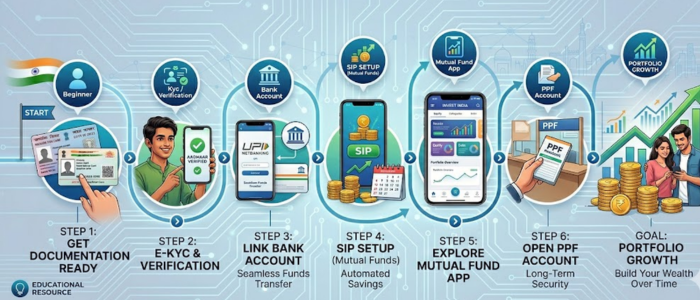
1. Open a bank account if you do not already have one with a bank that offers PPF and RD online
2. Get your PAN and Aadhaar ready as these are mandatory for all investment accounts in India
3. Build your emergency fund first by opening an RD or FD for 3 months of expenses before touching any market-linked product
4. Open a PPF account at your bank or post office and start with even Rs. 500 per month
5. Complete KYC on a SEBI-registered platform like Groww, Zerodha, or Kuvera, to start SIP in mutual funds
6. Start your first SIP in a Nifty 50 Index Fund or a large-cap mutual fund with whatever amount you can manage
7. Set a SIP auto-debit so the money moves before you get a chance to spend it
8. Review your portfolio once every 6 months, not once a week
5 Common Mistakes Beginners Make (And How to Avoid Them)
Mistake 1: Investing emergency money in SIPs
If your job is unstable or you have no cash buffer, a market crash can force you to redeem your SIP at a loss. Keep 3-6 months of expenses in an FD before starting market-linked investments.
Mistake 2: Chasing last year's top-performing fund
A fund that gave 45% last year is often one that takes the biggest hit next year. Focus on consistency over 5-7 years, not recent rankings.
Mistake 3: Stopping SIP when markets fall
This is the exact opposite of what you should do. When markets fall, your SIP buys more units at a lower price. Stopping a SIP during a crash locks in your losses.
Mistake 4: Putting everything in one place
FD alone will not beat inflation. SIP alone leaves you with no safety net. Diversify across at least 2-3 options from day one.
Mistake 5: Not investing because the amount feels "too small"
Rs. 500 a month feels insignificant. But as shown above, Rs. 500 a month for 30 years at 12% becomes over Rs. 17 lakh. There is no amount too small to start.
Conclusion
The best investment options for beginners in India in 2026 are not complicated. You do not need a financial advisor, a high salary, or a deep understanding of markets to get started. You need a clear goal, a small, consistent amount, and the discipline not to touch it.
Start with an FD for your emergency fund. Add a PPF account for safe long-term compounding. Begin a SIP in a Nifty 50 Index Fund or ELSS for growth and tax savings. That combination alone puts you ahead of most Indians who are still "planning to invest someday."
The only investment that never works is the one you never start.
ALSO READ:
- Top 10 SIP Plans in India (2026) – Best SIP Plans for Long-Term Wealth Creation
- SIP vs Lump Sum Investment: Which One Is Better for Beginners in India 2026
- How to Grow Your Wealth with SIPs and Mutual Funds
- 10 Best Earning Apps Without Investment in India (2026) – ₹500/Day Apps
- Top Investment Apps in India for Beginners
- Investment for Beginners: How to Start with Mutual Funds or Stock Market in India
Frequently Asked Questions (FAQs)
Q1. Which is the best investment option for beginners in India in 2026?
For most beginners, starting with a combination of PPF for safety and a Nifty 50 Index Fund SIP for growth is the simplest and most effective strategy. Add ELSS if you need to save tax under Section 80C.
Q2. How much money do I need to start investing in India?
You can start with as little as Rs. 100 per month via an RD or SIP. There is no minimum income requirement. Consistency matters far more than the amount when you are starting.
Q3. Is SIP better than FD for beginners in India?
For goals that are 5 years or more away, SIP in equity mutual funds historically outperforms FDs significantly. For goals under 2-3 years or for your emergency fund, FD is safer and more appropriate. Use both for different purposes rather than choosing one.
Q4. Which investment gives the best tax benefits in India?
ELSS mutual funds, PPF, NPS, and 5-year tax-saver FDs all qualify for Section 80C deduction up to Rs. 1.5 lakh. NPS additionally gives Rs. 50,000 under Section 80CCD(1B). ELSS offers the best combination of tax savings + returns + the shortest lock-in for younger investors.
Q5. Can a student start investing in India?
Yes. Anyone above 18 with a PAN card and bank account can open an RD, start a SIP, or open a PPF account. Students can start with Rs. 100-500 per month. Starting at 18 instead of 25 gives your money 7 extra years of compounding.
Q6. What is the safest investment option in India in 2026?
PPF, government-backed FDs, and Post Office RDs carry zero risk to your principal. PPF is considered the safest long-term investment in India because it is fully backed by the Government of India and offers completely tax-free returns.
Q7. Which is better for beginners: PPF or NPS?
Both serve different purposes. PPF is better for mid-term goals (15 years) with full flexibility at maturity. NPS is strictly a retirement product with restrictions on withdrawal before age 60. For beginners who are young, starting both makes sense: PPF for flexibility and NPS for the additional tax deduction.
Q8. How much should a beginner invest per month in India?
A common starting rule is to invest 20% of your monthly income. On a Rs. 25,000 salary, that is Rs. 5,000 per month. If that feels like too much, start with 10%. The percentage matters less than the consistency.
Comments (0)
Be the first to comment.