
Tax season doesn't have to feel like a maze. Whether you're salaried, self-employed, or earning through creator platforms like Zokera's follower cashback model, understanding tax-saving investments in India for 2026 can save you real money. With updated tax rules applying from FY 2026-27, the differences between the Old and New Tax Regimes have become more important than ever. This guide breaks down the best options under Section 80C, 80D, and beyond, so you can plan smarter and keep more of what you earn.
What Changed in India's Tax Rules for FY 2026-27
Tax rules for FY 2026-27 include important updates around tax slabs, rebates, deductions, and regime selection. Taxpayers should always verify the latest provisions through the official Income Tax Department portal before filing returns.
The New Tax Regime is now the default option for all taxpayers.
The Old Tax Regime is still available, but only if you actively opt in while filing.
Tax provisions, deductions, and exemptions should always be checked according to the latest rules notified by the Income Tax Department.
Tax relief under the New Regime comes mainly from revised slab rates, rebate provisions, and the standard deduction rather than investment linked deductions.
Employer contributions to certain notified retirement schemes may still get favourable tax treatment within prescribed limits, even under the New Regime.
Returns for income earned up to 31 March 2026 (FY 2025-26) are still filed under the old Income Tax Act, 1961. The Income Tax Act, 2025 applies only from Tax Year 2026-27 onwards, so the provisions of this guide apply to income earned from 1 April 2026.
This means your first decision in 2026 isn't which investment to pick. It's which regime actually suits your income profile, and that decision should come before you lock money into anything.
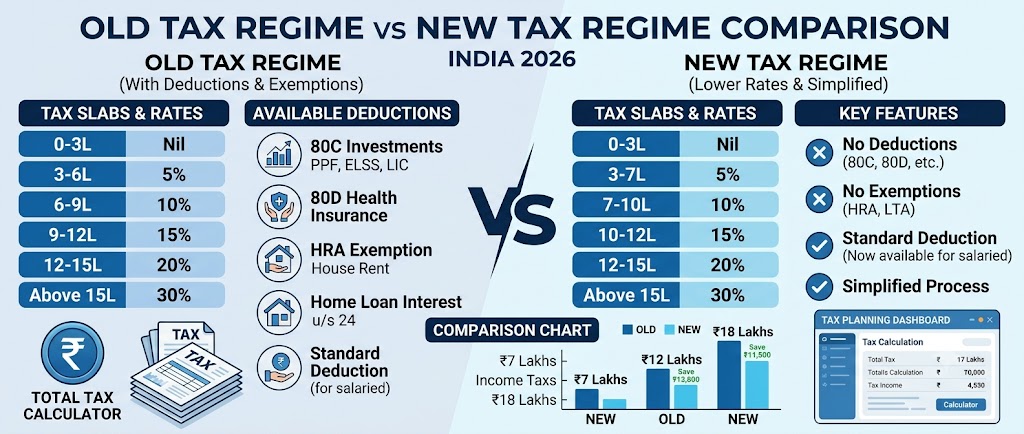
Old vs New Tax Regime: Which Should You Pick
Here's a side by side comparison to help you decide:
| Factor | Old Tax Regime | New Tax Regime |
|---|---|---|
| Tax rates | Higher slab rates | Lower slab rates |
| Deductions (80C, 80D, HRA, etc.) | Available | Mostly unavailable |
| Best suited for | High deduction claimants (loans, insurance, family expenses) | Low to moderate income earners with few claims |
| Investment planning needed | Yes, to maximize deductions | Minimal |
| Ideal income range for benefit | Below deduction heavy earners | Roughly ₹7 lakh to ₹15 lakh with few claims |
If you have significant deductions such as a home loan, life insurance premiums, or children's tuition fees, the Old Regime combined with smart tax saving investments usually works out better financially. If your income is straightforward with few claims to make, the New Regime's lower slabs may already give you the best outcome without needing to lock money into specific instruments at all.
A simple way to decide is to estimate your tax liability under both regimes using your actual numbers, ideally with a chartered accountant or a verified calculator, rather than guessing based on what worked for someone else last year. Since tax rules and slabs can change, always compare the latest provisions before making investment decisions.
Top Tax Saving Instruments Under Section 80C
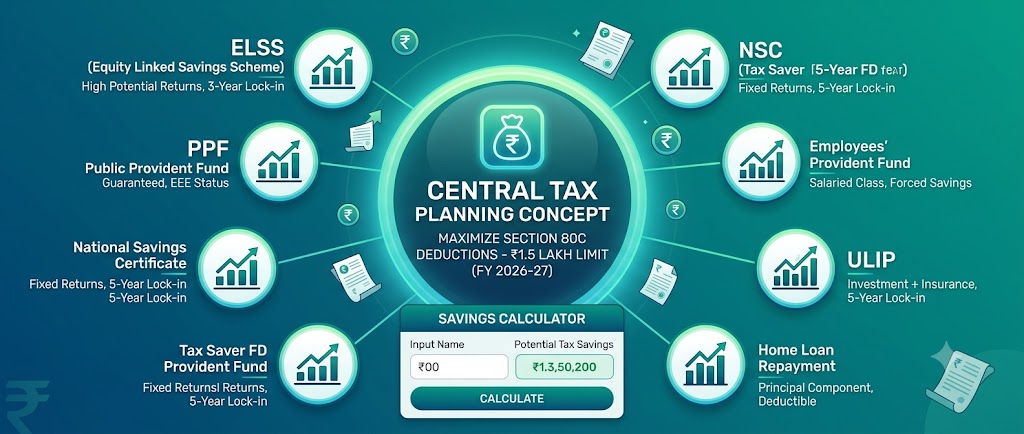
Section 80C remains the backbone of tax planning under the Old Regime, with a combined deduction limit of ₹1.5 lakh per financial year across all instruments listed below. This means the total you invest across ELSS, PPF, insurance premiums, and everything else in this list is capped together, not per product.
ELSS (Equity Linked Savings Scheme): Market linked mutual funds regulated under SEBI's mutual fund guidelines, with the shortest lock-in among all 80C options at just 3 years. Historical returns have ranged from 12 to 15 percent annually, though returns aren't guaranteed since they're tied to equity market performance.
PPF (Public Provident Fund): Government backed, fixed returns, 15 year tenure with partial withdrawal allowed after year 7. Considered one of the safest tax saving investments in India since the principal and interest are both government guaranteed.
NSC (National Savings Certificate): A fixed income instrument available at post offices with a 5 year lock-in and interest that's taxable but reinvested each year, which itself qualifies for further 80C deduction.
Tax Saver Fixed Deposits: Bank FDs regulated under Reserve Bank of India guidelines, with a mandatory 5 year lock-in, qualifying for 80C deduction on the principal invested. According to India Post, a 5 year Post Office Time Deposit also qualifies under this section.
Sukanya Samriddhi Yojana: For parents of a girl child, offering higher interest rates than most fixed income options and full tax exemption on maturity.
EPF (Employees' Provident Fund): Automatic deduction for salaried employees, with both employer and employee contributions eligible, and interest that's tax free up to prescribed limits.
ULIP (Unit Linked Insurance Plan): Combines life insurance and investment in one product, with returns linked to market performance and a 5 year lock-in.
Home Loan Principal Repayment: The principal portion of your EMI payments qualifies under 80C, separate from the interest deduction claimed under a different section.
Tuition Fees: Fees paid for up to two children's full time education also count toward the same 80C limit.
Beyond 80C: Section 80D and NPS
Once you've maximized 80C, two more avenues can reduce your taxable income further, and both are worth prioritizing before you look at anything outside the Old Regime's standard list.
Section 80D (Health Insurance Premiums): Deduction up to ₹25,000 for premiums paid for self, spouse, and children, with an additional amount available for parents, higher still if they're senior citizens. This is separate from the 80C limit, so it's effectively bonus tax saving on top.
NPS (National Pension System) under Section 80CCD: An additional deduction of up to ₹50,000 is available exclusively for NPS contributions, over and above the 80C limit. NPS is regulated by the Pension Fund Regulatory and Development Authority and is best suited for long term retirement planning given its extended lock-in until retirement age.
Between these two, 80D is usually the easier win since a health insurance policy is worth having regardless of the tax benefit. At the same time, NPS suits people who are already thinking long term about retirement.

Tax Planning for Creators, Freelancers, and Gig Earners
Most tax saving guides are written for salaried employees with predictable monthly income. If you're a content creator, affiliate marketer, or freelancer earning through platforms and cashback models like Zokera, your income pattern looks different, and so should your tax planning:
Irregular income means irregular tax liability. Since your earnings can swing month to month depending on brand collaborations or seasonal cashback payouts, it helps to estimate your annual income early and spread 80C investments across the year rather than rushing in March.
Advance tax applies to you too. As per rules laid out by the Income Tax Department, if your total tax liability exceeds ₹10,000 in a financial year, you're required to pay advance tax in quarterly instalments, regardless of whether you're salaried or not.
Track every income source separately. Cashback earnings, brand collaboration payouts, and affiliate commissions may fall under different heads of income depending on how they're structured. Keeping clean, separate records for each makes it far easier to claim eligible deductions and file accurately at year end.
ELSS suits variable income well. Its short lock-in and flexibility to invest lump sum or via SIP make it easier to fit around unpredictable creator income compared to long lock-in options like PPF or NPS, where a fixed monthly commitment can feel risky during a slow month.
Don't skip 80D. Freelancers often don't have employer provided health cover, which makes a personal health insurance policy and its 80D deduction even more valuable than it is for a salaried employee.
Keep a simple income and expense ledger. Even a basic spreadsheet separating platform income, expenses, and tax saving investments made during the year makes filing far less stressful when March arrives.
Whether your income comes from brand partnerships, follower cashback, or affiliate commissions, treating tax planning as part of your monthly routine rather than a March scramble makes a real difference over the years, both in the tax you save and the stress you avoid.
How to Choose: Risk, Lock-in, and Liquidity Compared
| Instrument | Risk Level | Lock-in Period | Liquidity |
|---|---|---|---|
| ELSS | Market linked (moderate to high) | 3 years | Low during lock-in |
| PPF | Very low | 15 years | Very low, partial withdrawal after year 7 |
| NSC | Very low | 5 years | Very low |
| Tax Saver FD | Very low | 5 years | Very low |
| NPS | Market linked (moderate) | Till retirement | Very low |
| ULIP | Market linked (moderate to high) | 5 years | Low |
| Sukanya Samriddhi | Very low | Till child turns 21 | Very low |
A balanced approach, rather than putting all your money into one scheme, usually works best. Combining a safer option like PPF with a growth oriented one like ELSS lets you manage both risk and returns while staying within the same 80C limit, and it also means you're not fully exposed if markets have a rough year right when you need liquidity.
Goal-Based Tax Saving: Match Investments to Your Life Goals
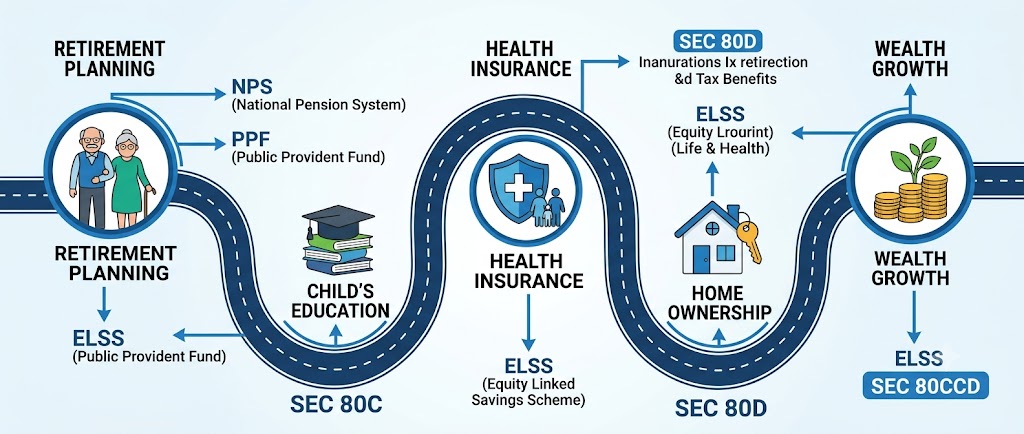
Picking a tax saving instrument in isolation, just to use up the 80C limit, often leads to a mismatch between when you'll actually need the money and when it becomes available. Mapping instruments to your real goals works better:
| Your Goal | Suggested Instrument | Why It Fits |
|---|---|---|
| Short term goal (3 to 5 years) | ELSS | Shortest lock-in among 80C options, with growth potential to beat inflation |
| Child's future (education or marriage) | Sukanya Samriddhi (for a girl child) or PPF | Long horizon, safe and compounding, aligned with a child's growth years |
| Retirement planning | NPS | Extra ₹50,000 deduction under 80CCD, built specifically for retirement payouts |
| Capital protection, no risk tolerance | PPF, NSC, or Tax Saver FD | Fixed, government backed or bank guaranteed returns |
| Health protection plus tax benefit | Health insurance under 80D | Covers medical costs and reduces taxable income at the same time |
| Home ownership | Home loan principal under 80C | Turns an existing EMI obligation into a tax saving one |
If you're a creator or freelancer without a fixed monthly surplus, start with the goal that matters most this year (often health cover or an emergency-adjacent option like ELSS) rather than trying to fund every goal at once.
A Simple Way to Start
If you're new to tax saving investments, here's a straightforward approach rather than trying to research every option at once:
- Calculate your expected taxable income for the year under both regimes.
- If the Old Regime works out better, decide how much of the ₹1.5 lakh 80C limit you can realistically invest.
- Split that amount between a safe option like PPF and a growth option like ELSS, based on your risk comfort.
- Add health insurance if you don't already have it, to claim 80D separately.
- Consider NPS only if retirement planning is already a goal, since its lock-in is the longest on this list.
- Review your choices every year rather than assuming last year's plan still fits, especially since tax rules and provisions may change over time.
Documents to Keep Ready Before Filing
Regardless of which regime you choose, having the right paperwork ready makes filing far smoother and reduces the chance of errors that trigger a notice later:
Form 16 if you're salaried, or income statements and invoices if you're a freelancer or creator.
Investment proofs for every 80C instrument you're claiming, including ELSS statements, PPF passbook entries, and insurance premium receipts.
Health insurance premium receipts for your 80D claim, covering self, family, and parents where applicable.
Home loan interest and principal certificates from your lender if you're claiming both 80C and the separate interest deduction.
Bank statements showing platform income, cashback payouts, or affiliate commissions credited during the year, especially useful if you're a creator with multiple income sources.
Advance tax challans, if applicable, so you have proof of the instalments already paid during the year.
Keeping these organized as the year progresses, rather than gathering them all in March, is one of the simplest ways to avoid last minute stress and reduce the risk of missing a deduction you were actually eligible for.
Common Mistakes to Avoid
Choosing an investment purely for the tax deduction without checking if it fits your actual financial goals.
Waiting until March to invest, which often leads to rushed, poorly researched decisions.
Ignoring lock-in periods and investing money you might need in the short term.
Not comparing the Old and New Regime numbers before committing to either one.
Overlooking 80D health insurance while focusing only on 80C.
Freelancers and creators skipping advance tax payments, leading to interest penalties later in the year.
Assuming pre-2026 tax advice still applies without checking it against the new Act.
Conclusion
Tax saving investments in India for 2026 aren't just about hitting the ₹1.5 lakh 80C limit anymore. With changing tax rules and evolving provisions, your first real decision is choosing between the Old and New Regime based on your actual numbers, not habit. If you do go with the Old Regime, spreading a mix of ELSS, PPF, and health insurance across the year, rather than rushing in March, gets you both better returns and less stress. And if you're earning through creator platforms or freelance work with irregular income, treating tax planning as a monthly habit instead of a year-end scramble is what actually protects your money in the long run.
Disclaimer: This article is for informational purposes only and should not be considered financial or tax advice. Tax laws may change, and readers should consult a qualified Chartered Accountant or tax professional before making investment or tax planning decisions.
ALSO READ:
- Top 10 SIP Plans in India (2026) – Best SIP Plans for Long-Term Wealth Creation
- SIP vs Lump Sum Investment: Which One Is Better for Beginners in India 2026
- How to Grow Your Wealth with SIPs and Mutual Funds
- 10 Best Earning Apps Without Investment in India (2026) – ₹500/Day Apps
- Top Investment Apps in India for Beginners
- Investment for Beginners: How to Start with Mutual Funds or Stock Market in India
- Best Investment Options for Beginners in India 2026: A Step-by-Step Guide
- Top Investment Apps in India for Beginners
Frequently Asked Questions (FAQs)
Q1. Is the New Tax Regime always better than the Old Regime?
Not always. It depends on how many deductions you can claim. High deduction claimants often benefit more from the Old Regime.
Q2. What is the maximum deduction under Section 80C?
₹1.5 lakh per financial year, combined across all eligible 80C instruments together.
Q3. Can freelancers claim the same tax saving investments as salaried employees?
Yes. 80C, 80D, and NPS deductions apply regardless of employment type, as long as you opt for the Old Regime.
Q4. Which is safer, PPF or ELSS?
PPF is safer since it's government backed with fixed returns. ELSS carries market risk but offers higher growth potential.
Q5. Do I need to pay advance tax if I earn through creator platforms?
Yes, if your total tax liability exceeds ₹10,000 in a financial year, advance tax applies regardless of income source.
Q6. Is NPS a good option for young creators?
It can be, for long term retirement planning, but its lock-in until retirement makes it less flexible for near term goals.
Q7. Can I switch between the Old and New Regime every year?
Salaried individuals generally can switch each year when filing, but those with business or freelance income have more restrictions, so it's worth checking the current rule before assuming.
Comments (0)
Be the first to comment.