
Quick answer: Yes, you can earn money from YouTube without making videos. There are three routes: run a faceless channel, own a channel while others produce the videos, or skip owning a channel and earn from creators who already have an audience. Faceless does not mean effortless, and YouTube still expects original work.
Key takeaways
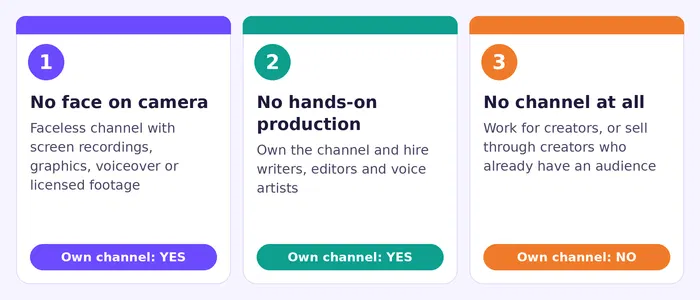
"Without making videos" means one of three things: no face on camera, no hands-on production, or no channel at all.
Ad revenue currently needs 1,000 subscribers plus qualified watch hours or Shorts views, and the entry numbers are higher for new applicants from February 1, 2027.
Services, clipping, and creator partnerships can earn without meeting a YouTube Partner Program threshold. Other affiliate methods may have their own eligibility requirements.
Reuploading other people's videos and mass-produced AI videos are the fastest ways to lose monetization.
You can earn money from YouTube without making videos, but the phrase hides three different goals, and the right route depends on which one is yours. This guide covers ten legit ways, how the money works, the 2026 monetization rules, and what to avoid.
Can You Really Earn From YouTube Without Making Videos?
Yes, and the answer depends on what you want to avoid.
Three meanings of "without making videos"
What you want to avoid | Realistic route | Needs your own channel? |
|---|---|---|
Appearing on camera | Faceless channel with screen recordings, graphics, voiceover, or licensed footage | Yes |
Producing videos yourself | Own the channel, hire writers, editors, and voice artists | Yes |
Owning a channel at all | Work for creators, or sell through creators who already have an audience | No |
A faceless channel still publishes videos. Someone has to research, script, edit, and upload them. You are only choosing whether that someone is you.
YouTube does not treat "faceless" as a separate category for monetization. What matters is whether the content is original, authentic, and useful to viewers, as set out in YouTube's channel monetization policies.
Which Route Fits You?
Start from what you already have, not from what sounds easiest.
A skill (writing, editing, design, voice): Sell it to creators. Ways 6 to 9 fit you.
A product or service you sell: Work with creators who reach your buyers. Way 5 fits you.
Money to invest and a management mindset: Own a channel and outsource production. Way 2 fits you.
Patience and a topic you can explain: Build a faceless channel. Ways 1, 3, and 4 fit you.
An audience on another platform: Tag products and earn commissions. Way 10 fits you, once you are in the Partner Program.
If you are still deciding how to monetize as a creator in general, how to start monetizing as a creator covers the options beyond YouTube.
10 Legit Ways to Earn Money From YouTube Without Making Videos
1. Start a faceless YouTube channel
A faceless channel uses screen recordings, original graphics, animation, product footage, licensed stock clips, or voiceover instead of an on-camera presenter.
Who it suits: People who can explain software, finance, study topics, gadgets, or history clearly.
How you earn: Ads after joining the Partner Program, affiliate links, sponsorships, your own products.
Watch out for: Every video needs original research, a real script, and a reason to exist. Template videos with swapped topics are what YouTube flags as inauthentic.
Also Read: YouTube Shorts Viral Topics for Beginners
2. Own the channel and outsource production
This is often called YouTube automation, which is a misleading name. It works more like a small media company. You choose the niche and topics, set quality standards, and review the final videos, while freelancers handle scripting, voiceover, editing, and thumbnails.
Who it suits: People with a budget and management skills but no wish to edit.
How you earn: The same streams as any channel.
Watch out for: You pay for videos before you know whether the channel will work. Outsourcing the work is fine, but outsourcing originality is not.
Also Read: YouTube Automation Channels
3. Run an audio or podcast channel
Audio works on YouTube when you pair the recording with visuals, such as a static image, slideshow, or animated waveform. Podcasts, interviews, commentary, guided meditation, and educational talks all fit.
Who it suits: People who talk well and prefer a microphone to a camera.
How you earn: Ads, sponsorships, affiliate links in descriptions.
Watch out for: Placing audio over a static image does not make a video monetizable by itself. The audio must carry substantial original value, such as real research, a distinct perspective, or an original recording. A looped track with a still image and no real content is exactly what viewers and reviewers treat as low effort, and it can still fail monetization review.
4. Use licensed or public domain material, then add real value
You can build videos around footage you did not shoot, such as properly licensed stock clips, public domain archives, or Creative Commons content, as long as your use fits the license.
Who it suits: Commentary, history, explainer, and analysis channels.
How you earn: Ads and affiliate links, once the channel qualifies.
Watch out for: Having permission to use a clip and being eligible to monetize it are separate questions. YouTube's reused content policy looks at whether you added original commentary, education, storytelling, or substantive editing. A compilation with minor changes can fail on both counts.
5. Sell products through YouTube creators
If you already sell something, you may not need a channel. Send a sample, sponsor a video, offer a tracked discount code, or give an affiliate commission to creators whose audience matches your buyers.
Who it suits: Small brands, makers, and D2C sellers.
How you earn: Product sales.
Watch out for: Pick creators by audience fit, not subscriber count. A small channel focused on your exact buyer can beat a larger unrelated one. Work out your margin per order after product cost, shipping, commission, and fees before scaling. For how brand and creator deals are structured, see commission vs sponsorship for creators.
6. Become a YouTube clipper
A clipper turns long videos, podcasts, or livestreams into short clips for Shorts.
Who it suits: People with a good eye for pacing and a feel for what makes a moment worth watching.
How you earn: A fixed fee per clip or a monthly retainer from the creator.
Watch out for: Work directly with the creator or get clear written permission. Downloading random videos and posting clips on your own channel invites copyright claims and reused content rejection. There is no standard clipper pay rate, so negotiate based on the deliverables.
7. Freelance scripts, voiceovers, or editing for creators
Every channel with a regular schedule has recurring production work. Write scripts from research notes, record voiceovers, or edit footage.
Who it suits: Writers, voice artists, and editors who want income before building an audience.
How you earn: Per video or monthly retainers.
Watch out for: A specific offer sells better than a vague one. "I turn your research notes into 8 minute scripts" is easier to buy than "I do YouTube stuff." If you are comfortable creating content for brands without a channel of your own, how to become a UGC creator in India is a related path.
Also Read: How to Create a YouTube Script Using AI Tools
8. Design thumbnails
Thumbnails decide whether a video gets clicked, so creators pay for them.
Who it suits: Graphic designers.
How you earn: Per thumbnail, or a package per weekly upload. Some designers also sell template packs.
Watch out for: Build a small portfolio with concept variations. Creators often want two or three thumbnail concepts per video so they can test which one gets more clicks.
9. Manage YouTube channels
Some creators don't need another editor. They need someone to run the operation: publishing calendar, uploads, titles and descriptions, chapters, analytics, and coordination between editors and designers.
Who it suits: Organized people who are comfortable with analytics and deadlines.
How you earn: Monthly retainers tied to clear deliverables, such as four long videos and twelve Shorts a month.
Watch out for: Define the scope in writing. "Channel management" without deliverables turns into unpaid extra work.
10. Tag products with the YouTube Shopping affiliate program
Creators in the Partner Program can tag products in videos, Shorts, and livestreams and earn a commission when viewers buy. According to YouTube Help, your channel must be in the Partner Program, meet the Partner Program subscriber threshold, and be based in an eligible country, which includes India. Music channels and channels set as Made for Kids are excluded.
In India, Flipkart, Myntra, Nykaa, Purplle, Shopsy and Tira are listed as partners, with AJIO, Meesho, Snapdeal and Tata CLiQ to join soon. Google also says it is expanding its Amazon partnership to India. Google reports that average affiliate payouts to Indian creators grew more than 160% year over year from Q1 2025 to Q1 2026. That is an average across creators, not a promise of what any single channel will earn.
Who it suits: Channels that review or compare products, including faceless ones.
How you earn: Commission per purchase.
Watch out for: Commissions depend on your audience and how relevant the product is. There is no guaranteed income, and you must disclose paid relationships. If affiliate income is new to you, affiliate marketing for beginners in India explains the basics.
How the Money Actually Works
Ads and YouTube Partner Program thresholds
Ad revenue and YouTube Premium revenue require a channel in the Partner Program. Currently, you can apply for ad and Premium revenue sharing with 1,000 subscribers plus either 4,000 qualified watch hours in the past 12 months or 10 million qualified Shorts views in the past 90 days.
The expanded YPP tier requires 500 subscribers, three public uploads in the past 90 days, and either 3,000 qualified watch hours or 3 million qualified Shorts views. It unlocks fan-funding and other features, but it does not include ad revenue sharing.
From February 1, 2027, new creators applying for ad and YouTube Premium revenue sharing will need 1,000 subscribers plus either 8,000 qualified watch hours or 20 million qualified Shorts views, according to YouTube's announcement. The 500 subscriber tier stays at its current numbers.
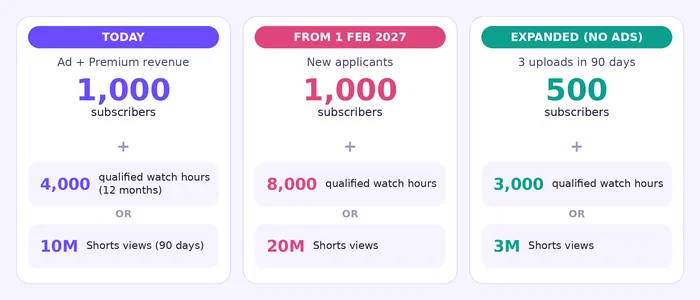
Watch hours and Shorts views do not combine, so you must clear one path fully. YouTube explains what counts in its qualified watch hours and Shorts views guide. Check the official eligibility page when you are ready to apply, since these numbers have moved before.
Reaching the numbers does not guarantee approval. YouTube still reviews the channel against its monetization policies.
Affiliate, sponsorships, your own products and services
You do not need to wait for ad revenue. Sponsorships, your own products, and freelance services can start earning before you qualify for the Partner Program. Affiliate links can too in many cases, but each program sets its own eligibility, and YouTube Shopping needs Partner Program membership. A small, engaged audience in a specific niche can be worth more to the right brand than a large unfocused one. If sponsorships are your goal, how to get brand deals as a micro influencer shows what brands look for.
How much can you realistically earn?
No one can promise a number. Ad earnings depend on your niche, audience country and watch time, and YouTube does not publish a fixed rate for Shorts views. Third-party estimates put Shorts ad earnings well below long-form, so most creators treat Shorts as a growth and funnel tool, not a main income source. Freelance work pays based on the deliverables you agree with each client.
Route | Income model | Usually needs an audience? |
|---|---|---|
Freelance scripts | Per project or retainer | No |
Thumbnail design | Per thumbnail or package | No |
Clipping | Per clip or retainer | No |
Faceless channel | Ads, affiliate, sponsorships | Yes |
Creator partnerships | Commission or sponsorship | The creator's audience |
YouTube Shopping | Affiliate commission | Yes |
If your income grows past a side hustle, read GST registration for content creators before it becomes a problem.
What Not to Do
Do not reupload other people's videos. Reposting TikToks, Shorts, or YouTube videos with a minor edit risks copyright claims and monetization rejection.
Do not mass-produce nearly identical AI videos. AI is not banned. YouTube's inauthentic content policy targets repetitive or mass-produced content, including AI content from generic templates, and it applies to the whole channel.
Do not assume views equal monetization. Meeting the thresholds only lets you apply.
Do not buy views or subscribers. Fake engagement does nothing for the audience you need to earn.
How to Start in 7 Days
Day 1: Pick one route from the ten above, based on what you already have.
Day 2: Choose a narrow niche or client type.
Day 3: Study five channels or creators in that space and note what they publish and what they need.
Day 4: Build one sample: a script, a thumbnail set, a short clip reel, or a first video outline.
Day 5: Set up your channel or your portfolio.
Day 6: Publish your first video or pitch your first five creators.
Day 7: Review what worked and plan the next two weeks.
Where Zokera Fits for Creators
If you already have an audience on YouTube, you can use it to earn beyond ads and sponsorships. Zokera gives creators another way to monetize product recommendations through a creator storefront.
Creators can choose products from Zokera’s network of 1,100+ brand partnerships and share their storefront through YouTube descriptions, Instagram, Telegram, or WhatsApp. When followers shop through eligible storefront purchases, creators can earn cashback.
You do not need to manage inventory, shipping, or a website. This makes Zokera useful if you want to turn product recommendations into an additional income stream without creating products yourself.
Become a Zokera creator to explore how creator storefronts work. You can also read our guide on making money from social media.
Also Read: YouTube Creators Zokera Se Zyada Kaise Earn Kar Sakte Hain?
Conclusion
You can earn from YouTube without being on camera or creating every video yourself. Choose a method that fits your skills, audience, and goals.
Start with one method and build from there. For more earning ideas, explore our guide to passive income for content creators and learn how to make money online.
Frequently Asked Questions (FAQs)
1. Can you earn money on YouTube without making videos?
You can run a faceless channel, outsource production, or earn from creators through services, clipping, and partnerships. Some affiliate programs also let you earn without ad-revenue eligibility.
2. Can you earn from YouTube without 1,000 subscribers?
Yes. Services, sponsorships, and your own products do not need the YouTube ad-revenue threshold. Affiliate programs have their own eligibility rules, so check the requirements for the specific program.
3. Can AI-generated videos be monetized?
Yes, if they are original, authentic, and useful. Generic, repetitive, template-based AI videos can lose monetization.
4. Can I monetize other people's videos?
Not by reposting them. Reused content needs meaningful original commentary or transformation, and copyright applies separately.
5. What is YouTube automation?
It means running a channel by hiring others for scripts, voiceovers, editing, and thumbnails. It still needs your decisions and quality control.
6. How many subscribers and views do you need to monetize YouTube?
Currently, ad and Premium revenue sharing needs 1,000 subscribers plus either 4,000 qualified watch hours in 12 months or 10 million qualified Shorts views in 90 days. From February 1, 2027, new applicants will need 1,000 subscribers plus either 8,000 qualified watch hours or 20 million qualified Shorts views.
Comments (0)
Be the first to comment.