
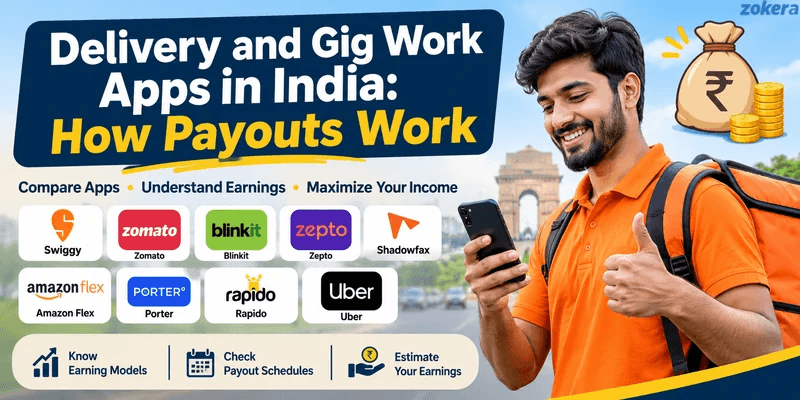
People searching for gig work apps in India can find opportunities in food delivery, grocery orders, parcel transportation, and ride-hailing. However, choosing a platform involves more than comparing advertised monthly earnings. You also need to understand how each app calculates payments, when it transfers money, and which expenses reduce your income. This guide compares popular delivery and ride partner apps, explains their payout systems, and shows how to estimate your actual take-home earnings.
Quick Answer
Some popular gig work apps in India include Swiggy, Zomato, Blinkit, Zepto, Shadowfax, Amazon Flex, Porter, Rapido, and Uber. These platforms use different earning models, including per-order payments, task-based fees, scheduled delivery blocks, and ride fares.
Payout schedules also vary. Swiggy, Zomato, Blinkit, Porter, and Uber describe weekly payment arrangements in their partner information. Amazon Flex lets partners select payment days, with payments processed as early as the next selected day. Always check the current terms in your partner account because availability and payment options can change.
Key Takeaways
Gig work apps offer delivery, transportation, and parcel-based earning opportunities.
Earnings usually depend on completed orders, rides, distance, working hours, and eligible incentives.
Some platforms pay weekly, while others offer scheduled payment days or wallet-based withdrawals.
Fuel, vehicle maintenance, rentals, mobile data, and applicable deductions reduce take-home income.
Advertised earning limits are not guaranteed salaries or net income.
Check local availability, onboarding costs, payout terms, and vehicle requirements before joining.
What Are Gig Work Apps in India?
Gig work apps connect independent workers with customers or businesses that need deliveries, transportation, or other services. Workers receive assignments through an app and earn according to the platform's payment structure.
Unlike conventional salaried jobs, many gig work arrangements offer flexible log-in hours or assignment-based schedules. However, flexibility does not mean that orders, rides, or delivery blocks are always available.
Common types of gig work include:
Food delivery: Collect restaurant orders and deliver them to customers.
Grocery delivery: Deliver groceries and daily essentials from stores or fulfilment centres.
Parcel delivery: Transport e-commerce packages between delivery stations, businesses, and customers.
Goods transportation: Move packages, furniture, or business consignments using eligible two-wheelers or commercial vehicles.
Ride-hailing: Provide bike, auto, or cab rides through a driver-partner app.
Scheduled delivery work: Accept delivery blocks with a defined start time and estimated duration.
The earning model depends on the type of work. A food delivery partner may earn per completed order, while an Amazon Flex partner selects available delivery blocks. A ride-hailing driver earns through completed trips. If you want to compare gig assignments with other short-term opportunities, see our guide to online jobs that pay weekly in India.
9 Delivery and Gig Work Apps in India
Different platforms offer different types of assignments, payment structures, and working arrangements. The following options cover food delivery, quick commerce, logistics, goods transportation, and ride-hailing.
1. Swiggy Delivery Partner
Swiggy is a food and grocery delivery platform with a delivery partner programme. Partners collect customer orders from restaurants or participating stores and deliver them to the provided address.
How it works: Register through Swiggy's delivery partner process, submit the required details, complete onboarding, and start accepting eligible delivery assignments in your service area. Swiggy says partners can choose shifts and work part-time or full-time, subject to local operations.
How earnings are calculated:
Payments for completed deliveries.
Eligible incentives and order-based bonuses.
Other applicable payments shown in the partner app.
How payouts work: Swiggy's official delivery partner page says earnings are transferred directly to the partner's bank account every week. The app provides the relevant earnings information.
Requirements and expenses: The official page lists identity proof, PAN, bank details, and a driving licence where required. A cycle option may not require a driving licence. Swiggy says an onboarding fee applies and can vary by city. Partners should confirm the current amount before proceeding.
Best suited for: People looking for food delivery work with flexible shift options.
2. Zomato Delivery Partner
Zomato offers delivery assignments for food and grocery orders through its delivery partner network. Partners use the delivery app to receive and complete assignments.
How it works: Submit the registration details, complete the required verification and onboarding steps, and start accepting orders once the account is activated.
How earnings are calculated:
Per-delivery payments.
Starting or referral bonuses where offered.
Other city-specific incentives shown to eligible partners.
How payouts work: Zomato's delivery partner FAQ describes weekly bank transfers and says partners can check their earnings in the app's Payments section. Bonus availability and onboarding fees can vary by city.
Requirements and expenses: The published FAQ lists age, smartphone, vehicle, driving licence, registration certificate, insurance, address proof, PAN, and bank account requirements. Confirm the latest requirements during registration because app and onboarding policies can change.
Best suited for: People interested in food delivery and flexible log-in hours.
3. Blinkit Delivery Partner
Blinkit operates a quick-commerce platform focused on groceries and everyday essentials. Delivery partners collect orders from nearby stores or fulfilment locations and deliver them to customers.
How it works: Fill out the delivery partner form on Blinkit's official page. The team contacts applicants about the next onboarding steps. Partners complete document verification and training before starting deliveries.
How earnings are calculated:
Payments for completed deliveries.
Eligible incentives and bonuses.
Other components described during local onboarding.
How payouts work: Blinkit's official delivery page says payments are made to the partner's bank account every seven days. It also advertises flexible work-hour options, subject to the available local arrangements.
Requirements and expenses: Blinkit's page describes delivery partners using their own two-wheelers. Check the current document, vehicle, joining cost, and insurance conditions with the onboarding team before accepting an offer.
Best suited for: People interested in grocery and quick-commerce delivery.
4. Zepto Delivery Partner
Zepto is a quick-commerce platform that delivers groceries and daily essentials. Delivery partners complete local assignments through its delivery network.
How it works: Interested applicants should use Zepto's current official partner or onboarding channel to check whether registrations are open in their area. The onboarding process and delivery arrangements may depend on the city and operating partner.
How earnings are calculated:
Payments for completed delivery tasks.
Distance, time, demand, or other task-related components where applicable.
Eligible incentives described in the partner's current terms.
How payouts work: Do not assume that every Zepto partner has the same payment schedule. Confirm the payout frequency, payment intermediary, tax deductions, and bank-credit timeline in the current onboarding terms or partner dashboard.
Requirements and expenses: Ask for the current vehicle, licence, identity, bank account, and onboarding requirements. If a third-party delivery vendor is involved, confirm whether that vendor or Zepto processes the payment.
Best suited for: People looking for local grocery delivery assignments where Zepto is actively onboarding partners.
5. Shadowfax Delivery Partner
Shadowfax is a logistics and delivery company that works across e-commerce, food, and other last-mile delivery categories. Its partner network offers delivery assignments for different business requirements.
How it works: Register through the Shadowfax delivery partner channel or app, submit the required documents, and complete the verification process. Available assignments depend on the service area and current demand.
How earnings are calculated:
Completed delivery assignments.
Eligible distance or task-related payments.
Performance or referral incentives where offered.
How payouts work: Shadowfax's partner information should be checked for the latest payout cycle and payment conditions applicable to the city and assignment type. Confirm whether the payment is processed by Shadowfax directly or through a delivery partner/vendor arrangement.
Requirements and expenses: Check the required vehicle type, driving licence, registration, insurance, identity documents, and any onboarding or equipment charges before accepting work.
Best suited for: People interested in e-commerce parcels, logistics, and last-mile delivery.
6. Amazon Flex
Amazon Flex allows delivery partners to deliver Amazon orders using eligible vehicles. Unlike a standard per-order model, the programme organises work through scheduled delivery blocks.
How it works: Sign up through Amazon Flex, complete the background check, provide the required documents and payment details, and select an eligible service area. The app displays available delivery blocks with their dates, duration, and estimated earnings.
Amazon says standard delivery blocks can last between two and six hours. Amazon Now blocks are typically four hours and involve repeated short-distance deliveries from a pickup location.
How earnings are calculated:
Each available block displays estimated earnings.
The amount is linked to the block and its estimated duration.
Amazon Now offers may show an earnings range.
Actual earnings can be affected if a block is ended early or the service provided differs from the estimate.
How payouts work: Amazon Flex processes payments as early as the next selected payment day through direct bank deposit. Partners can choose payment days in the app. Amazon also notes that earnings may be subject to tax withholding under applicable rules.
Requirements and expenses: Amazon's India FAQ lists age, PAN, bank account, smartphone, eligible vehicle, driving licence, registration, insurance, and other vehicle documents. A background check is also required. Fuel and vehicle maintenance remain important operating costs.
Best suited for: People who prefer reserving delivery blocks and want part-time or supplemental delivery work. Amazon states that blocks are not guaranteed and depend on availability.
7. Porter Partner
Porter connects customers and businesses that need goods transported with driver partners who have eligible vehicles. Depending on the vehicle category and service area, assignments can include two-wheeler deliveries, pickup vehicles, and commercial goods transportation.
How it works: Download the Porter Partner app, register your vehicle and details, and complete the platform's onboarding process. Available trips depend on the vehicle type, city, and demand.
How earnings are calculated:
Payments for completed trips.
Vehicle category and trip-related fare components.
Eligible incentives or other terms shown in the partner app.
How payouts work: Porter's partner information says the driver app provides daily earnings details and weekly payout information. Check the app for the payment statement, deductions, and bank-credit details.
Requirements and expenses: Vehicle documents, licence, insurance, and other requirements depend on the vehicle category. Account for fuel, maintenance, commercial vehicle costs, and any applicable platform charges.
Best suited for: Drivers who want goods-transportation assignments, including eligible two-wheelers and commercial vehicles.
8. Rapido Captain
Rapido offers bike, auto, and cab mobility services in eligible locations. Its Captain programme connects driver partners with customers requesting rides.
How it works: Register through the Rapido Captain app or its official onboarding channel, submit the required documents, and complete verification. Once activated, a Captain can receive eligible ride requests in the service area.
How earnings are calculated:
Completed rides.
Applicable fare and trip-related components.
Eligible incentives or bonuses shown in the Captain app.
How payouts work: Payment and withdrawal options should be checked in the current Captain app and local partner terms. Do not assume that all services and cities use an identical wallet or bank-transfer process.
Requirements and expenses: Requirements depend on whether the partner provides bike, auto, or cab services. Check the licence, vehicle permits, registration, insurance, and other local requirements. Fuel and maintenance affect take-home income.
Best suited for: Eligible bike, auto, and cab drivers interested in ride-based work.
9. Uber Driver

Uber connects riders with driver partners through its driver app. Depending on the city and service, eligible partners may provide cab or other supported transportation services.
How it works: Register through Uber's driver platform, submit the required personal and vehicle documents, and complete the applicable verification. Once approved, partners can receive trip requests in their operating area.
How earnings are calculated:
Completed trips and applicable fares.
Eligible promotions or incentives.
Adjustments and other items shown in the earnings statement.
How payouts work: Uber's India driver earnings page says earnings are automatically transferred every week. Drivers can track earnings in the app and review available cash-out options where supported.
Requirements and expenses: Vehicle eligibility, permits, licence, insurance, and onboarding requirements depend on the city and service. Consider fuel, servicing, insurance, vehicle financing, and other operating costs.
Best suited for: Eligible vehicle owners who want ride-hailing assignments.
Comparison of Delivery and Gig Work Apps in India
The table below compares the work category and payout information publicly described by the platforms. It does not rank apps by guaranteed income because earnings vary by city, time, vehicle, and assignment availability.
Platform | Work Type | Earning Model | Public Payout Information |
|---|---|---|---|
Swiggy | Food and grocery delivery | Delivery payments and eligible incentives | Weekly bank transfer |
Zomato | Food and grocery delivery | Per-delivery payments and city-specific bonuses | Weekly bank transfer in partner FAQ |
Blinkit | Quick-commerce delivery | Completed deliveries and eligible bonuses | Weekly bank transfer |
Zepto | Quick-commerce delivery | Task-based delivery payments | Confirm current local terms |
Shadowfax | Logistics and last-mile delivery | Delivery assignments and eligible incentives | Confirm current partner terms |
Amazon Flex | Parcel and scheduled delivery | Delivery blocks with estimated earnings | Partner-selected payment days |
Porter | Goods transportation | Trip-based payments | Weekly payout information in partner app |
Rapido | Bike, auto, and cab rides | Ride-based earnings | Check current Captain app terms |
Uber | Ride-hailing | Trip fares and eligible promotions | Weekly automatic transfer |
Payment policies can change. A platform may also use different arrangements across cities, service categories, or third-party delivery vendors. Check the latest partner dashboard before relying on a payout schedule.
How Do Gig Work App Payouts Work?
Gig work platforms generally calculate earnings from completed assignments. However, the calculation method and the date when money reaches a bank account are two different things.
A partner may see earnings in the app before the amount becomes withdrawable or is credited to the bank. Understanding each stage helps avoid confusion about pending payments.
1. Per-Order or Per-Delivery Payments
Food and grocery delivery platforms commonly pay partners for completed deliveries. The amount may depend on the platform's current rate card, delivery distance, order type, and other assignment conditions.
For example, a partner may complete several deliveries during a shift. The app records each eligible assignment and adds the applicable payment to the earnings statement.
2. Distance and Task-Based Payments
Some platforms use distance, time, task complexity, or other factors to calculate delivery fees. The exact formula may differ by platform and city.
Before joining, check whether the displayed amount includes the complete trip or whether additional distance-related payments apply separately.
3. Incentive-Based Earnings
Platforms may offer bonuses when partners meet specific conditions. These offers can change according to demand, location, and campaign period.
Common incentive types include:
Completing a minimum number of deliveries within a specified period.
Working during selected peak hours.
Meeting eligible weekly or daily targets.
Completing referral requirements.
Accepting assignments under a limited-time promotion.
An incentive is not guaranteed income. Read the conditions carefully and check whether cancellations, rejected assignments, or missed targets affect eligibility. Task-based work follows a different model from delivery assignments; our guide to micro jobs apps for extra income in India explains how small online tasks are paid.
4. Scheduled Delivery Block Payments
Amazon Flex uses scheduled delivery blocks. Partners can review an available offer before reserving it, including its estimated duration and earnings.
The block-based model differs from per-order delivery because the partner accepts a defined work period. However, available blocks are not guaranteed, and the estimated earnings should not be treated as a fixed monthly salary.
5. Wallet Withdrawals and Bank Transfers
Some partner apps show earnings in an in-app wallet or balance. Others transfer payments directly to the registered bank account on a set schedule.
Check these details before joining:
When earnings become available for withdrawal.
Whether the platform uses a weekly payment cycle.
Whether instant cash-out is available in your account.
Whether withdrawal fees or minimum balance rules apply.
How long the bank takes to process a transfer.
An amount shown as earned, an amount available to withdraw, and an amount credited to your bank may be different figures.
Daily vs Weekly Payouts: What's the Difference?
Daily and weekly payouts describe how often a worker can receive money. They do not describe how much the worker earns.
Factor | Daily or On-Demand Withdrawal | Weekly Payout |
|---|---|---|
Access to money | More frequent, if eligible | Available after the payment cycle |
Cash-flow planning | Useful for frequent expenses | Easier for weekly budgeting |
Withdrawal conditions | May have fees or eligibility rules | Follows the platform's payment schedule |
Payment tracking | Requires frequent monitoring | Easier to review weekly totals |
Best suited for | Workers who need frequent access | Workers comfortable with scheduled transfers |
A next-day payment option is not necessarily the same as an instant withdrawal. The platform may process the payment on a selected day, while the bank takes additional time to credit it.
Before choosing an app, read its payment policy and check the options actually available in your partner account.
How Much Can You Earn Through Gig Work Apps in India?
There is no fixed monthly income across gig work apps in India. Earnings depend on the platform, city, working hours, completed assignments, order demand, and incentives.
A January 2026 Moneycontrol report on delivery partner earnings, citing TeamLease Services, said that a full-time delivery partner in a metro city could earn gross monthly income of around ₹20,000 to ₹30,000, depending on platform, location, hours, and incentives. The same report discussed an example of approximately ₹26,500 in gross monthly earnings and around ₹21,000 after estimated fuel and maintenance costs for a specific full-time work pattern. A separate Mint report examining delivery partner earnings dashboards also showed how an individual worker's weekly income can fluctuate, even within the same month.
These figures are not a guaranteed salary or a promise from any app. They describe reported estimates and a particular work pattern. A part-time partner, a worker in a smaller city, or someone facing low order demand may earn substantially less.
Part-Time vs Full-Time Gig Work
Part-time and full-time workers can have different earning patterns because they spend different amounts of time available for assignments.
Part-time work may suit students, people with another job, or workers who want supplementary income. However, earnings depend on the hours and assignments available during the time they log in.
Full-time work can produce higher gross earnings when demand and assignment availability are sufficient. It can also increase fuel, maintenance, and other operating costs.
Consider these factors before estimating income:
Hours spent online, including time waiting for assignments.
Number of completed orders or rides.
Average distance travelled per assignment.
Incentives actually achieved.
Fuel, maintenance, rentals, and other expenses.
What Factors Affect Gig Worker Earnings?
1. Number of Completed Orders or Rides
More completed assignments can increase gross earnings. However, order allocation depends on local demand and platform operations.
2. Working Hours and Peak Periods
Lunch, dinner, weekends, and festive periods may bring higher demand in some locations. More demand does not guarantee that every partner will receive more assignments.
3. Location and Service Area
Earnings can differ between cities and neighbourhoods. Areas with more restaurants, stores, warehouses, or ride requests may offer more opportunities.
4. Distance and Travel Time
Longer routes can increase fuel use and reduce the number of assignments a partner can complete in a shift. Check how the platform accounts for distance and waiting time.
5. Incentives and Bonuses
Eligible incentives can raise gross earnings, but the partner must meet the offer's conditions. Do not include a bonus in your expected income until you know you qualify for it.
6. Vehicle and Operating Costs
Fuel, servicing, tyres, insurance, rentals, phone data, and vehicle financing can reduce the amount left after work expenses.
Gross Earnings vs Actual Take-Home Income
Gross earnings are the amount recorded before work-related expenses. Take-home income is what remains after deducting those expenses and any applicable charges or taxes.
For example, consider this illustrative monthly calculation:
Earnings and Expenses | Amount |
|---|---|
Gross earnings | ₹25,000 |
Fuel | ₹3,500 |
Vehicle maintenance | ₹900 |
Mobile and internet | ₹300 |
Other work-related costs | ₹300 |
Estimated amount remaining | ₹20,000 |
This is an example to explain the calculation, not an average or guaranteed earning figure for any platform. Actual expenses depend on the vehicle, city, route distance, working hours, and assignment type.
Use this formula:
Estimated take-home income = Gross earnings − Fuel − Maintenance − Rental and other work costs − Applicable deductions and taxes
Also check whether the app's displayed earnings already include incentives, reimbursements, tips, or deductions. Avoid subtracting the same expense twice.
What Documents Do You Need to Join Delivery Partner Apps?
Document requirements vary by platform, vehicle type, service category, and city. Commonly requested documents include:
Aadhaar card or another accepted identity proof.
PAN card.
Bank account details.
Driving licence, where required.
Vehicle registration certificate.
Valid vehicle insurance.
Pollution Under Control certificate, where applicable.
Smartphone and active mobile number.
Address or background verification details, where required.
For example, Amazon Flex's India FAQ lists PAN, bank details, an eligible vehicle, and vehicle documents such as a driving licence, registration certificate, insurance, and PUC, where applicable. Swiggy and Zomato publish their own partner requirements.
Before submitting documents, use the platform's official website or verified partner app. Never share an OTP, UPI PIN, or banking password with an onboarding agent.
How to Choose the Right Gig Work App
The best platform depends on your vehicle, location, available time, and preferred type of work. A food delivery app may suit someone who wants local restaurant orders, while a goods-transport platform may be more suitable for a commercial vehicle owner.
Your Requirement | Platforms to Compare |
|---|---|
Food delivery | Swiggy, Zomato |
Grocery and quick-commerce delivery | Blinkit, Zepto |
E-commerce and logistics assignments | Shadowfax, Amazon Flex |
Goods transportation | Porter |
Bike, auto, or cab rides | Rapido |
Cab-based ride-hailing | Uber |
Before registering, compare the following:
Local availability: Confirm that the platform is onboarding partners in your area.
Payment cycle: Check the payout date, withdrawal rules, and bank-credit timeline.
Earning structure: Understand per-order, per-task, per-trip, or block-based payments.
Vehicle requirements: Confirm whether your vehicle type is accepted.
Joining costs: Ask for a written breakdown of any onboarding, kit, or equipment charges.
Insurance and safety: Check the coverage, eligibility, exclusions, and claim process.
Work conditions: Understand shift requirements, cancellation rules, and incentive conditions.
If you want to explore other flexible income opportunities beyond delivery work, compare these options with part-time online jobs from home in India and survey apps to earn money in India. These have different work and reward models, so they should not be treated as delivery jobs.
Tips to Improve Your Earnings as a Gig Worker
Choosing a platform is only the first step. Managing working hours and operating expenses can help you understand whether the work is financially worthwhile.
Compare nearby service areas: Check where restaurants, stores, warehouses, or ride requests are concentrated.
Track peak demand: Note the hours when your app regularly offers assignments in your area.
Record every expense: Track fuel, servicing, rentals, phone data, and other work-related costs.
Read incentive conditions: Check the target, time window, and eligibility rules before relying on a bonus.
Maintain your vehicle: Regular servicing can reduce unexpected repair costs and downtime.
Review your earnings statement: Compare gross earnings, deductions, and bank credits after each payment cycle.
Prioritise road safety: Do not speed or take unsafe routes to complete more assignments.
A useful way to compare platforms is to calculate your net earnings per working hour. Include waiting time, travel to pickup points, and other unpaid time instead of counting only the time spent completing a delivery.
Conclusion
Delivery and gig work apps in India can create flexible earning opportunities across food delivery, quick commerce, parcel logistics, goods transportation, and ride-hailing. However, the platform with the highest advertised earning figure is not automatically the best option. The payment model, local order demand, payout schedule, vehicle costs, and time spent waiting for assignments all affect the money a worker actually keeps. Compare the current partner terms of each app, calculate expected take-home income after expenses, and verify local onboarding conditions before registering. A well-informed choice can help you select gig work that fits your vehicle, schedule, and income requirements.
Frequently Asked Questions (FAQs)
1. Which are the best gig work apps in India?
Swiggy, Zomato, Blinkit, Zepto, Shadowfax, Amazon Flex, Porter, Rapido, and Uber are options across delivery, logistics, goods transportation, and ride-hailing. The right choice depends on your city, vehicle, and preferred work type.
2. Which delivery apps offer weekly payouts?
Swiggy, Blinkit, and Uber publish weekly payment information for their partners. Zomato's delivery partner FAQ also describes weekly bank transfers. Porter provides weekly payout information in its partner app. Confirm the current terms for your city and account.
3. Which gig work apps offer daily payouts?
Payment options can change by platform and location. Amazon Flex lets partners select payment days and says payments can be processed as early as the next selected day. Check each app's current cash-out options before assuming that daily or instant withdrawal is available.
4. How much can a delivery partner earn in India?
Income depends on the city, working hours, completed orders, incentives, and expenses. A January 2026 Moneycontrol report cited a gross monthly range of around ₹20,000 to ₹30,000 for full-time delivery partners in metro cities, but this is not guaranteed income.
5. Can I work part-time using delivery partner apps?
Yes. Some platforms offer flexible log-in hours or part-time arrangements. Amazon Flex uses available delivery blocks, while food and grocery delivery platforms may allow partners to choose when to log in, subject to local operating rules.
6. Do I need my own bike for delivery work?
Not always. Vehicle requirements vary by platform and service. Some programmes accept cycles, e-bikes, or other eligible vehicles, while others require a registered two-wheeler or commercial vehicle. Check the current rules before registering.
7. What expenses should gig workers consider?
Common expenses include fuel, vehicle maintenance, mobile data, rentals, insurance, equipment, and applicable onboarding charges. These costs reduce the amount a worker keeps from gross earnings.
8. Are gig work app earnings guaranteed?
No. Most delivery and ride-based platforms calculate earnings from completed assignments and eligible incentives. Order demand, working hours, location, and platform policies can change the amount earned.
9. Can I work with multiple gig work platforms?
It depends on each platform's agreement and operational requirements. Review the terms before joining multiple apps, and make sure that schedules, vehicle requirements, and account policies do not conflict.
10. How can I check pending delivery partner payments?
Open the earnings, payments, or wallet section of the partner app. Compare completed assignments, pending balances, deductions, payment statements, and bank credits. Contact official partner support if a payment remains overdue.
11. Are gig workers eligible for social security benefits in India?
India's Code on Social Security, 2020 came into force on 21 November 2025 and includes provisions relating to gig and platform workers. The government has also used the e-Shram portal to register unorganised, gig, and platform workers. Eligibility for a particular benefit depends on the applicable scheme, rules, and registration requirements. Workers can check the official e-Shram portal and the Ministry of Labour and Employment's update on social security for gig and platform workers.
Comments (0)
Be the first to comment.