
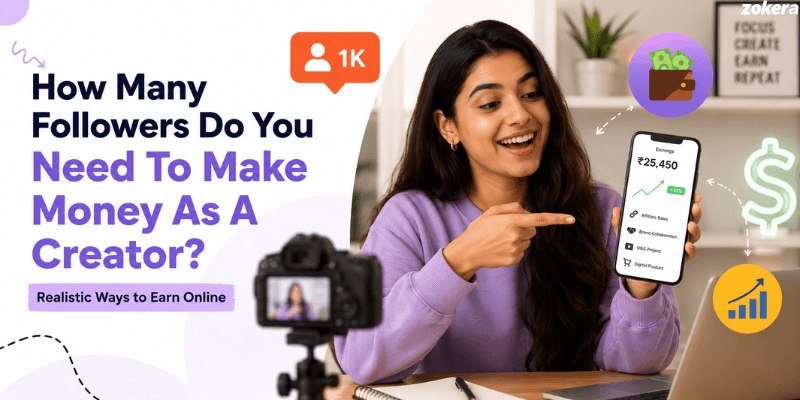
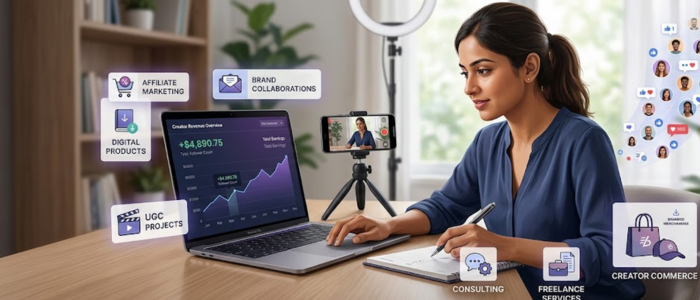
You do not need thousands of followers to start earning as a creator. A smaller audience can still become valuable when it is relevant, engaged, and trusts your recommendations. Today, creators can earn through UGC, affiliate marketing, brand collaborations, digital products, freelance services, and creator commerce. Some methods depend on audience reach, while others depend more on skills and expertise. This guide explains how creators earn without a large following, what actually matters beyond follower count, and how to choose the right monetization model.
Do You Need a Large Following to Make Money as a Creator?
No. A large following can make certain opportunities easier, especially campaigns where brands want broad reach. But it is not a universal requirement for creator monetization.
The creator economy has several income models, and they do not all reward the same thing. An influencer may earn because a brand wants access to their audience. A UGC creator may earn because they can produce high-quality content. A freelancer earns from expertise, while an affiliate creator earns when recommendations lead to qualifying actions or purchases.
This is why asking only "How many followers do I need?" can lead you in the wrong direction.
A better question is:
What value can I create for my audience, a brand, or a customer?
A creator with 3,000 followers in a highly specific niche can be commercially useful if those followers are genuinely interested in the creator's recommendations. At the same time, a much larger account may not perform well if its audience has little connection with the product or service being promoted.
This people-first approach also aligns with Google's guidance on creating helpful, reliable content, which emphasizes creating content primarily for people rather than producing pages simply to manipulate search rankings.
What Matters More Than Follower Count?
If your audience is still small, focus on the signals that show genuine value.
Audience Relevance
A niche audience is easier to understand and serve.
For example, a creator focused on affordable skincare for college students has a much clearer commercial audience than a creator who posts about completely unrelated topics.
A defined niche can also make it easier to find relevant products, pitch suitable brands, and create content that answers specific questions.
Audience Trust
Trust is one of a creator's most valuable assets.
If followers regularly ask where you bought something, which product you recommend, whether something is worth the money, or which option they should choose, your content is already influencing decisions.
That does not mean every recommendation should become an advertisement. In fact, constantly promoting products can weaken trust.
The stronger approach is to recommend products only when they genuinely solve a problem for your audience.
Engagement and Intent
Do not look at likes alone.
Pay attention to:
- Comments
- Saves
- Shares
- Story replies
- DMs
- Profile visits
- Link clicks
- Product clicks
A follower who saves a buying guide or asks for a product link may be showing stronger commercial intent than someone who simply scrolls past a viral post.
Content Quality
Content itself can become a product.
A creator who can produce strong product videos, tutorials, testimonials, reviews, or short-form advertisements can potentially earn from brands even without a huge audience.
This is particularly relevant to UGC, where the brand is often paying for the content asset rather than access to the creator's followers. Shopify similarly distinguishes paid UGC from influencer marketing based on this difference in value.
7 Ways Creators Earn Without a Large Following
1. Affiliate Marketing
Affiliate marketing is one of the most accessible ways to monetize product-focused content.
The basic model is simple:
- Join an affiliate program.
- Receive a tracking link or another attribution method.
- Recommend a relevant product.
- A viewer clicks and completes a qualifying action.
- You earn according to the program's terms.
The creator's job is not simply to place links everywhere. The real value comes from helping the audience decide what to buy.
Useful affiliate content includes:
- Product reviews
- Comparisons
- Buying guides
- Budget recommendations
- Pros and cons
- Product tutorials
- "Best for" recommendations
- Alternative-product guides
Platforms are also building shopping directly into creator ecosystems. For example, eligible creators can use the YouTube Shopping affiliate program to tag products and earn commissions from qualifying purchases.
For smaller creators, the key is relevance over volume. Promoting ten unrelated products is usually less useful than becoming known for reliable recommendations within one niche.
If you earn money or receive another material benefit from recommending a product, make the relationship clear to your audience. The FTC's influencer disclosure guidance explains how creators can make sponsored and affiliate relationships transparent.
2. Brand Collaborations
You do not necessarily need a massive following to approach brands.
A brand may care about:
- Niche relevance
- Audience quality
- Engagement
- Content quality
- Product fit
- Authenticity
- Previous work
- Campaign objectives
This means a small creator's pitch should not be:
"I have 3,000 followers. Please sponsor me."
Instead, explain why your audience and content are useful to that particular brand.
A good pitch should communicate:
- Your niche.
- Your audience.
- Your content style.
- Why the product fits.
- What content you can create.
- Relevant results or portfolio examples.
When a collaboration involves a paid endorsement or another material relationship, creators should also understand the applicable disclosure requirements. The FTC's Endorsement Guides provide detailed guidance on disclosures for endorsements and sponsored content.
Small creators can also make themselves easier to evaluate by maintaining a simple media kit with audience demographics, engagement information, previous collaborations, and examples of their best work.
If you are exploring creator earnings, Realistic First-Month Earnings as a New Creator on Zokera provides a more specific look at the early earning stage.
3. UGC Content
UGC is especially relevant if you want to earn from your content skills rather than your follower count.
With influencer marketing, the creator's audience and distribution are usually part of the value.
With paid UGC, the brand may hire the creator to produce content that the brand can use on its own marketing channels, subject to the agreed usage rights. This is one reason UGC can be valuable to brands as a content and marketing asset, even when the creator does not have a large audience.
Typical UGC formats include:
- Product demonstrations
- Unboxing videos
- Testimonials
- Tutorials
- Voiceover videos
- Lifestyle clips
- Problem-solution videos
- Short-form ad creatives
This creates an important opportunity for smaller creators.
You could have 1,000 followers and still build a portfolio that demonstrates excellent video production, storytelling, editing, and product presentation.
If your goal is to pursue this route, How to Become a UGC Creator in India can serve as the next resource.
4. Sell Your Skills as a Service
Your creator profile can also function as a portfolio.
If you are good at something businesses or individuals need, your content can demonstrate that skill.
Examples include:
- Video editing
- Copywriting
- Graphic design
- Photography
- Social media management
- Content strategy
- Personal branding
- Consulting
For example, a copywriter can post headline breakdowns. A video editor can show before-and-after edits. A designer can explain how a visual was created.
The monetization path becomes:
Content → Expertise → Trust → Inquiry → Client
Here, your audience does not have to be huge because the customer is paying for your skill.
5. Digital Products
Creators can turn their knowledge into digital products such as:
- Templates
- Checklists
- Ebooks
- Guides
- Worksheets
- Canva templates
- Notion templates
- Presets
- Mini-courses
The most important factor is not how broad the product is. It is how clearly it solves a problem.
For example, instead of creating a generic "Instagram Guide," a creator could sell:
"50 Instagram Reel Hooks for Small Businesses."
The second product has a much clearer audience and use case.
A small audience can be enough when the product solves a problem that those people genuinely have.
6. Coaching and Consulting
Creators with genuine professional expertise can monetize through coaching or consulting.
Depending on their experience, they may offer:
- Career guidance
- Fitness coaching
- Content strategy
- Personal branding
- Freelancing guidance
- Business consulting
- Social media consulting
This model can work with a smaller audience because the creator does not need thousands of customers.
However, expertise matters. Your content should demonstrate why people should trust your advice rather than relying on follower count as proof of authority.
7. Creator Commerce
Creator commerce connects content, product discovery, recommendations, and shopping.
Instead of sending followers to disconnected product links, creators can organize relevant recommendations around their niche.
A fashion creator could organize products into collections such as:
- College outfits
- Workwear
- Budget fashion
A tech creator could create collections for:
- Creator gear
- Budget gadgets
- Desk accessories
A beauty creator could organize:
- Skincare
- Everyday makeup
- Haircare
This makes product discovery more organized and gives the audience a clearer next step after consuming the content.
You can learn more about the concept through Zokera's What Is Creator Commerce and Why Is It the Future?.
Can You Make Money With 1,000 Followers?
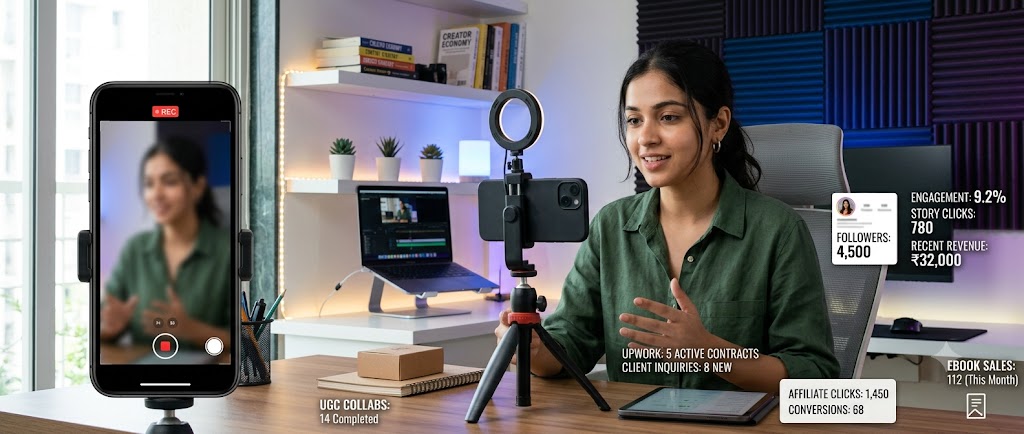
Yes, but 1,000 followers do not guarantee income.
A creator with 1,000 relevant followers may be able to monetize through affiliate marketing, UGC, services, digital products, creator commerce, or selected brand collaborations.
Another creator with 20,000 followers could earn very little if the audience is poorly matched to the niche or there is no clear monetization strategy.
The important question is what you are monetizing.
| Monetization method | Follower dependence | Main value |
|---|---|---|
| UGC | Low | Content skills |
| Freelance services | Low | Expertise |
| Consulting | Low to medium | Knowledge and trust |
| Digital products | Medium | Problem-solving |
| Affiliate marketing | Medium | Trust and purchase intent |
| Creator commerce | Medium | Product relevance |
| Brand collaborations | Medium to high | Audience and campaign fit |
Follower requirements also vary by platform and monetization feature. For example, creators can check the current YouTube Partner Program eligibility requirements rather than assuming that one follower threshold applies to every monetization opportunity.
Can You Make Money Without Followers?
Yes, but you need to choose the right monetization model.
Audience-based income becomes harder when you have no audience because fewer people are available to see your recommendations.
Skill-based income is different.
You can create UGC, offer freelance services, build a portfolio, or sell expertise without first becoming a large influencer.
Think of it this way:
Audience-Based Monetization
You earn because people follow, trust, and act on your recommendations.
Examples:
- Affiliate marketing
- Creator commerce
- Brand collaborations
- Memberships
Skill-Based Monetization
You earn because you can create something valuable.
Examples:
- UGC
- Video editing
- Design
- Copywriting
- Photography
- Consulting
This distinction is important because new creators often spend too much time waiting to reach an arbitrary follower milestone.
How Should Small Creators Choose a Monetization Method?
Start with the type of content you already create.
Choose Affiliate Marketing or Creator Commerce If:
- You regularly recommend products.
- Followers ask for product links.
- Your content includes reviews or comparisons.
- Your audience has shopping intent.
Choose UGC If:
- You enjoy creating videos.
- You can demonstrate products naturally.
- You understand short-form content.
- You want to work with brands without depending on your reach.
Choose Services If:
- You have a marketable skill.
- Your content can demonstrate that skill.
- Businesses could benefit from your expertise.
Choose Digital Products If:
- Followers repeatedly ask similar questions.
- You have knowledge that can be packaged.
- Your audience has a specific problem.
Choose Brand Collaborations If:
- You have a defined niche.
- Your audience fits specific brands.
- Your content quality is strong.
- You can demonstrate engagement or previous results.
Do not try to launch every monetization method at once. Pick the one that fits your existing strengths, test it, and expand after you have evidence that it works.
How Small Creators Can Turn Content Into Income
A creator business becomes easier to build when every piece of content has a role.
Think of the journey as:
Reach → Attention → Trust → Intent → Action → Revenue
Step 1: Attract the Right Audience
Create content around topics that your target audience actually cares about.
Step 2: Build Trust
Share useful information, real experiences, opinions, tutorials, comparisons, and demonstrations.
Step 3: Create Intent
Help people solve problems or make decisions.
For product creators, that could mean comparing products or explaining what to buy.
For service creators, it could mean demonstrating expertise.
Step 4: Give a Clear Next Step
Depending on your business model, that could be:
- Storefront
- Product recommendation
- Affiliate link
- Portfolio
- Service page
- Digital product
- Consultation
Step 5: Measure the Result
Do not stop at views.
Measure whether your content produces clicks, inquiries, leads, purchases, or other meaningful actions.
What Metrics Should Small Creators Track?
Follower growth is useful, but it should not be your only measurement.
Audience Metrics
- Reach
- Follower growth
- Engagement rate
- Saves
- Shares
- Watch time
Intent Metrics
- Profile visits
- DMs
- Story replies
- Link clicks
- Product clicks
Business Metrics
- Leads
- Purchases
- Conversion rate
- Revenue
- Repeat customers
- Brand inquiries
For example, a post with 2,000 views that generates 30 product clicks may provide more useful commercial data than a post with 50,000 views and no meaningful action.
That does not make the viral post worthless. It simply means different content can serve different stages of the funnel.
A 30-Day Plan to Start Monetizing a Small Audience
If you already have a small audience, use the next 30 days to build a simple monetization system.
Week 1: Understand Your Audience
Review your existing content and identify:
- Topics receiving meaningful engagement.
- Questions followers repeatedly ask.
- Products people ask about.
- Skills people associate with you.
- Problems your audience wants solved.
Choose one primary monetization direction.
Week 2: Build Proof
Create content that demonstrates your value.
If you want affiliate income, publish useful product content.
If you want UGC work, create sample videos.
If you want clients, publish expertise-based content.
If you want brand deals, organize your best work into a portfolio.
Week 3: Add the Monetization Path
Make the next step easy to find.
Depending on your model, that could be:
- Storefront
- Portfolio
- Service page
- Affiliate link
- Digital product
- Consultation
Do not make your audience search through your profile to understand what to do next.
Week 4: Measure the Results
Review:
- Which posts generated clicks?
- Which topics generated DMs?
- Which products attracted interest?
- Which content generated leads?
- Which CTA worked best?
Use those findings to plan the following month.
How Zokera Fits In
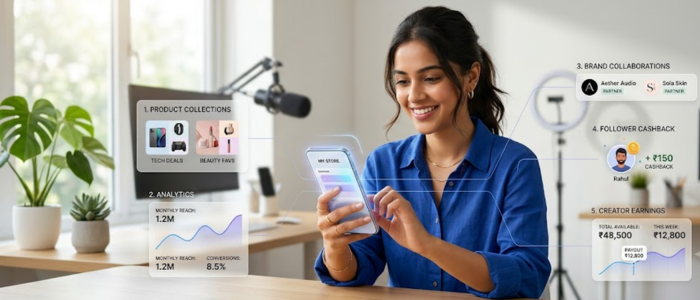
For creators who already recommend products, Zokera provides a structured way to connect content, product discovery, and creator earnings. Instead of repeatedly sharing individual product links, creators can organize relevant recommendations to make them easier for followers to explore.
What Creators Can Do With Zokera
Create a Creator Storefront: Organize recommended products in one place so followers can easily discover what you recommend.
Build Product Collections: Group products around specific themes such as budget gadgets, everyday fashion, skincare essentials, or creator gear.
Use Auto-DM: Share relevant product information with followers through automated Instagram conversations when appropriate.
Track Performance: Use creator analytics to understand which content and product recommendations are generating interest and results.
Access 1000+ Brand Partnerships: Discover products and brands that can be relevant to your niche and audience.
WEGive Followers Cashback: Eligible purchases can provide follower cashback, adding an extra benefit for people who shop through creator recommendations.
How the Creator-Commerce Journey Works
The process can be simple:
Content → Product Recommendation → Creator Storefront → Follower Purchase → Eligible Follower Cashback + Creator Earnings
This model can be useful for creators who already make product reviews, comparisons, tutorials, recommendations, or shopping-focused content.
For example, a fashion creator could create a "Budget College Outfits" collection instead of sharing separate product links across multiple posts. A tech creator could create a "Creator Setup Under ₹20,000" collection and direct followers to the relevant products from their content.
You can learn more about the model in Zokera's Creator Commerce guide.
If you're also researching creator income, How Much Do Instagram Creators Earn in India? covers the broader earning potential of Instagram creators.
The important point is that these tools should support useful content, not replace it. The stronger the recommendation and the more relevant the product is to the audience, the more naturally creator commerce fits into the content journey.
Common Mistakes Small Creators Should Avoid
Waiting for a Specific Follower Number
There is no universal rule that says you must reach 10,000 followers before monetizing.
If you already have an engaged niche audience or a marketable skill, you can begin testing appropriate income streams earlier.
Buying Followers
Fake followers do not create genuine customers and can distort your engagement data.
Build an audience that actually cares about your niche.
Promoting Everything
If every product is suddenly "the best," your recommendations become less credible.
Promote products that genuinely fit your audience.
Focusing Only on Views
Views create attention, but attention is not the same as revenue.
Track what happens after people see your content.
Trying Every Monetization Method
Starting affiliate marketing, UGC, coaching, digital products, subscriptions, and sponsorships simultaneously can make your strategy unfocused.
Start with one primary model and build from there.
Conclusion
A large following can open doors, but it is not the only way to build creator income. What matters more is having the right audience, creating content people trust, and choosing a monetization model that matches your strengths.
If your audience is small, start with one clear opportunity instead of trying everything at once. Focus on creating useful content, understand what your followers respond to, and build a simple path from content to action to income.
The goal is not to wait until you have thousands of followers. It is about starting to create value with the audience and skills you already have.
ALSO READ:
- How Digital Storefronts Work for Creators in India
- How to Set Up Your Zokera Creator Storefront in Minute
- What Is Zokera and How Does It Work? The Ultimate Guide for Creators in India
- Zokera Auto-DM: Turn Every Instagram Comment Into a Sale
- Best Creator Commerce Platform in India 2026: Everything You Need to Know
- How to Make Money from Your Social Media Following in India
- How Instagram Influencers Can Monetize Using Zokera (2026)
Frequently Asked Questions (FAQs)
1. Can creators make money without a large following?
Yes. UGC, affiliate marketing, services, digital products, creator commerce, consulting, and selected brand collaborations can all provide monetization opportunities without requiring a massive audience.
2. How many followers do you need to make money as a creator?
There is no universal number. Requirements depend on the monetization method and platform. Some income streams depend more on skills and expertise than follower count.
3. Can I make money with 1,000 followers?
Yes. A relevant audience of 1,000 followers can potentially support affiliate income, UGC, creator commerce, services, digital products, and some brand opportunities.
4. Can you make money without followers?
Yes. UGC, freelance services, editing, design, copywriting, photography, and consulting can be started without relying on a large social audience.
5. Is UGC better than influencer marketing for small creators?
Not necessarily better, but it can be more accessible because UGC focuses on content production rather than requiring the creator to distribute the content to a large audience.
6. What is creator commerce?
Creator commerce connects creator content and product recommendations with shopping. Creators can organize relevant products into storefronts or collections and potentially earn from qualifying purchases.
7. Does Zokera offer follower cashback?
Zokera includes follower cashback for eligible purchases. Cashback availability and applicable terms can vary by product or offer.
8. How many brand partnerships does Zokera have?
Zokera offers access to 1000+ brand partnerships, giving creators opportunities to discover and promote relevant products from participating brands.
Comments (0)
Be the first to comment.