
Most sellers think product descriptions are just for listing features. That is why their products get views but barely any sales. A strong product description does much more than explain what a product is. It builds trust, answers buyer questions, improves SEO, and convinces people to click “Add to Cart.” Learning how to write product descriptions that sell can directly improve your conversions.
In this guide, you will learn simple copywriting techniques, SEO tips, and proven frameworks to create high-converting product descriptions.
What Is a Product Description?
A product description is the written content on your product page that explains what your product is and why someone should buy it.
Simple definition. But most sellers write it like this:
"Blue cotton kurti. Available in S, M, L. Machine washable."
That is not a product description. That is a label.
The buyer reading that description is thinking:
- So what?
- How does this look on me?
- Will it fit my style?
- Is it worth ₹899?
Your description needs to answer all of that before the buyer even thinks to ask.
Why Product Descriptions Matter
Think about it this way. When someone walks into a physical store, the salesperson talks to them. Explains the product. Answers questions. Builds confidence.
Your product page has no salesperson. The description does that job.
A well-written product description:
Reduces the "price?" DMs and repeated questions
Builds trust even before the buyer knows your brand
Helps your product rank on Google and inside marketplace search
Increases the chance of someone actually hitting "Add to Cart."
Sellers who put effort into descriptions consistently see better conversions than those who rely on photos alone. The photo gets attention. The description closes the sale.
Features vs Benefits in Product Descriptions
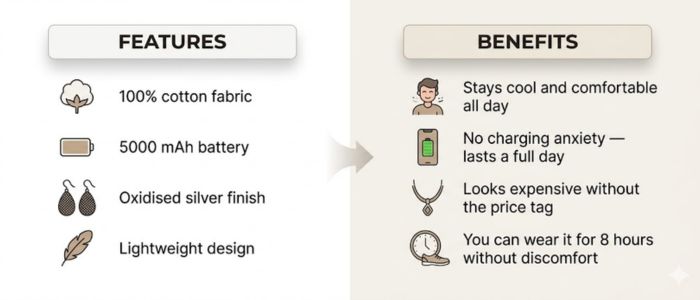
This is the most important thing in this entire guide. Read it twice. Understanding features vs benefits is the foundation of how to write product descriptions that sell.
A feature is what your product has. A benefit is what your product does for the buyer.
| Feature | Benefit |
|---|---|
| 100% cotton fabric | Stays cool and comfortable all day |
| 5000 mAh battery | No charging anxiety — lasts a full day |
| Oxidised silver finish | Looks expensive without the price tag |
| Lightweight design | You can wear it for 8 hours without discomfort |
Every time you write a feature, ask yourself, so what does this mean for the buyer? That answer is your benefit. Lead with benefits. Mention features after.
How to Write Product Descriptions That Sell: Step-by-Step
Step 1: Know Exactly Who You Are Writing For
Before you type a single word, get clear on your buyer.
Are they a college student looking for affordable fashion? A working professional who needs something presentable but comfortable? A mom buying a gift?
The clearer your buyer picture, the sharper your description. A skincare product for teenagers sounds completely different from the same product marketed to women in their 30s.
Ask yourself:
What problem does my product solve for this person?
What would make them hesitate to buy?
What words do they use when they talk about this product?
Write for one person. Not everyone.
Step 2: Start With a Hook, Not a Heading
Most product descriptions start with the product name. Boring. Try starting with the problem or the outcome instead.
Weak opening: Handmade silver earrings with stone detailing.
Strong opening: These earrings do one thing really well: they make a simple outfit look put-together without any effort.
Which one makes you want to read more?
Your first line should pull the buyer in. Make them feel like this product was made for them specifically.
Step 3: Use the FAB Formula
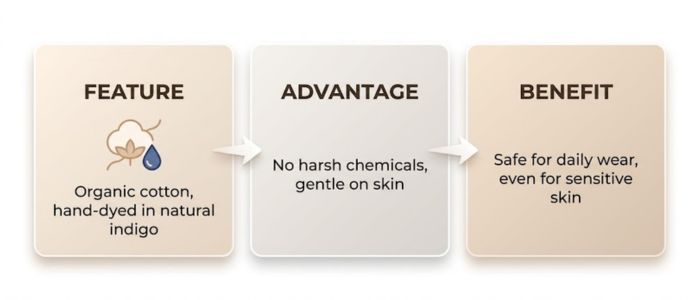
FAB stands for Feature, Advantage, Benefit. It is one of the most reliable structures for product copy. The FAB formula is the simplest answer to how to write product descriptions that sell consistently.
Feature: What it is Organic cotton, hand-dyed in natural indigo
Advantage: Why that feature matters. No harsh chemicals, gentle on skin
Benefit: What it means for the buyer. Safe for daily wear, even for sensitive skin
String these together, and your description practically writes itself.
Step 4: Write Like You Are Talking to a Friend
Read your description out loud. Does it sound like something a real person would say? Or does it sound stiff and formal?
Compare these two:
Version A: This product is manufactured using high-quality raw materials, ensuring durability and longevity.
Version B: Built to last. We have had customers use this for 2+ years without any issues.
Version B is warmer, more believable, and easier to read. That is the tone you want.
Use "you" and "your" throughout. Address the buyer directly.
Step 5: Add Specifics, Not Vague Claims
"Premium quality" means nothing. "Excellent material" means nothing. Buyers have read these phrases a thousand times, and their brains switch off.
Replace vague claims with specific details:
Instead of "high quality stitching" → double-stitched seams that hold even after 50 washes
Instead of "great for gifting" → comes in a gift-ready box, no extra wrapping needed
Instead of "comfortable" → lightweight at just 180 grams, you will forget you are wearing it
Specifics build credibility. Vague words destroy it.
Step 6: Address Objections Before They Come Up
What stops your buyer from purchasing? Think about it.
For clothing, is it sizing? ("Runs true to size. If you are between sizes, go up one.")
For skincare, is it ingredients? ("Paraben-free, dermatologist-tested.")
For electronics, is it compatible? ("Works with Android and iOS. No separate app needed.")
Answer these objections within your description. Do not wait for the buyer to DM you. By then, they have already moved to a competitor.
Step 7: End With a Clear Call to Action
Tell your buyer what to do next. Do not assume they will figure it out.
"Add to cart and get it delivered in 3-5 days."
"Order before 5 PM for same-day dispatch."
"Only 4 pieces left, grab yours now."
A nudge at the end, even a small one, makes a difference.
How to Make Your Product Description SEO-Friendly
Knowing how to write product descriptions that sell means nothing if your page never gets found. Here is how to make Google work in your favour.
1. Use your main keyword naturally: If you are selling "handmade clay diyas," that phrase should appear in your title, first paragraph, and at least one heading. Do not stuff it. Just use it where it fits.
2. Write a unique description for every product: Copy-pasting the same base description with minor changes kills your SEO. Google treats it as duplicate content and will deprioritise your listing.
3. Keep sentences short on mobile: More than 60% of Indian ecommerce buyers shop on their phones. Long paragraphs are hard to read on small screens. Use bullet points for features and keep your paragraphs to 2-3 lines max. Mobile-friendly formatting directly impacts your conversion rate.
4. Include image alt text: When you upload your product photo, always add a description in the alt text field. Example: "Handmade oxidised silver jhumkas with stone detailing" not just "image1.jpg."
5. Add an FAQ section: Commonly asked questions like "Does this come in other sizes?" or "What is the return policy?" are real search queries. Answering them on your product page helps with SEO and reduces buyer friction.
Product Description Examples: Bad vs Good
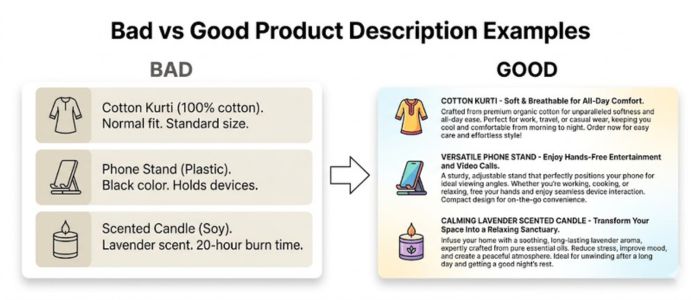
Product: Cotton Kurti
Bad: Cotton kurti in blue color. Available in all sizes. Comfortable fabric.
Good: Light, breathable, and easy to style, this cotton kurti works for everything from casual outings to office days. The soft fabric keeps you cool even in Indian summers, and the A-line cut flatters most body types. Available in S to XXL. Machine washable.
Product: Phone Stand
Bad: Adjustable phone stand. Good quality. Useful for work from home.
Good: Tired of holding your phone during video calls? This adjustable desk stand props your phone at the perfect eye level, no more awkward angles or neck strain. Folds flat in seconds, fits in your bag, and works with all phone sizes, including the newer large-screen models.
See the difference? The second one sells a solution. The first one just lists a thing.
Product: Scented Candle
Bad: Soy wax candle with lavender fragrance.
Good: Turn stressful evenings into a calmer routine with this lavender soy candle. The slow-burning wax lasts up to 40 hours, while the subtle fragrance helps your room feel relaxed without being overpowering.
Product Descriptions for Creator Stores
If you are a creator selling through your own digital storefront, like a Zokera store, your product description does double duty. It sells the product, and it also builds your personal brand.
Your followers already trust you. Use that. Mention why you personally recommend or use the product. Share a quick story if relevant. That kind of authenticity converts much better than polished corporate copy.
A few things to always include in your creator store descriptions:
What the product is and who it is for
Why did you choose to feature this product specifically
Key benefits (not just features)
Size, material, or spec details where relevant
Shipping and delivery info
A direct CTA
Your followers earn cashback on every purchase they make through your Zokera storefront. Mention that too. It is a real incentive that gives buyers one more reason to buy through your link over someone else's.
Quick Checklist Before You Publish Any Product Description
Before you hit publish, run through this:
Does it lead with a benefit, not a feature?
Does it speak directly to one type of buyer?
Does it answer the most common objections?
Is there a clear call to action at the end?
Are there specific details instead of vague claims?
Is the main keyword included naturally?
Is it readable on mobile (short paragraphs, bullet points)?
If you can check all seven, you have a strong description.
Common Product Description Mistakes to Avoid
Avoid these, and you are already ahead of most sellers:
"Premium quality" and similar vague claims say something specific or skip it
Copy-pasting manufacturer descriptions, Google ignores duplicate content, so will buyers
Features only, no benefits, tell them what it does for them, not just what it has
Wall of text on mobile, short paragraphs, bullet points, white space
No call to action, always tell the buyer what to do next
Never update descriptions if it is not converting; rewrite them
Conclusion
A product photo gets the scroll to stop. The description gets the sale. Every product you list without a strong description is a missed opportunity. You already did the hard work of creating or sourcing the product. Do not let weak product copy stop it from converting.
Pick your worst-converting product today and rewrite the description using the FAB formula. Once you know how to write product descriptions that sell, even small improvements in copy can increase clicks, add-to-carts, and conversions faster than most sellers expect.
ALSO READ:
- 5 Ways to Earn Money on Zokera Without a Huge Following
- What Brands Look for When Choosing a Creator to Work With
- How to Make Money from Your Social Media Following in India
- How to Build an Engaged Audience That Actually Buys (2026 Guide)
- How to Create the Perfect Product Collection for Your Niche
- How YouTube Creators Can Earn More with Zokera (Beyond Just Ad Revenue)
FAQs: How to Write Product Descriptions That Actually Sell
Q1. What should a product description include?
Benefit, key features, who it's for, specific details, and a clear CTA.
Q2. How long should a product description be?
50-100 words for simple products. 150-300 words for detailed or higher-priced items.
Q3. Do product descriptions help with SEO?
Yes. Use your focus keyword naturally in the title, first paragraph, and one heading.
Q4. Can a product description really increase sales?
Yes. Benefit-focused copy reduces hesitation and converts more browsers into buyers.
Q5. What words should I avoid in product descriptions?
"Premium quality," "excellent material," "best product" vague claims that mean nothing to the buyer.
Q6. Should product descriptions be emotional or technical?
The best product descriptions combine both. Emotional language grabs attention, while technical details build trust.
Q7. How do I write product descriptions for mobile users?
Use short paragraphs, bullet points, and simple language because most shoppers browse on phones.
Q8. Can AI write product descriptions?
Yes, but AI-generated descriptions still need human editing to sound natural, specific, and brand-focused.
Comments (0)
Be the first to comment.