
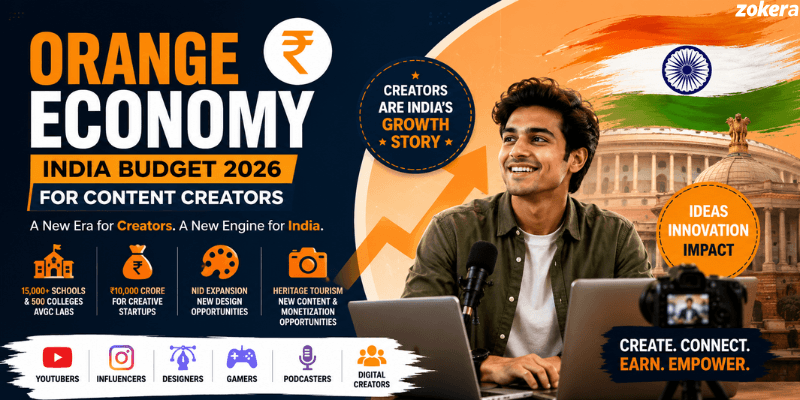
India's Union Budget 2026 did something historic. For the first time, the government officially recognized the "Orange Economy" as a major growth sector. From AVGC labs to startup funding, creators are now part of India's economic future. If you are a YouTuber, influencer, designer, gamer, or digital creator, this budget directly impacts your opportunities, income potential, and career growth. Here is what the orange economy India budget 2026 content creators update means and how creators can benefit from it right now.
What Is the Orange Economy?
The Orange Economy India budget 2026 content creators discussion is becoming one of the biggest talking points in India's digital industry.
The Orange Economy is simply the creative economy. It covers all industries where the main product is not a physical good but an idea.
This includes:
Animation, visual effects, gaming, and comics (AVGC)
Digital content creation and social media
Music, films, and OTT content
Design, intellectual property, and cultural tourism
Podcasts, newsletters, and online education
The term was coined in a 2013 book by former Colombian President Ivan Duque. India officially adopted it in the Budget 2026 as a strategic growth driver, not just a cultural footnote.
You can learn more through the Orange Economy global overview.
In simple words: if you make content for a living, you are part of the Orange Economy.
Where Did the Term Orange Economy Come From?
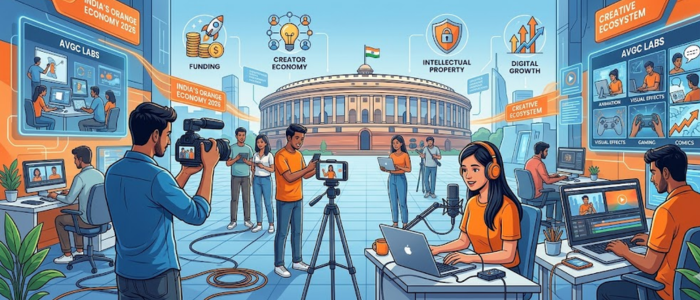
Most people hear "Orange Economy" and wonder why orange. The color has nothing to do with fruit. Orange is associated with creativity, warmth, and cultural expression across many traditions. The term was first introduced by Ivan Duque Marquez and Felipe Buitrago in their 2013 book "The Orange Economy: An Infinite Opportunity." They argued that creative industries represent an infinite economic opportunity because ideas, unlike raw materials, never run out.
India picked up this framework and applied it to its own strengths: a young population, deep cultural diversity, growing digital infrastructure, and a creator ecosystem that is already one of the largest in the world.
What Did Budget 2026 Announce for the Orange Economy?
Budget 2026 was the first time India's government treated creators as an economic engine. Here are the key announcements that directly affect you.
According to the official PIB Budget announcements, the government introduced multiple initiatives connected to India's creative and AVGC ecosystem.
AVGC Content Creator Labs in 15,000 Schools and 500 Colleges
The government earmarked Rs 250 crore to set up Animation, Visual Effects, Gaming, and Comics labs in 15,000 secondary schools and 500 colleges across India. These labs will be run under the Indian Institute of Creative Technologies (IICT) in Mumbai.
This means the next generation of Indian creators will get trained tools, industry-linked curriculum, and professional skills from the school itself. For existing creators, this signals a massive talent pipeline coming into the space in the next 3 to 5 years.
More details about the AVGC push were also covered by Business Today's Budget 2026 coverage.
Rs 10,000 Crore for Creative Startups
The budget allocated Rs 10,000 crore in funding for creative startups. This includes platforms, tools, and businesses built around content and creativity. More money in the ecosystem means more brand budgets, more platforms competing for creators, and more monetization options for you.
National Institute of Design Expansion
A new National Institute of Design (NID) will be set up in eastern India. This decentralizes design education and opens up the creator economy beyond metro cities. For creators who work in graphic design, product design, fashion, and visual content, this means more trained collaborators and a stronger design culture across India.
You can explore more about India's design education ecosystem on the official National Institute of Design website.
Heritage Tourism and Creator Opportunity
15 major archaeological sites, including Lothal, Dholavira, and Sarnath, will be developed as experiential cultural destinations. The budget specifically noted that content creators can monetize videos at these tourist sites. This is a direct, stated opportunity for travel and culture creators.
Additionally, the budget proposed upskilling 10,000 tourist guides at 20 iconic destinations. This kind of cultural infrastructure investment creates fresh content opportunities for travel creators, food creators, and regional language creators who cover Indian history and heritage.
India’s Creator Economy by the Numbers
India has over 100 million content creators
Influencer marketing industry may cross Rs 5,000 crore by 2027
Regional language content is growing faster than English content
Short-form video consumption continues to rise across Tier 2 and Tier 3 cities
According to the Kofluence Creator Economy Report, regional creators and influencer-led commerce are growing significantly in India.
What Does the Orange Economy Mean for Content Creators in India?
The biggest takeaway is simple: content creation is now becoming part of India’s recognized growth economy.
This changes how brands, businesses, investors, and even families look at creator careers.
More Brand Money Is Coming Into the Creator Space
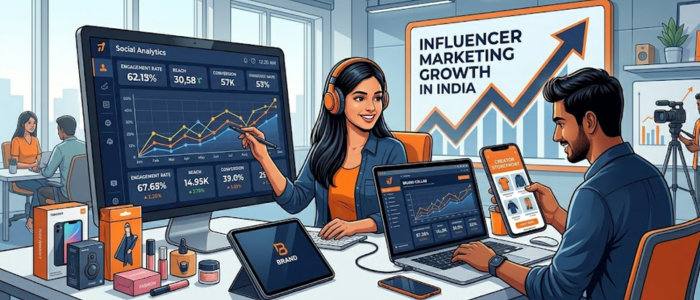
India's influencer marketing sector is already valued at Rs 3,000 to 3,500 crore and is projected to reach Rs 4,500 to 5,000 crore by 2027. With the government now backing the creative economy officially, brands will increase their creator budgets further. More brand collaborations, better pay rates, and longer partnerships are coming for ready creators.
Industry insights from BCG's creator economy research also highlight the increasing role of creators in digital commerce and brand marketing.
A Career in Content Creation Is Now Government-Backed
For years, parents and society asked creators: "But is it a real job?" Budget 2026 answers that. The government has formally recognized content creation as a career worth skilling, funding, and building institutions around.
This shifts public perception and opens doors for creators in Tier 2 and Tier 3 cities who faced the most resistance.
Tier 2 and Tier 3 City Creators Will Grow Fastest
The AVGC labs and NID expansion are specifically designed to reach beyond metros. With 65% of India's population under 35 and affordable internet now everywhere, the next wave of successful creators will come from smaller cities.
Regional language creators are already seeing 3 to 5 times higher engagement than metro creators in several niches.
India Is Positioning Itself as a Global Creative Hub
The Orange Economy push is not just about domestic jobs. India wants to export creative content, animation, gaming, and design to global markets.
For creators, this means potential international brand deals, global platform opportunities, and a government that is actively opening doors to world markets for creative talent.
How Can You Take Advantage of the Orange Economy Right Now?
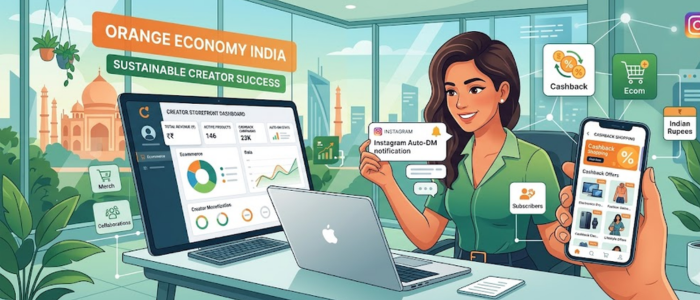
Knowing about the Orange Economy is step one. Acting on it is what separates creators who grow from those who wait.
Build Your Creator Storefront Today
The Orange Economy is moving from ad revenue to direct commerce. Creators who own their monetization, meaning they sell directly to their audience, will win the most in this new era.
A creator storefront on Zokera lets you do exactly that. You get a customizable storefront, access to 1000+ brand partnerships, and a direct earning channel that does not depend on platform algorithms or ad rates.
Read more about How to Set Up Your Zokera Creator Storefront.
Partner With 1000+ Brands and Earn More Per Post
Brand partnerships are the fastest-growing income stream for creators in India right now. On Zokera, you can connect with 1000+ brands across categories and earn from every collaboration.
As brand budgets grow with the Orange Economy push, being on a dedicated creator commerce platform means you capture that growth directly.
Here’s a detailed guide on how to earn with brand partnerships.
Let Your Followers Earn Cashback When They Shop Through You
One of the most powerful tools for creator-led commerce is the follower cashback model. When your followers shop through your Zokera storefront, they earn cashback on their purchases.
This makes your storefront more than a link. It becomes a reason for your followers to keep coming back. More repeat purchases mean more earnings for you, with zero extra effort.
Use Instagram Auto-DM to Convert Every Reel Into Revenue
Budget 2026 is driving more brands toward creator-led commerce. Your Instagram Reels and posts are now business assets, not just content.
With Zokera's Instagram Auto-DM feature, every comment on your post can trigger an automated DM with your storefront link. You create once, and your storefront works while you sleep.
Start With Zero Followers if You Have To
One of the biggest myths in the creator economy is that you need a large audience to start earning.
On Zokera, there is no minimum follower requirement. Whether you have 500 followers or 500,000, you can set up your storefront, partner with brands, and start earning today.
The Orange Economy is open to every creator, not just the ones already famous.
Conclusion
The Orange Economy is no longer just a concept. Budget 2026 officially positions creators, designers, gamers, and digital storytellers as part of India’s economic future.
With creator labs, startup funding, and rising brand investment, Indian creators now have bigger opportunities than ever before. The orange economy India budget 2026 content creators movement could reshape how digital creators earn in the coming years.
Platforms like Zokera can help creators monetize through storefronts, brand partnerships, cashback, and creator-led commerce.
ALSO READ:
- Affiliate Marketing for Beginners: A Creator's Simple Guide
- 5 Reasons Why Every Indian Creator Needs a Digital Storefront
- Zokera Auto-DM: Turn Every Instagram Comment Into a Sale
- How to Earn Money from Instagram Reels (2025 Guide)
FAQs
Q1. What is the Orange Economy in simple terms?
The Orange Economy is the creative economy. It includes content creation, animation, gaming, music, design, and any industry where the product is an idea or creative work rather than a physical good.
Q2. Why did Budget 2026 mention the Orange Economy?
Budget 2026 officially recognized the Orange Economy as a major driver of employment and exports in India. The government announced Rs 250 crore for creator labs, Rs 10,000 crore for creative startups, and new design institutions to build the creative workforce.
Q3. How many jobs will the Orange Economy create in India?
India's AVGC sector alone is projected to require 20 lakh (2 million) professionals by 2030. Combined with content creation, design, and digital media, the Orange Economy is expected to be one of India's top employment sectors this decade.
Q4. What is AVGC, and how does it relate to content creators?
AVGC stands for Animation, Visual Effects, Gaming, and Comics. It is the technical backbone of India's creative economy. Content creators who work in video, animation, gaming, or digital storytelling directly benefit from AVGC skill development and funding.
Q5. How can Indian content creators benefit from Budget 2026?
Creators benefit through more brand money entering the space, government-backed career legitimacy, new training infrastructure, and direct commerce tools. Building a creator storefront on platforms like Zokera positions you to capture this growth.
Comments (0)
Be the first to comment.