
UPI rewards have become a common part of digital payments in India. A payment may earn cashback, reward points, vouchers, scratch cards, or merchant offers. However, not every UPI transaction qualifies for a reward.
The reward may also have a minimum transaction value, spending limit, expiry date, or redemption condition. Understanding these rules helps you judge whether an offer is actually valuable. This guide explains how UPI rewards work, the different reward types, how RuPay credit card rewards fit into UPI, and how to calculate the real value of what you earn.
What Are UPI Rewards?
UPI rewards are benefits offered for eligible transactions made through UPI apps, banks, cards, merchants, or loyalty programmes.
The reward can have different forms depending on the programme. Some rewards reduce your effective spending, while others give you points or vouchers for later use.
Common UPI reward types include:
Cashback credited after an eligible payment
Reward points that can be redeemed later
Scratch cards with variable rewards
Coupons and shopping vouchers
Referral rewards for inviting new users
Merchant-specific offers
Card-linked rewards on eligible UPI transactions
The important point is that the advertised reward does not always equal the amount you actually save. A reward may have a cap, minimum spend, or redemption restriction.
How Do UPI Rewards Work?
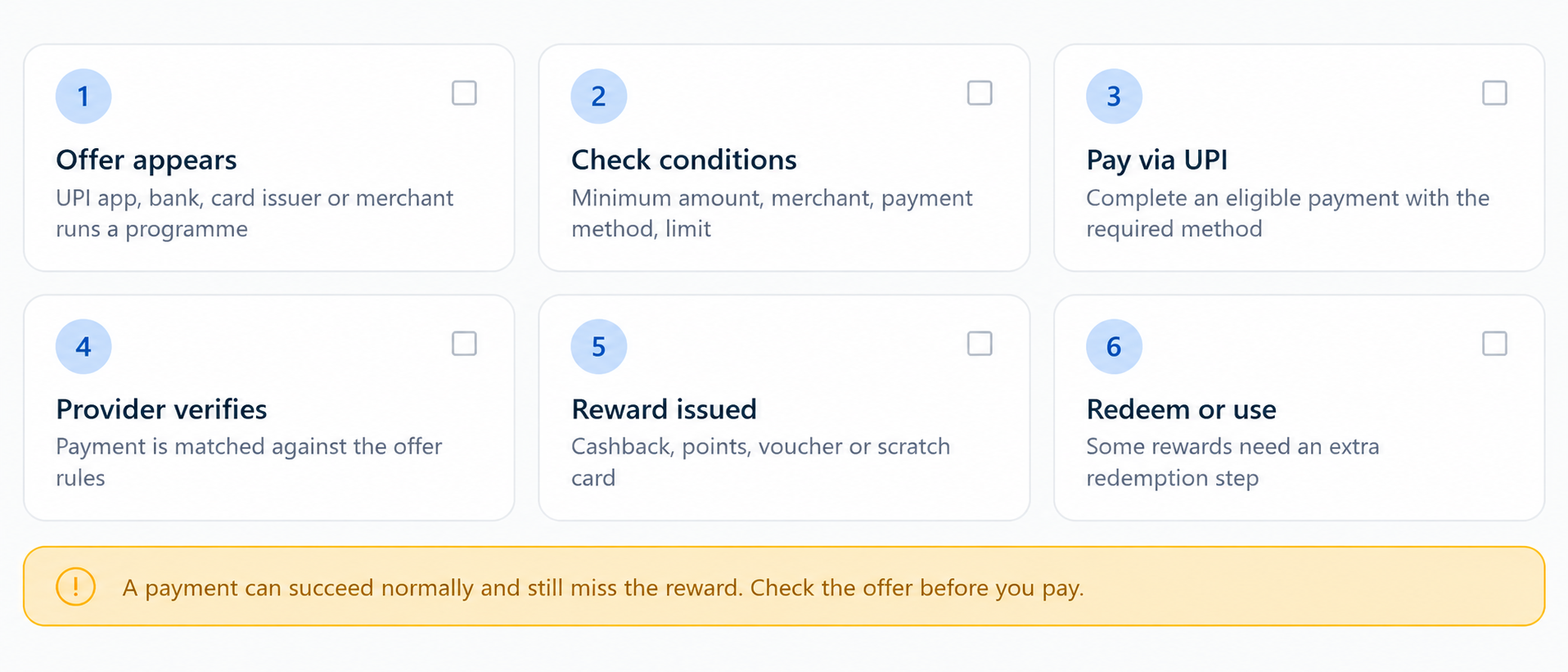
Most UPI reward programmes follow a simple process, although their eligibility rules can differ.
An offer becomes available: The UPI app, bank, card issuer, or merchant provides a reward programme.
You check the conditions: The offer may specify a minimum amount, merchant, payment method, or transaction limit.
You complete an eligible payment: You make the payment using the required UPI method.
The transaction is verified: The provider checks whether the payment meets the offer conditions.
The reward is issued: You may receive cashback, points, a voucher, or another reward.
You redeem or use the reward: Some rewards have no additional action, while others require redemption.
This is why checking the offer before paying matters. A payment can succeed normally but still fail to qualify for a promotional reward.
What Types of UPI Rewards Can You Get?
UPI rewards are not limited to cashback. Different programmes use different reward models.
1. Cashback
Cashback returns part of your eligible spending as a monetary benefit.
For example, an offer could provide ₹50 cashback after an eligible transaction. Another offer may provide a percentage of the transaction value.
Cashback can be attractive because its value is usually easy to understand. However, you should still check the maximum cashback limit.
For example, an offer advertising 10% cashback may have a ₹50 maximum. Spending ₹2,000 would not give you ₹200 cashback.
If you want to understand how cashback offers work across UPI payments, explore Zokera's UPI cashback offers guide.
2. Reward Points
Reward points work differently from direct cashback. You collect points and redeem them according to the programme's rules.
The biggest mistake is treating points as equivalent to cash.
For example, 500 points may not necessarily equal ₹500. The actual value depends on the redemption rate and available rewards.
Before valuing points, check:
How many points you earn per transaction
What each point is worth
Where the points can be redeemed
Whether redemption has a minimum threshold
Whether the points expire
A points programme can look generous until you calculate its actual monetary value.
3. Scratch Cards
Some UPI apps use scratch cards as a reward mechanism.
After an eligible transaction, you may receive a scratch card containing a reward. The amount can vary depending on the programme.
Scratch cards can include:
Cashback
Coupons
Vouchers
Discount offers
Other promotional rewards
Do not assume that receiving a scratch card guarantees a high-value reward. The actual value depends on the programme's rules.
4. Vouchers and Coupons
Some UPI rewards come as vouchers instead of direct cashback.
For example, an eligible transaction could provide a voucher for shopping, food, travel, or another category.
Before considering a voucher valuable, check:
Its expiry date
Minimum purchase requirement
Eligible merchants
Applicable categories
Whether it can be combined with other discounts
Whether unused value is lost
A ₹100 voucher you would never use has little practical value.
5. Referral Rewards
Referral programmes reward users for bringing new customers to a UPI app or financial service.
The reward may depend on several conditions. The invited user may need to register, make a qualifying payment, or complete another action.
Referral rewards therefore require more than simply sharing a link. Always check the eligibility conditions before expecting the reward.
6. Merchant-Specific Rewards
Merchants can also offer rewards for payments made through selected UPI methods.
These offers may apply only to certain stores, categories, transaction values, or payment methods.
For example, a merchant could offer a reward when you pay through a specific UPI app during a promotional period.
These offers can be useful when the purchase is already planned. They are less useful when they encourage unnecessary spending.
UPI Cashback vs Reward Points
Cashback and reward points can both reduce the effective cost of spending. However, their value works differently.
Feature | UPI Cashback | UPI Reward Points |
|---|---|---|
Reward format | Money or cashback benefit | Points |
Value calculation | Usually straightforward | Depends on conversion rate |
Redemption | Often automatic | Usually required |
Expiry | Depends on programme | Common in some programmes |
Spending restrictions | May apply | Often applies |
Best for | Simple savings | Users comfortable with redemption |
Cashback is easier to evaluate because you can usually see its rupee value directly.
Points require more attention because the same number of points can have different values across programmes.
How RuPay Credit Card Rewards Work on UPI
RuPay credit cards can be linked to UPI for eligible merchant payments. This creates another reward layer because the transaction can qualify for the card's applicable reward structure.
Reward eligibility still depends on the card issuer, card type, transaction category, and applicable terms.
Before using a RuPay credit card for rewards on UPI, check:
Whether the card supports UPI linking.
Which merchant transactions qualify.
How the issuer calculates rewards.
Whether specific transaction categories are excluded.
Whether the rewards have a cap or redemption condition.
NPCI has also issued RuPay credit card reward parity guidance for eligible transactions. The guidance says RuPay credit card rewards on UPI should not be lower than card transaction rewards, except where the issuer does not earn interchange fees. Individual card programmes can still have their own terms and exclusions.
How to Calculate the Real Value of a UPI Reward
The advertised reward percentage does not always tell you how much you actually save.
A simple calculation can help:
Effective reward rate = Reward value ÷ Transaction value × 100
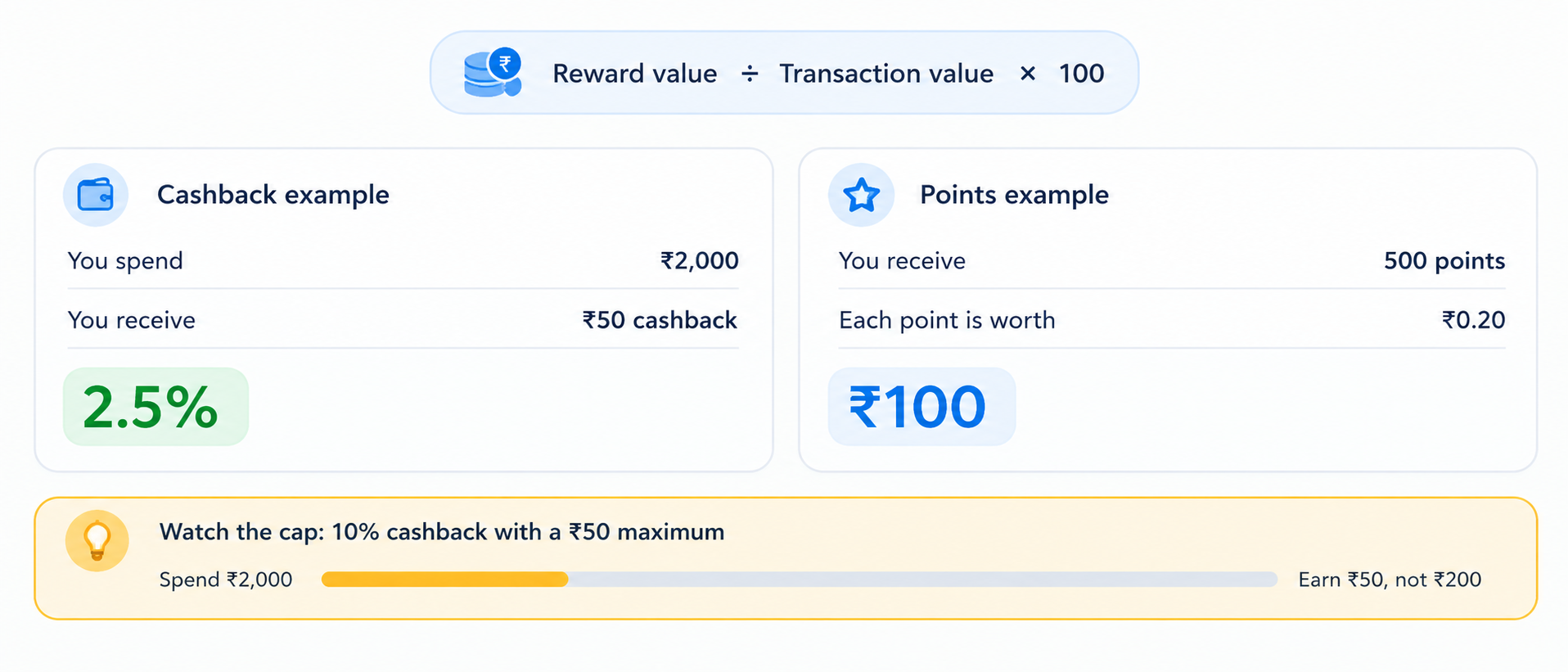
For example, suppose you spend ₹2,000 and receive ₹50 cashback.
₹50 ÷ ₹2,000 × 100 = 2.5%
Your effective reward rate is therefore 2.5%, even if another part of the offer uses a larger headline percentage.
The same principle applies to points.
Suppose you receive 500 points. If the programme values those points at ₹0.20 each, their actual value is:
500 × ₹0.20 = ₹100
This makes it easier to compare cashback, points, vouchers, and other rewards on the same basis.
Where Can You Find UPI Rewards?
UPI rewards can come from several places. You do not have to rely only on the rewards section of your payment app.
UPI Apps
Payment apps may offer promotional cashback, scratch cards, vouchers, or merchant offers.
The available rewards can change frequently. Therefore, check the current offer before making a large eligible payment.
Banks and Credit Cards
Banks and card issuers can provide rewards for eligible UPI transactions.
RuPay credit cards are particularly relevant because eligible cards can be linked to UPI for merchant payments.
Always check the card's current reward terms rather than relying on an older offer.
Merchants
Individual merchants can run UPI payment offers.
These may provide cashback, discounts, vouchers, or additional benefits for using a particular payment method.
Merchant offers can be useful when you were already planning to make the purchase.
Loyalty Programmes
Some financial products and payment ecosystems use points or stars instead of direct cashback.
Google Pay's current Flex rewards, for example, use Stars as a reward currency. Google states that one Star can be redeemed for ₹1 on eligible Flex payments within Google Pay. See the Google Pay Flex rewards terms.
The programme also has specific reward cycles, eligibility requirements, caps, and redemption restrictions.
This shows why the reward format alone does not determine its value. You must also understand where and how you can use it.
Shopping Platforms
Some shopping platforms combine payment rewards with shopping-related savings.
These can include cashback, coupons, vouchers, or creator-linked rewards.
If you want to compare different shopping reward models, see Zokera's shopping reward apps in India.
What Should You Check Before Using a UPI Reward?
A reward is useful only when its conditions fit your transaction.
1. Minimum Transaction
Some rewards require you to spend a minimum amount.
Do not increase your spending only to qualify for a small reward.
2. Reward Cap
A percentage-based offer can have a maximum reward amount.
For example, 10% cashback capped at ₹50 stops increasing once you reach the cap.
3. Eligible Merchant
Some rewards apply only to selected merchants or categories.
A payment at another merchant may not qualify even if you use the same UPI app.
4. Payment Method
The offer may require a particular payment method.
For example, an offer may apply to a RuPay credit card linked to UPI but not to a regular bank account.
5. Reward Conversion
Points and stars need a conversion value before you can compare them with cashback.
Check how much the reward is actually worth.
6. Expiry
Some points, vouchers, and promotional rewards have expiry dates.
An expired reward has zero value, regardless of how large the original balance was.
7. Redemption Restrictions
Some rewards can only be used for specific purchases or through a particular platform.
Check these restrictions before counting the reward as real savings.
8. Monthly Limits
Reward programmes can limit how much you earn during a specific period.
A high reward rate may therefore apply only to a small amount of spending.
Can You Combine Multiple UPI Rewards?
Sometimes, but stacking depends entirely on the terms of each programme.
A single purchase can potentially involve different layers, such as:
A merchant discount
A bank or card offer
A UPI app reward
A shopping platform reward
However, one reward does not automatically make another reward eligible.
Some offers specifically exclude transactions that use another promotion. Others may apply independently.
The safest approach is to check the terms of each reward before assuming that they can be combined.
Common Mistakes When Using UPI Rewards
Reward programmes are designed to encourage repeat usage. That can sometimes make users focus on the reward instead of the purchase.
1. Spending More to Unlock Rewards
A ₹50 reward does not make a ₹1,000 unnecessary purchase worthwhile.
Only use an offer when the underlying purchase already makes sense.
2. Ignoring Reward Caps
A high percentage can look impressive until you discover its maximum payout.
Always calculate the maximum rupee value before comparing offers.
3. Treating Points as Cash
Points are not automatically equal to their face value.
Check the actual redemption rate before deciding whether an offer is attractive.
4. Missing Expiry Dates
Vouchers and points can lose their value after expiry.
Check reward balances regularly if you use several programmes.
5. Assuming Every Payment Qualifies
Using the same UPI app does not guarantee the same reward on every transaction.
Eligibility can change by merchant, category, payment method, or campaign.
6. Using the Wrong Payment Method
An offer may require a particular card or payment route.
If you pay through another method, the transaction may not qualify.
Are UPI Rewards Really Worth It?
UPI rewards can be worthwhile when they reward spending you would have made anyway.
The most useful question is not, “Which offer gives the highest percentage?”
Instead, ask:
How much is the reward actually worth?
Does my transaction qualify?
Is there a reward cap?
Do I need to spend more to unlock it?
Can I use the reward?
Does it expire?
Does another payment method provide better value?
A smaller reward with simple redemption can sometimes be more useful than a larger reward with complicated restrictions.
The best reward is therefore not necessarily the biggest advertised reward. It is the one that provides genuine value without changing your normal spending behaviour.
UPI Rewards in 2026: From Cashback to Reward Currencies
UPI rewards are becoming broader than traditional cashback.
Payment ecosystems now use several reward formats, including points, Stars, vouchers, merchant incentives, and card-linked benefits.
This makes reward evaluation more important. Users need to understand both the advertised benefit and its practical value.
Google Pay's current Flex programme is one example. Its rewards are issued as Stars, with specific earning rules, reward cycles, category benefits, and a total reward cap. Google Pay currently states that Flex rewards are changing from October 16, 2026, so users should check the latest Flex rewards terms before relying on a specific reward rate.
The programme shows how digital payment rewards are moving towards structured reward currencies rather than simple cashback alone.
At the same time, RuPay credit cards linked to UPI create another layer by combining credit card rewards with UPI merchant payments.
For users, this means comparing the complete reward structure matters more than chasing a single headline percentage.
Conclusion
UPI rewards can offer useful savings, but the headline reward is not always the real benefit. Cashback, points, vouchers, scratch cards, and card-linked rewards all work differently. Checking eligibility, reward caps, redemption value, and expiry dates helps you understand what an offer is actually worth.
If you already shop online through creator recommendations, Zokera adds another way to earn value through qualifying creator storefront purchases. Explore Zokera and discover how creator commerce can turn everyday recommendations into rewards.
Also Read:
UPI Lite: Everything You Need to Know About UPI Lite in India
Best UPI Cashback Apps in India (2026) – Earn ₹500 Monthly Easily
Frequently Asked Questions (FAQs)
1. What are UPI rewards?
UPI rewards are benefits earned through eligible UPI transactions. They can include cashback, points, vouchers, scratch cards, and merchant offers.
2. How do UPI rewards work?
You complete an eligible transaction under the offer's conditions. The provider then issues the applicable reward.
3. Are UPI rewards the same as cashback?
No. Cashback is one type of UPI reward. Other rewards can include points, vouchers, scratch cards, and merchant benefits.
4. Can UPI payments earn reward points?
Yes. Some banks, cards, and payment programmes provide reward points for eligible UPI transactions.
5. Can RuPay credit cards earn rewards on UPI?
Eligible RuPay credit cards can earn rewards on qualifying UPI merchant transactions. The exact benefits depend on the card issuer and its terms.
6. How do I calculate the value of UPI reward points?
Multiply the number of points by their actual redemption value. Then compare that value with the transaction amount to determine the effective reward rate.
7. Do UPI rewards expire?
Some UPI rewards can expire. Check the specific programme's terms for points, vouchers, Stars, or other promotional rewards.
8. Are all UPI transactions eligible for rewards?
No. Reward eligibility can depend on the merchant, transaction amount, payment method, category, campaign, and other conditions.
Comments (0)
Be the first to comment.