
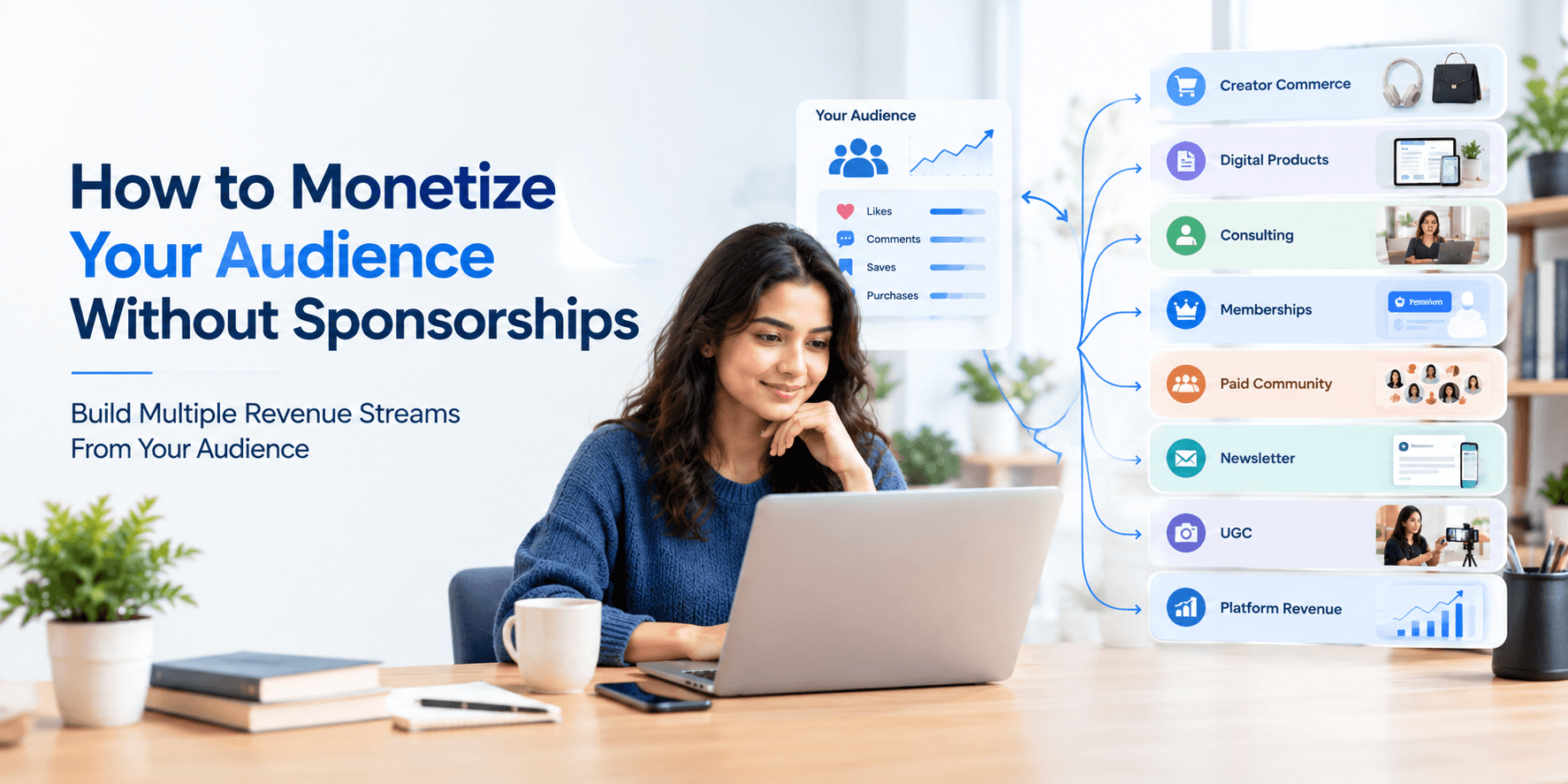
Building an audience is valuable, but audience size alone does not create income. Many creators still depend heavily on sponsorships and brand deals, which can make revenue unpredictable. If you want to monetize your audience without sponsorships, the better approach is to build income streams around what your audience already wants, whether that is products, education, access, expertise, or recommendations.
The strongest creator businesses do not simply add as many monetization methods as possible. They identify audience intent first, choose the right revenue model, test it with real demand, and then build multiple complementary income streams. This approach can make creator income more predictable without turning every piece of content into an advertisement.
Why Creators Are Looking Beyond Sponsorships
Sponsorships can be useful, but they are not always a reliable foundation for a creator business. A brand controls its campaign budget, timing, approval process, and requirements. A creator can have strong engagement one month and still have no campaigns the next.
There is also a difference between being paid for access to an audience and earning because an audience takes action. Sponsorships generally monetize the first model. Affiliate sales, creator commerce, digital products, memberships, services, and communities can monetize the second.
That distinction matters because audience action can continue after the original content is published. A useful product recommendation can generate purchases later. A digital product can be sold repeatedly. A membership can generate recurring revenue. A course can continue generating sales without requiring a new sponsor for every launch.
Instead of building your creator business around:
Finding the next sponsorship
Negotiating every campaign
Meeting brand-specific content requirements
Waiting for another campaign brief
You can build around:
What your audience regularly searches for
What problems they ask you to solve
Products they already want to buy
Skills or knowledge they want to learn
Communities or access they value
Actions they are already taking because of your recommendations
That is the foundation of sponsorship-independent creator monetization. If you are still deciding where to begin, this guide to how to start monetizing as a creator covers the basic process of turning an audience into income.
Start With Audience Intent, Not a Monetization Trend
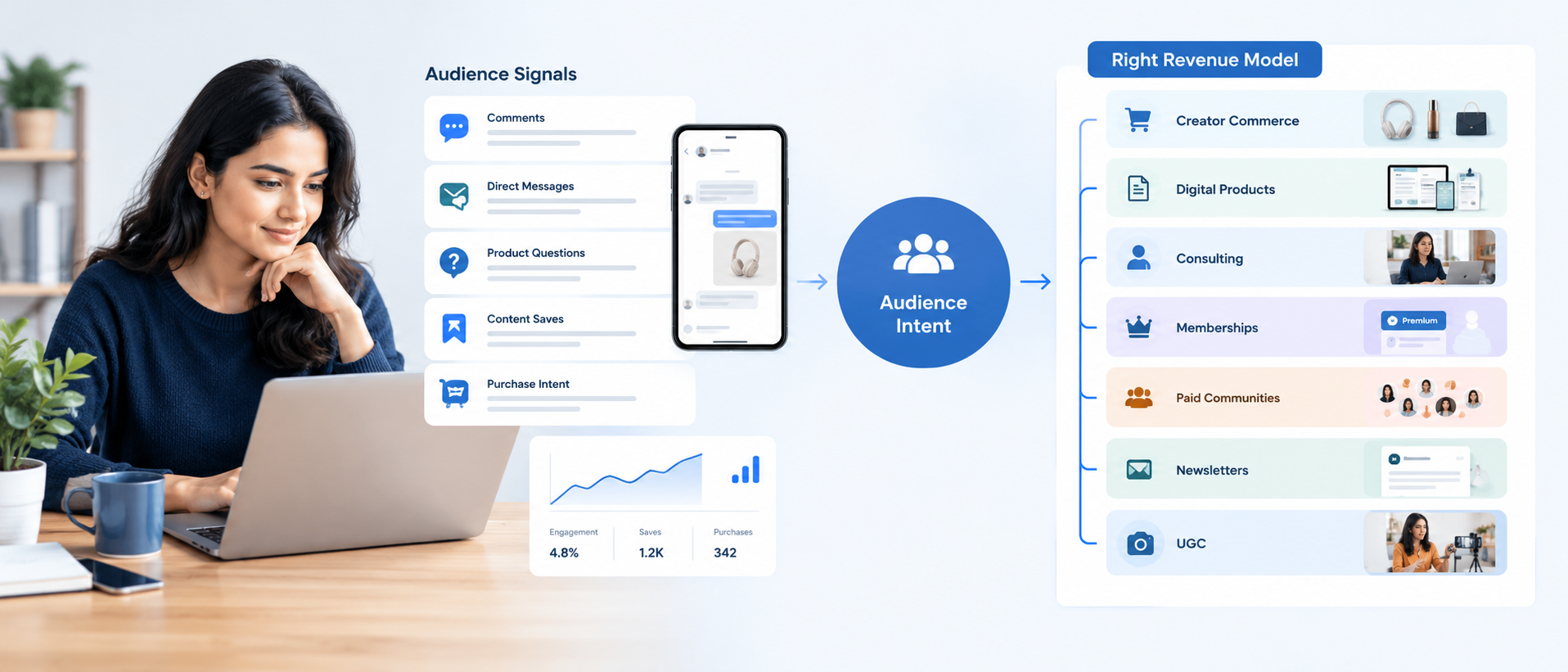
One of the biggest mistakes creators make is choosing a monetization method because another creator is making money from it.
A creator with a fitness audience might successfully sell a workout program, while a technology creator with the same follower count might perform much better with product recommendations or paid consulting. The difference is not necessarily audience size. It is audience intent.
Before choosing a monetization model, look at the questions, comments, messages, searches, and purchase-related behaviour surrounding your content.
For example:
Audience signal | Potential monetization model |
|---|---|
Followers frequently ask what products you use | Affiliate or creator commerce |
People ask you to teach a skill | Course or workshop |
Followers want personal advice | Consulting or coaching |
Audience wants exclusive access | Membership |
Followers want interaction with each other | Paid community |
People want ready-to-use resources | Digital products |
Brands need your content skills | UGC or licensing |
Audience repeatedly reads your analysis | Paid newsletter |
The important point is that the audience tells you what to monetize.
If your followers constantly ask, “Which camera should I buy?”, selling a camera-related recommendation through a commerce model may be more natural than launching a generic course.
If they repeatedly ask, “How did you learn video editing?”, an educational product may have stronger potential.
This audience-first approach also reduces the risk of creating something nobody wants.
1. Creator Commerce and Affiliate Recommendations
Creator commerce and affiliate marketing are among the simplest ways to monetize an audience without creating your own physical product.
The basic model is straightforward: you recommend products that are relevant to your content, your audience purchases through a tracked recommendation, and you earn according to the applicable program terms. On YouTube, for example, eligible creators can also use the YouTube Shopping affiliate program to tag products and earn from qualifying purchases.
This works particularly well for creators whose content already includes products. It also fits naturally with a shoppable content strategy, where content helps people discover, evaluate, and purchase relevant products. Fashion creators can recommend clothing and accessories. Beauty creators can curate skincare and makeup. Technology creators can recommend devices and accessories. Fitness creators can share equipment, apparel, and useful products.
The important difference is recommendation quality. Successful affiliate content does not feel like a list of random links. It explains why a product is useful, who it is suitable for, what its limitations are, and when someone should consider an alternative.
A creator storefront can make this model easier by giving an audience one place to discover multiple recommendations instead of forcing followers to search through individual links. That is also why understanding how digital storefronts work for creators in India is useful before choosing this model.
Zokera, for example, combines creator storefronts, product recommendations, collections, Auto-DM, and follower cashback into a creator commerce model. The broader difference is explained in this comparison of creator commerce vs affiliate marketing.
Affiliate and creator commerce work especially well when:
Your content naturally involves products
Followers frequently ask for recommendations
Your audience has clear buying intent
You create reviews, comparisons, tutorials, or shopping content
You want to monetize older content as well as new posts
For creators in India, this can also be a practical starting point because you do not need to manufacture products, manage inventory, or handle shipping yourself.
If you want to understand the broader model first, read what creator commerce is and how it works.
2. Sell Digital Products
Digital products allow creators to turn knowledge, systems, templates, or resources into something they can sell repeatedly.
Unlike one-to-one services, a digital product does not require you to personally deliver the same work to every customer. Once created, the product can potentially be sold to many people with relatively little additional delivery effort.
The strongest digital products usually solve a specific problem, rather than attempting to teach everything the creator knows.
Examples include:
Templates
Checklists
Guides
Ebooks
Presets
Notion systems
Spreadsheets
Content calendars
Design resources
Research databases
Swipe files
Planning frameworks
For example, a content creator teaching Instagram growth could sell a content planning template rather than simply writing an ebook called Everything About Instagram.
The more specific the problem, the easier it is for an audience member to understand what they are buying. If you want a practical India-focused guide, see how to sell digital products in India, which covers product ideas, pricing, marketing, and selling considerations.
A useful digital-product formula
Audience problem → practical solution → ready-to-use resource
If your audience repeatedly struggles with the same problem, that repeated friction can become a product opportunity. This also fits into the wider creator monetization framework covered in how to start monetizing as a creator.
3. Courses and Workshops
Courses work when your audience does not just want information. They want a structured path to achieve an outcome.
There is an important difference between posting educational content and selling education. Free content can explain what something is, while a paid course can provide the complete process, sequence, exercises, examples, templates, and implementation guidance.
You do not necessarily need to create a massive 50-hour course.
A focused workshop can sometimes be a better starting point.
For example:
“How to Edit Better Reels in 7 Days”
“Instagram Content Planning Workshop”
“Beginner SEO for Small Businesses”
“How to Build Your First Digital Product”
A workshop can also help validate demand before investing months into a large course.
If people attend the workshop, complete the exercises, ask follow-up questions, and request deeper training, you have stronger evidence that a larger educational product may be worth building.
4. Consulting, Coaching and Services
If your audience follows you because of your expertise, you may not need a product at all initially. You can monetize that expertise directly.
Consulting and coaching are particularly useful for creators with smaller but highly relevant audiences because they can generate revenue without requiring massive reach. Audience relevance matters more than follower count in many cases, as explained in how creators earn without a large following.
A creator with 3,000 highly relevant followers may have more commercial value than someone with 100,000 followers who has little connection with their audience's problems.
Depending on your niche, you could offer:
One-to-one consulting
Coaching sessions
Audits
Strategy calls
Portfolio reviews
Content reviews
Business consultations
Personalized plans
Done-for-you services
The limitation is scalability. Your time becomes part of the product.
That is why many creators use services as an early monetization model and later turn repeated client problems into scalable products, workshops, templates, or memberships.
5. Memberships and Subscriptions
Memberships introduce something that sponsorships generally do not: recurring revenue.
Instead of earning once when a campaign runs, you create an ongoing reason for members to pay every month or year.
The key is not simply putting your content behind a paywall. People need a clear reason to remain subscribed.
That could include:
Exclusive content
Members-only tutorials
Early access
Private Q&A sessions
Monthly resources
Behind-the-scenes content
Exclusive recommendations
Direct access to the creator
Discounts or member benefits
The strongest membership offers usually combine content + access + community or utility.
If the only benefit is “more posts,” subscribers may not see enough ongoing value. The strongest membership models make the recurring benefit clear before someone subscribes, rather than relying on access alone. If the membership helps them achieve a specific outcome, retention can become much stronger.
6. Build a Paid Community
A paid community is different from a membership because the primary value can come from interaction, not just access to the creator's content.
People may pay to be surrounded by others who share the same goal, profession, interest, or challenge.
For example:
A freelance creator community could offer networking, job discussions, feedback sessions, expert events, and peer support.
A fitness community could provide accountability, challenges, discussions, and group sessions.
A business community could connect founders with each other and provide regular expert sessions.
The creator becomes the person who creates the environment, establishes the standards, and provides valuable direction.
People may pay for a community because they want:
Accountability
Networking
Expert access
Peer feedback
Industry connections
Faster problem-solving
Exclusive opportunities
A sense of belonging
This model can become particularly powerful when the audience already communicates with each other in comments, DMs, Discord, Telegram, WhatsApp, or other community spaces.
7. Launch a Paid Newsletter
Newsletters can turn audience attention into a direct communication channel.
A free newsletter can help you build an owned audience, while a paid version can provide deeper analysis, research, recommendations, tutorials, or industry insights.
This model is especially relevant for creators whose value comes from information and interpretation.
For example, a finance creator could provide deeper market analysis. A technology creator could publish detailed product research. A marketing creator could share practical growth experiments and case studies.
The strongest paid newsletters generally answer a question that readers consider valuable enough to pay to have answered regularly.
That means the value is not simply “more content.” It is better information, better analysis, better curation, or saved time.
8. UGC and Content Licensing
You can also monetize your content skills without turning your audience into the direct customer.
User-generated content, or UGC, allows creators to produce content that brands can use in their own marketing. The creator does not necessarily need to publish the content to their own audience.
This makes UGC different from traditional sponsorships.
With a sponsorship, your audience is usually part of the value being sold. With UGC, the brand is primarily paying for your ability to create effective content.
Creators can produce:
Product demonstrations
Short-form videos
Testimonials
Tutorials
Product photography
Unboxing videos
Voiceovers
Lifestyle content
Content licensing can take this further by allowing brands or publishers to use existing creator content under agreed terms.
This can be useful for creators who have strong production skills but do not want their entire business to depend on sponsored posts. For creators who want to explore this path in more detail, how to become a UGC creator in India covers the basics of building a portfolio, choosing a niche, and pitching brands.
9. Sell Physical Products
Some creators eventually turn their audience into a customer base for physical products.
This can include merchandise, niche products, creator-led brands, or products specifically designed around the audience's interests.
However, physical products introduce more operational complexity than digital products or affiliate recommendations.
You may need to consider:
Manufacturing
Inventory
Packaging
Shipping
Returns
Customer support
Cash flow
Product quality
That does not make physical products a bad model. It simply means they should usually come after you have evidence that your audience wants the product.
A creator should ideally validate demand before investing heavily in inventory. If your audience is more interested in discovering existing products than buying your own inventory, how a creator storefront increases sales without a website shows how a curated storefront can reduce shopping friction.
10. Use Platform Monetization as One Layer, Not the Entire Strategy
Platforms themselves can provide monetization opportunities through ads, memberships, fan funding, shopping features, subscriptions, and other programs.
YouTube, for example, provides multiple monetization features through the YouTube Partner Program, including advertising, memberships, Supers, Shopping, and YouTube Premium revenue for eligible creators. Eligibility varies by feature and can change over time.
The problem is relying on platform revenue alone.
Your income can be affected by:
Platform policy changes
Eligibility requirements
Algorithm changes
Audience geography
Advertising demand
Seasonal fluctuations
Platform-specific reach
Platform monetization is therefore better viewed as one layer of a creator business, rather than the complete business model.
How to Choose the Right Monetization Model
You do not need to launch all ten methods.
In fact, trying to launch everything simultaneously is one of the fastest ways to create unnecessary work.
Start by matching your audience's intent with the model that requires the least behavioural change.
If your audience mainly wants... | Start with... |
|---|---|
Product recommendations | Affiliate or creator commerce |
Your expertise | Consulting or coaching |
Practical resources | Digital products |
Structured learning | Courses or workshops |
Exclusive access | Membership |
Peer interaction | Paid community |
Regular analysis | Paid newsletter |
Better content for brands | UGC |
Your existing content | Licensing |
Entertainment | Platform monetization |
Then ask three questions:
1. What does my audience already ask for?
Repeated questions are often stronger signals than likes.
2. What action is my audience already willing to take?
A follower who regularly clicks product links has different intent from someone who only watches entertainment content.
3. What can I deliver consistently?
A monetization model only works if you can maintain the value after people start paying.
The right model sits where audience demand, creator expertise, and sustainable delivery overlap.
Build a Monetization Stack Instead of Chasing One Income Stream
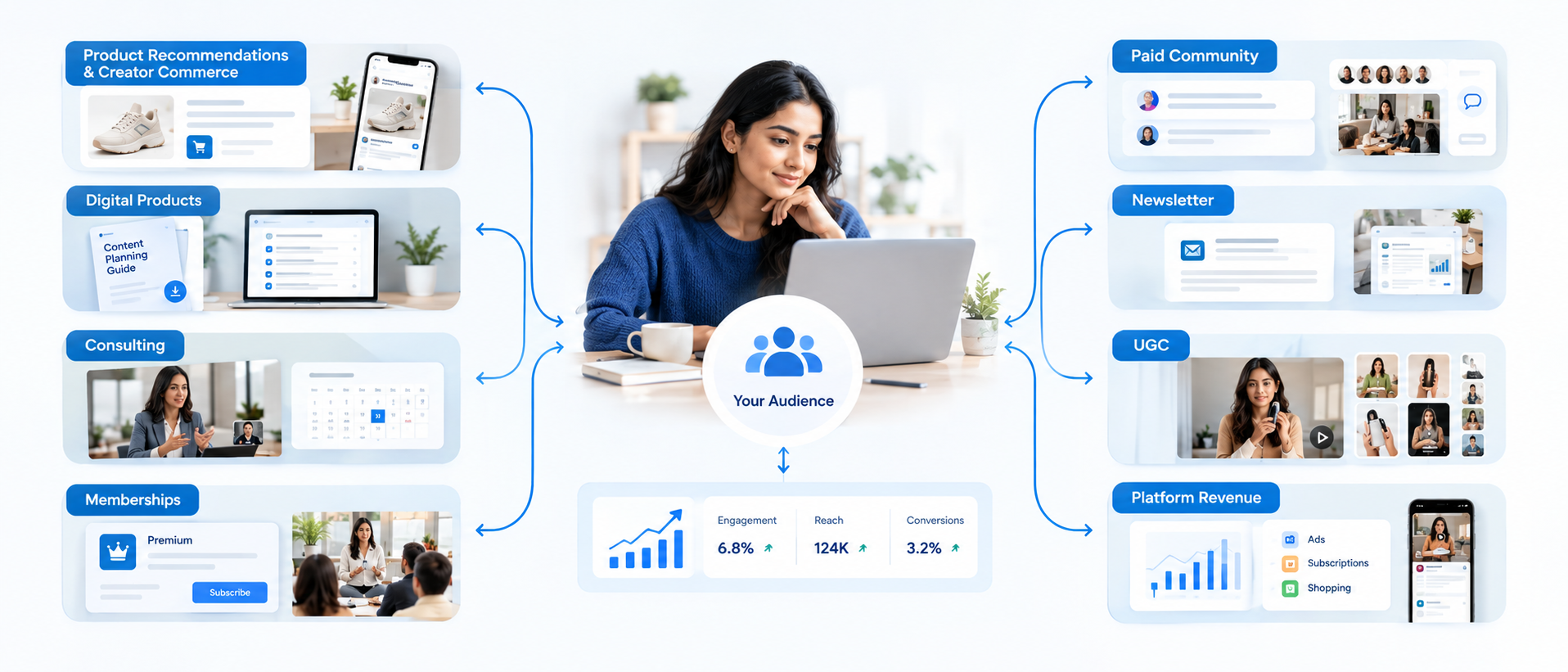
The goal shouldn't be to replace sponsorships with another single income source.
The stronger strategy is to build a monetization stack.
For example, a beauty creator could combine:
Product recommendations through creator commerce
A digital skincare guide
Paid consultations
A premium community
A business creator could combine:
Consulting
Templates
Workshops
Paid newsletter
Membership
A fitness creator could combine:
Product recommendations
Digital workout plans
Group coaching
Paid community
Platform revenue
These models can reinforce one another.
Someone who discovers you through a product recommendation can later buy your guide. A consulting client can later join your community. A newsletter subscriber can later become a course customer.
This creates a customer journey instead of a collection of disconnected income streams. Creators starting from scratch can use how to start monetizing as a creator as a practical starting point for choosing the first layer.
A Practical 90-Day Plan to Monetize Your Audience
If you are starting from zero, do not spend three months building a product before knowing whether people want it.
Use the first 90 days to validate demand.
Days 1 to 30: Find the strongest audience signal
Review your last 30 to 50 pieces of content.
Look for:
Topics generating the most meaningful comments
Questions that repeatedly appear in DMs
Products people ask you about
Tutorials people request
Problems followers repeatedly describe
Content that generates clicks or saves
Topics that bring highly relevant followers
Choose one monetization opportunity based on the strongest signal.
Days 31 to 60: Test before building
Create the smallest useful version of your offer.
That could be:
A short workshop
A simple template
A consultation
A curated product collection
A paid newsletter issue
A small membership
A short digital guide
Your objective is not perfection.
Your objective is to discover whether people will actually take the desired action.
Days 61 to 90: Improve and add a second layer
Once you identify what works, improve the offer rather than immediately launching five more.
Track:
Click-through rate
Conversion rate
Sales
Revenue per customer
Repeat purchases
Membership retention
Customer questions
Refunds or cancellations
Then introduce a second monetization layer that naturally connects with the first.
For example, if product recommendations generate strong engagement, a curated creator storefront can become the foundation for additional commerce content. If consulting sells consistently, the repeated problems you solve may become a digital product or workshop.
Do You Need a Large Audience to Monetize Without Sponsorships?
No. Audience size matters, but it is only one variable.
A smaller audience can be commercially valuable when it is highly relevant, engaged, and willing to take action.
Consider the difference between these two audiences:
Creator A: 100,000 followers, broad entertainment content, very low purchase intent.
Creator B: 5,000 followers, highly specific audience, strong trust, frequent product questions, and high engagement.
Creator B may have a better starting point for affiliate sales, consulting, digital products, or a paid community. Zokera's guide to earning without a huge following also explains why creators do not necessarily need a massive audience to begin monetizing.
This is why creators should track audience intent, not just follower count. A practical example of this principle is covered in how creators earn without a large following.
If you want a practical breakdown of monetization for smaller audiences, see how creators can earn without a large following.
Common Mistakes Creators Make
Choosing the model before understanding the audience
Just because a particular monetization method is popular does not mean your audience wants it.
Launching too many offers
Ten monetization methods can create more complexity than revenue. Start with one strong offer.
Creating before validating
Do not spend months building a course, community, or product without testing whether people want it.
Making every post promotional
Your audience followed you for your content, not for constant sales messages. Keep the majority of your content genuinely useful.
Ignoring disclosure requirements
If you have a material connection with a brand, appropriate disclosure matters. ASCI's influencer guidelines include “Affiliate” among the permitted disclosure labels and emphasize that disclosures should be clear and understandable to consumers.
Focusing only on followers
Followers create potential reach. Trust, relevance, intent, and action create monetization opportunities.
Building a business entirely on one platform
Your social account can help you acquire attention, but your monetization strategy should not depend entirely on one algorithm or platform feature.
Sponsorships Can Still Be Part of the Business
Monetizing without sponsorships does not mean sponsorships are bad.
The problem is dependency, not sponsorship itself.
A creator with several revenue streams can approach brand deals differently. They can reject campaigns that do not fit their audience because they are not relying on every sponsorship for survival.
That changes the creator's negotiating position.
Instead of:
“I need this campaign.”
The business becomes:
“Does this campaign make sense for my audience and brand?”
That is a much healthier position for a creator business.
Conclusion
You do not need to wait for another brand deal to turn an audience into a business. The better approach is to understand what your audience already wants, match that demand with the right monetization model, validate it with real behaviour, and gradually build a revenue stack around it. If your audience already trusts your product recommendations, Zokera can help you turn that intent into creator commerce through a personalized storefront, product collections, Auto-DM, analytics, and follower cashback. Zokera creator storefront and start monetizing the audience you have already built.
Frequently Asked Questions (FAQs)
1. Can you monetize an audience without sponsorships?
Yes. Creators can earn through affiliate marketing, creator commerce, digital products, courses, consulting, coaching, memberships, paid communities, newsletters, UGC, licensing, physical products, and platform monetization.
2. What is the best way to monetize an audience without sponsorships?
There is no single best method. The right option depends on audience intent. Product-focused audiences may respond well to affiliate or creator commerce, while expertise-driven audiences may be better suited to consulting, courses, or digital products.
3. Can small creators monetize without brand deals?
Yes. A smaller but highly relevant and engaged audience can support affiliate sales, consulting, digital products, memberships, or other direct monetization models.
4. Is affiliate marketing better than sponsorships?
Neither is universally better. Sponsorships can generate larger individual payments, while affiliate income can continue generating revenue from eligible purchases. Affiliate and creator commerce can also be easier to integrate into ongoing content when recommendations are genuinely relevant.
5. How can creators build recurring income?
Memberships, subscriptions, paid communities, newsletters, coaching programs, and other recurring offers can create repeat revenue. The key is providing an ongoing reason for customers to remain subscribed.
6. How many followers do you need to monetize without sponsorships?
There is no universal follower threshold. Audience relevance, trust, engagement, purchase intent, and the monetization model often matter more than raw follower count.
Comments (0)
Be the first to comment.