
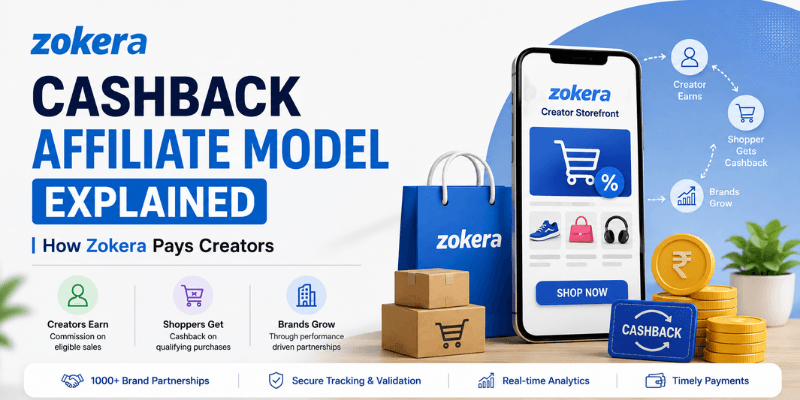
If you want a cashback affiliate model explained in practical terms, think of it as affiliate marketing with a shopper reward built into the buying journey. A brand gets a tracked sale, the creator can earn from an eligible purchase, and the shopper can receive cashback when the purchase qualifies. For creators, this creates a stronger reason for followers to shop through their recommendations. Zokera brings this model into creator commerce through creator storefronts, product recommendations, creator earnings, and cashback for followers.
What Is a Cashback Affiliate Model?
A cashback affiliate model combines affiliate marketing with cashback rewards.
In traditional affiliate marketing, a creator recommends a product using a trackable link. When someone clicks that link and completes an eligible purchase, the creator or affiliate partner can earn a commission under the program's terms.
The cashback model adds another benefit for the shopper.
When a shopper completes a qualifying purchase through the appropriate tracked journey, they can receive cashback according to the program's terms.
The basic flow looks like this:
Brand → Affiliate tracking → Creator recommendation → Shopper purchase → Sale validation → Creator earning + Shopper cashback
The exact commission and cashback structure can vary by merchant, product, platform, and program.
That distinction is important because not every affiliate program includes cashback, and not every purchase automatically qualifies for a reward.
For creators who want to understand the broader monetization model first, this guide to affiliate marketing for Instagram creators in India provides useful background.
How Does the Cashback Affiliate Model Work?
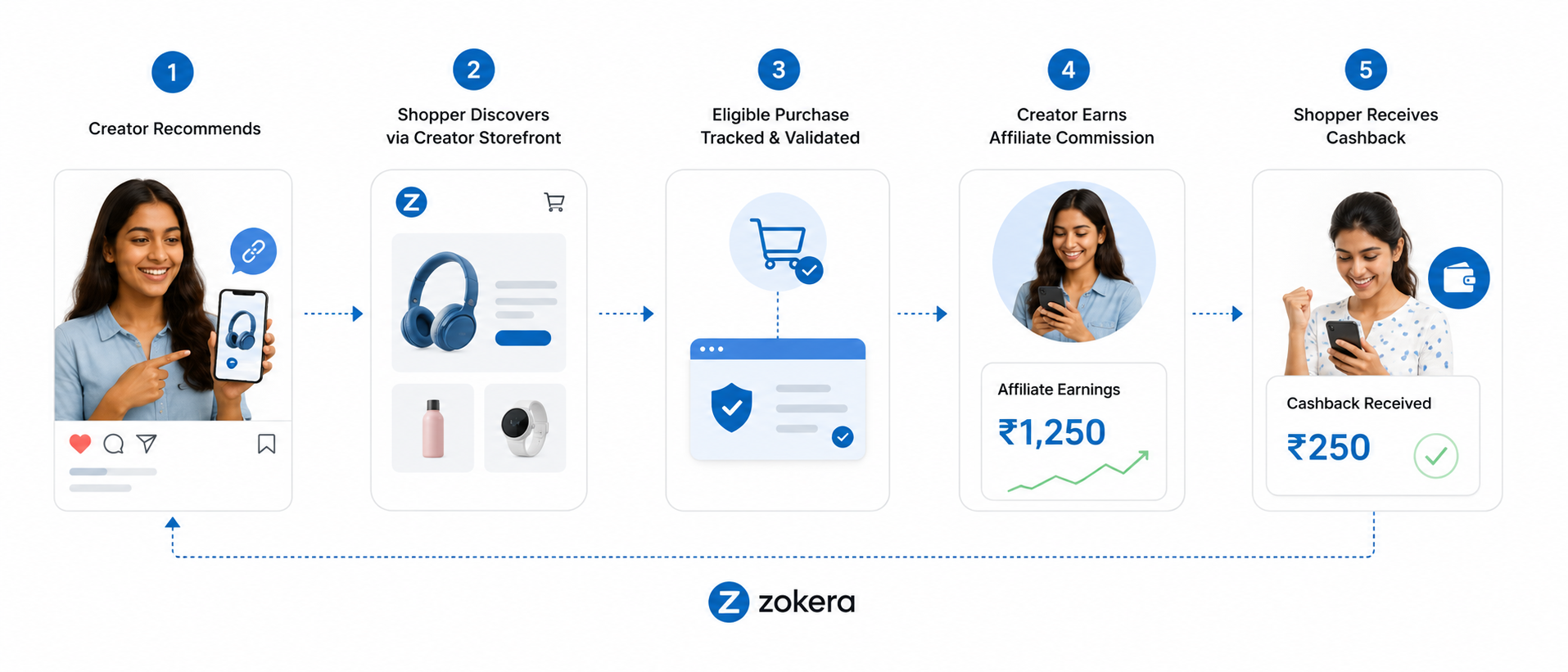
The process can look complicated when tracking, commissions, and cashback happen behind the scenes. From the shopper's perspective, however, it usually follows a straightforward path.
Step 1: A creator recommends a product
The journey begins with a product recommendation.
A creator might feature a product through:
Instagram Reels
Instagram Stories
YouTube videos
Blog posts
WhatsApp
Telegram
A creator storefront
The recommendation should be relevant to the creator's audience rather than being based only on the commission available.
Step 2: The shopper clicks through
The follower clicks the creator's tracked link or visits the creator's storefront.
The tracking system helps identify where the shopper came from and which creator or affiliate should receive attribution if the purchase is completed.
Step 3: The shopper makes an eligible purchase
The shopper completes the transaction with the participating merchant.
At this stage, the transaction may be recorded as pending rather than immediately becoming a final commission or cashback reward.
Step 4: The transaction is tracked and validated
This is one of the most important parts of the cashback affiliate model.
A purchase can later be cancelled, returned, refunded, or rejected because of specific program conditions.
The transaction therefore needs to pass the applicable validation process before the final reward becomes payable.
Step 5: The applicable commission is processed
Once the transaction qualifies, the applicable affiliate commission is processed according to the merchant or platform's terms.
For creators, this is the earning opportunity generated by the referred sale.
Step 6: The shopper receives cashback
If the offer includes cashback and the transaction qualifies, the shopper receives the applicable cashback.
This is what makes the model different from ordinary affiliate marketing.
The creator has an incentive to generate the sale, while the shopper gets an additional reason to complete the purchase through the creator's shopping journey.
How Does the Money Flow in a Cashback Affiliate Model?
This is where many beginners misunderstand how cashback actually works.
In a common cashback affiliate structure, the merchant pays an affiliate commission when a referred sale takes place. The cashback ecosystem can then use part of the affiliate economics to reward the shopper, depending on the program structure.
A simplified model looks like this:
Merchant
↓
Affiliate commission
↓
Affiliate/cashback ecosystem
↓
Creator earning + shopper cashback
The exact financial arrangement is not universal.
Different merchants and platforms can have different commission rates, cashback amounts, validation periods, exclusions, and payout rules.
So creators should never promise a fixed commission or cashback amount unless the applicable program has clearly provided that information.
The key point is that cashback is generally connected to the economics of the tracked affiliate transaction rather than being an unrelated reward added to every purchase.
Cashback Affiliate Model vs Traditional Affiliate Marketing
The two models use similar affiliate mechanics, but the shopper experience is different.
Factor Traditional | TraditionaMarketing Cashbackting | Cashback Affiliate Model |
|---|---|---|
Product recommendation | Yes | Yes |
Affiliate tracking | Yes | Yes |
Creator/affiliate earning | Yes | Yes |
Shopper reward | Usually not part of the model | Cashback may be offered |
Purchase incentive | Product recommendation | Product recommendation + cashback |
Validation | Usually required | Usually required |
Main benefit | Affiliate monetization | Affiliate monetization + shopper incentive |
Traditional affiliate marketing mainly creates a relationship between the merchant and affiliate.
Cashback affiliate marketing adds another layer: the shopper can receive a reward for completing the purchase through the qualifying channel.
For creators, that can make a storefront more compelling than simply sharing isolated product links.
To understand how the two approaches fit together in creator commerce, see this comparison of creator commerce vs affiliate marketing.
Why Do Shoppers Get Cashback?
Cashback gives shoppers a reason to use the creator's shopping path.
Consider a follower who already wants to buy a pair of shoes.
They can search for the product independently, or they can use a creator's storefront if that storefront offers a relevant product and cashback opportunity.
The second option gives the shopper another potential benefit.
For creators, this can make recommendations more useful because the follower is not only discovering a product but also getting a possible shopping reward.
The cashback therefore becomes part of the customer experience.
It is not a replacement for trust.
A creator still needs to recommend products that actually make sense for their audience.
How Do Creators Earn With a Cashback Affiliate Model?
Creators earn by influencing eligible purchases.
Their value comes from helping followers discover products, understand why those products are useful, and decide whether they are worth buying.
A creator may:
Review a product.
Demonstrate how it works.
Compare it with alternatives.
Add it to a storefront.
Share the storefront with followers.
Generate eligible purchases.
Earn the applicable commission.
If you are specifically exploring how creators earn commission on Instagram, the important distinction is that the creator's content creates the product-discovery and purchase journey, while tracking connects eligible sales back to the creator.
The follower can benefit too.
When the follower shops through an eligible Zokera storefront purchase, they can receive cashback according to the applicable Zokera terms.
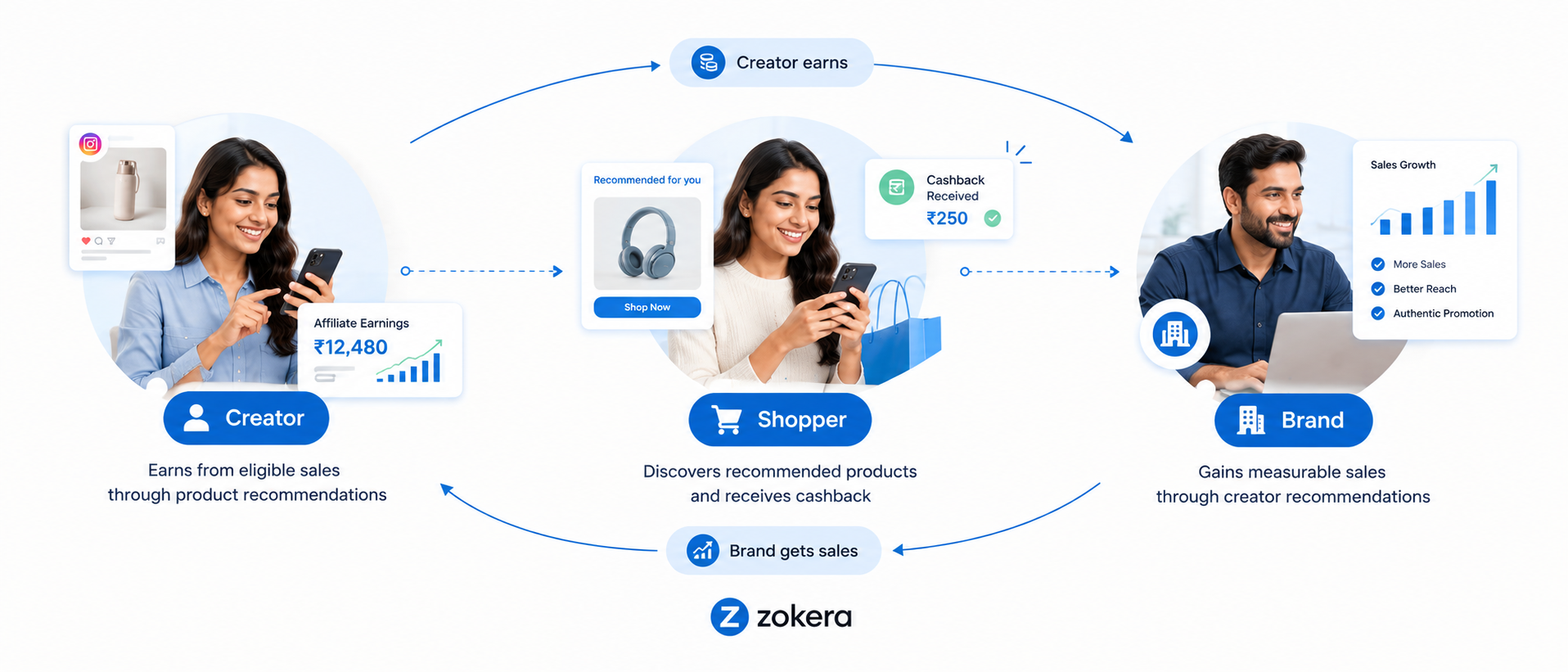
That creates a three-sided value exchange:
Creator: earns from eligible sales.
Follower: discovers products and can receive cashback.
Brand: gets a measurable opportunity to generate a sale.
How Zokera Uses the Cashback Affiliate Model
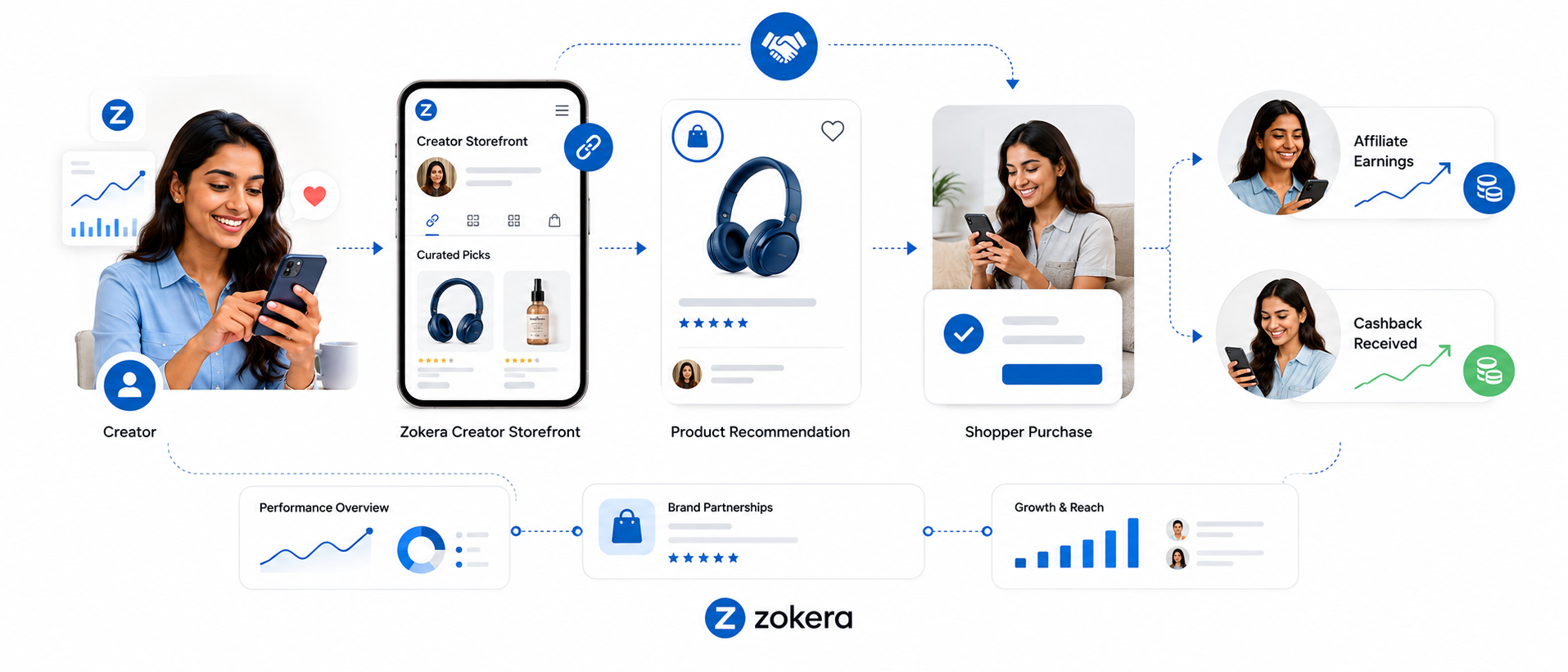
Zokera brings the cashback concept into a creator-commerce environment.
Instead of asking creators to manage a collection of unrelated affiliate links, the platform gives creators a personalized storefront where they can curate products and share recommendations with their audience.
The current Zokera model clearly describes the flow: followers shop through an eligible creator storefront, purchase, the sale can be attributed to the creator, the creator can earn applicable commission, and the follower can receive cashback.
The journey looks like this:
Creator recommends a product
↓
Product is added to the Zokera storefront.
↓
Follower visits the storefront
↓
Follower shops
↓
Eligible purchase is tracked.
↓
Creator earns applicable commission
↓
Follower receives applicable cashback.
The follower cashback is an important part of this model.
Zokera's beginner guide states that followers earn cashback when they shop through a creator's storefront, giving shoppers an additional reason to purchase through the creator rather than going directly to the brand.
Creators can also set up a Zokera creator storefront to organize relevant products in one place instead of sending followers through disconnected links.
Zokera's creator-commerce ecosystem also includes Auto-DM, analytics, brand partnerships, and other tools designed to connect content with shopping. Its current platform content highlights 1000+ brand partnerships and cashback for followers.
For beginners, the complete guide to earning on Zokera explains how storefronts, product recommendations, commissions, cashback, and creator monetization work together.
A Practical Cashback Affiliate Model Example
Imagine a fashion creator posts an Instagram Reel featuring a college outfit.
The creator recommends a pair of sneakers and adds the product to their Zokera storefront.
A follower watches the Reel and visits the storefront.
The follower selects the sneakers and completes an eligible purchase.
The transaction is tracked and goes through the applicable validation process.
If the purchase qualifies:
The brand records the referred sale.
The applicable commission is processed.
The creator receives the applicable earnings.
The follower receives the applicable cashback.
The creator did not need to manufacture the sneakers.
They did not need to hold inventory.
They did not need to handle shipping.
Their role was to create useful content, recommend a relevant product, and send interested followers to the shopping journey.
This is one reason creator commerce can extend traditional affiliate marketing into a more complete shopping experience.
Creators can also use shoppable links on Instagram Reels to connect product-focused content with their shopping destination.
What Happens If a Shopper Returns the Product?
This is a detail that should never be skipped when explaining cashback affiliate marketing.
A purchase may initially appear as pending.
If the shopper later cancels, returns, or refunds the order, the transaction may no longer qualify for the final commission or cashback.
The same can happen if the purchase violates specific offer conditions.
This is why creators should avoid statements such as:
"You will definitely get cashback on every order."
A safer and more accurate approach is:
"Eligible purchases can earn cashback according to the applicable terms."
The exact treatment depends on the merchant and program.
The important takeaway is that pending does not always mean approved.
Creators should understand the relevant eligibility and validation rules before communicating cashback claims to their audience.
Benefits of the Cashback Affiliate Model
Benefits for creators
A cashback affiliate model can help creators:
Monetize product recommendations
Build a centralized shopping destination.
Give followers an additional reason to purchase
Turn product-focused content into measurable sales.
Create repeat shopping opportunities.
Reduce dependence on scattered affiliate links.
For creators, however, cashback should be treated as a conversion aid rather than the entire monetization strategy.
The foundation remains audience trust and product relevance.
Benefits for followers
Followers can:
Discover products through creators they trust
Browse curated recommendations
Shop through a creator storefront.
Receive cashback on eligible purchases.
Get more value from products they were already interested in buying
This is particularly useful for creators who regularly publish reviews, comparisons, tutorials, shopping guides, or product recommendations.
Benefits for brands
Brands can potentially use cashback affiliate marketing to:
Generate performance-based sales
Reach targeted creator audiences
Give shoppers an additional purchase incentive
Track referred transactions
Connect affiliate costs with measurable outcomes.
However, brands also need to consider whether cashback generates genuinely incremental purchases or simply captures customers who were already planning to buy.
That distinction is important when evaluating the actual value of a cashback partner.
How Can Creators Use Cashback Affiliate Marketing Effectively?
The best creators do not build their strategy around cashback alone.
They use cashback as an additional benefit around useful content.
Recommend products you actually understand
If you have used a product, tested it, compared it, or genuinely understand its benefits, your recommendation becomes more credible.
Build useful product collections.
Instead of sharing unrelated products, create collections around specific audience needs.
For example:
Best skincare products for beginners
Budget creator setup
College fashion essentials
Travel products worth buying
Home office upgrades
A relevant collection can turn a storefront into a useful shopping destination.
You can also learn how digital storefronts work for creators in India to understand why a centralized product destination can be more useful than individual links.
Explain the cashback benefit clearly.
If an eligible purchase can earn cashback, tell followers directly.
For example:
"You can shop this product through my storefront and receive cashback on eligible purchases."
That is much more useful than simply saying:
"Buy this from my link."
Create content before sharing the link
A useful review, tutorial, comparison, or demonstration gives the follower a reason to click.
The link should complete the content experience, not replace it.
Track what converts
A post can receive thousands of views and still generate few purchases.
Another post might reach a smaller audience but generate much stronger sales.
Creators should therefore pay attention to the full journey:
Views → Clicks → Purchases → Approved transactions → Earnings
Zokera's creator tools are designed to help creators monitor performance rather than rely only on views or follower counts.
Cashback Affiliate Model vs Creator Commerce
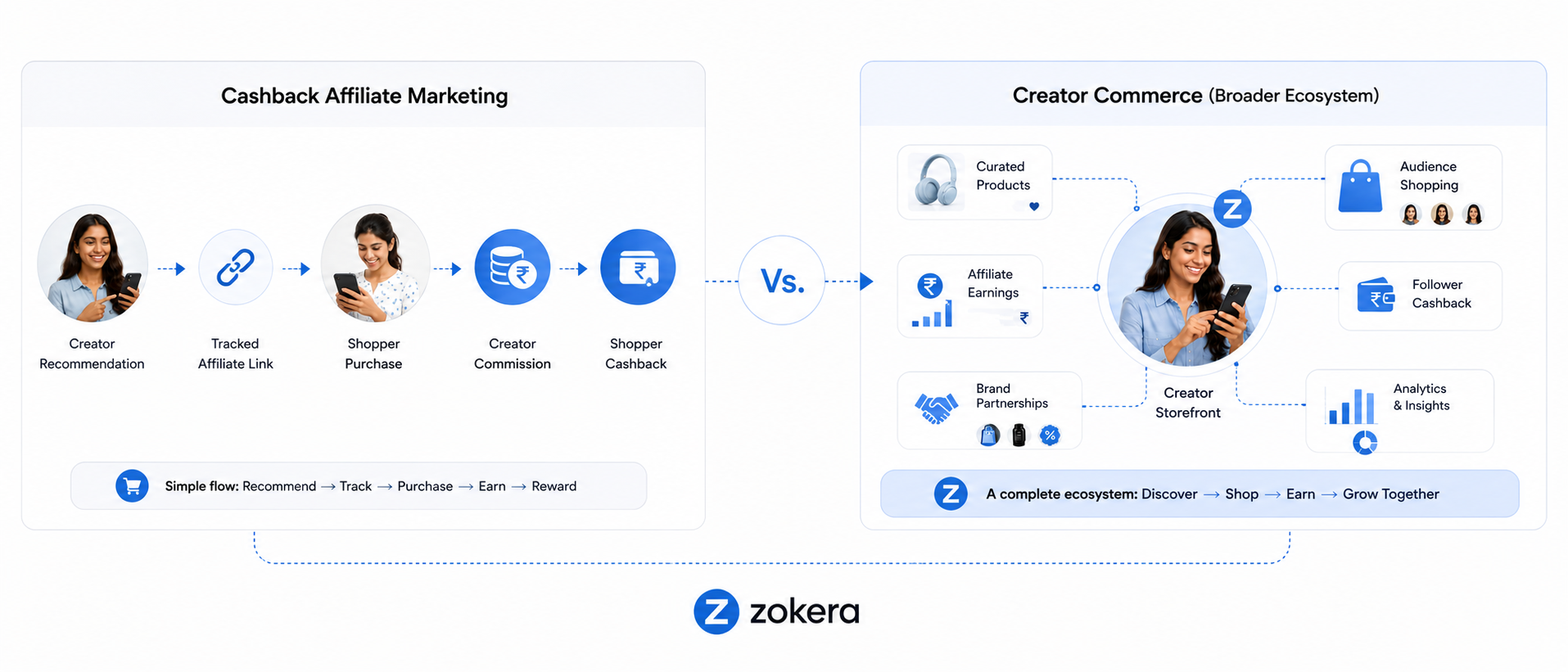
Cashback affiliate marketing and creator commerce overlap, but they are not identical.
Affiliate marketing focuses primarily on generating referred sales.
Creator commerce expands the experience by combining:
Creator recommendations
Product discovery
Storefronts
Affiliate earnings
Shopper cashback
Brand partnerships
Performance tools
That makes creator commerce a broader system.
A creator is not simply sharing a URL. They are building a product-discovery experience around their content and audience.
Zokera's creator-commerce content describes this difference by comparing traditional affiliate links with a personalized storefront that can include products, cashback for followers, brand partnerships, Auto-DM, and analytics.
Creators who want to explore more monetization options can also see how to scale a creator business with Zokera.
Common Cashback Affiliate Mistakes to Avoid
1. Choosing products only because they pay more
A higher commission does not automatically make a product a better recommendation.
Audience relevance should come first.
2. Ignoring the shopper experience
If the buying journey is confusing, the creator may lose the sale even when the content performs well.
3. Making guaranteed-income claims
Affiliate income depends on audience intent, product relevance, clicks, conversions, approved transactions, and applicable program terms.
4. Promising cashback on every purchase
Use "eligible purchases" unless the specific program clearly states otherwise.
5. Hiding affiliate relationships
Creators should disclose relevant commercial relationships clearly.
In India, ASCI's influencer disclosure tool specifically lists "Affiliate" as an acceptable disclosure label and says disclosures should be upfront and easy for consumers to understand.
For additional guidance on influencer disclosures and material connections, creators can also refer to the FTC's social media influencer disclosure guidance. The FTC recommends making a financial or other material connection clear and placing the disclosure where people can easily notice it.
India's Department of Consumer Affairs also publishes the Guidelines for Prevention of Misleading Advertisements and Endorsements for Misleading Advertisements, 2022, which is relevant when considering responsible commercial communication.
6. Treating every click as a sale
Clicks are only the beginning.
The meaningful outcome is what happens after the click: eligible purchases, approved transactions, creator earnings, and shopper behavior.
Is the Cashback Affiliate Model Worth It for Creators?
For creators who regularly influence product purchases, it can be a useful monetization model.
The strongest opportunity is not simply:
"Earn commission."
It is:
Content → Trust → Product recommendation → Storefront → Purchase → Creator earning + Shopper cashback
That gives both sides a reason to participate.
The creator has a reason to recommend relevant products.
The follower has a reason to shop through the creator.
The brand has a performance-based route to reach potential customers.
Zokera combines this model with creator storefronts, brand partnerships, Auto-DM, analytics, creator earnings, and cashback for followers. Its current creator content also emphasizes that followers can earn cashback when they shop through the creator's storefront.
Creators can also explore ways to earn passive income as a content creator by turning useful product content into longer-term shopping opportunities.
The important thing is not to chase cashback alone.
Cashback can encourage the purchase, but trust is what makes the recommendation believable.
conclusion
The cashback affiliate model explained simply connects brands, creators, and shoppers through tracked purchases. Creators can earn from eligible sales while followers receive cashback on qualifying purchases. With Zokera, creators can turn product recommendations into a simple shopping experience through a storefront, affiliate earnings, follower cashback, and 1000+ brand partnerships.
Frequently Asked Questions (FAQs)
1. What is a cashback affiliate model?
A cashback affiliate model combines affiliate marketing with a shopper reward. A creator or affiliate generates a tracked purchase, the applicable commission is processed after validation, and the shopper can receive cashback when the purchase qualifies.
2. How does cashback affiliate marketing work?
A creator recommends a product, the shopper clicks through a tracked link or storefront, completes an eligible purchase, and the transaction is validated. The applicable creator commission and shopper cashback are then processed according to the program's terms.
3. Who pays for cashback in affiliate marketing?
The exact structure varies by program. In a common cashback model, the merchant pays an affiliate commission for the referred sale, and the cashback reward can be funded from the affiliate economics.
4. Do Zokera followers get cashback?
Yes. When followers shop through an eligible Zokera creator storefront purchase, they can receive cashback according to the applicable Zokera terms.
5. Do Zokera creators earn commission when followers shop?
Eligible purchases made through a creator's storefront can be attributed to that creator, and the creator can receive the applicable commission according to the relevant terms.
6. What happens to cashback if an order is returned?
A returned, cancelled, refunded, or otherwise ineligible transaction may not qualify for final cashback or commission. The exact treatment depends on the applicable program conditions.
7. Is cashback affiliate marketing different from traditional affiliate marketing?
Yes. Both use affiliate tracking and referred purchases, but cashback affiliate marketing adds a shopper reward to the transaction.
8. Is cashback affiliate marketing good for creators?
It can be useful for creators who regularly influence product purchases. The strongest results generally come when cashback is combined with relevant products, useful content, audience trust, and a simple shopping journey.
Comments (0)
Be the first to comment.