
.jpg&w=3840&q=75)
When creators search for how creators earn commission on Instagram, the process can seem complicated when affiliate links, brand codes, and product recommendations are spread across different platforms. With Zokera, creators can share a personal storefront link, followers can shop through it, the sale is tracked automatically, and eligible commission is credited to the creator while the follower can earn cashback on the purchase. Here's exactly how that flow works and how it differs from traditional affiliate setups.
The Commission Landscape for Instagram Creators Right Now
Instagram itself has been expanding its own native affiliate tools. As of April 2026, Instagram head Adam Mosseri announced that eligible creators aged 18 and up with at least 1,000 followers can tag products directly in Reels to earn commission, a capability that hadn't existed since 2022, according to reporting from Shopify. It's a genuinely useful addition, but it only covers products already sitting in Meta's brand catalog, and it still rewards just the creator.
Outside of that, most creators are still working with the older model: a brand hands over a promo code or a tracking link, the creator posts it, and commission depends entirely on that one brand's terms, one dashboard, one negotiation. Buffer's 2026 monetization research notes that affiliate income remains one of the most beginner-friendly paths precisely because it needs no follower minimum, but the tracking and commission structure still shifts brand to brand, which is exactly the friction a storefront model is built to remove.
Here's how the three approaches actually compare:
| Native Instagram Reels Tagging | Standard Affiliate Code | Zokera Storefront | |
|---|---|---|---|
| Follower requirement | 18+, 1,000+ followers | Varies by brand | No inherent barrier (confirm current eligibility before publishing) |
| Product catalog | Limited to Meta's brand catalog | Single brand only | 1000+ brand partnerships |
| Commission tracking | Per Instagram's dashboard | Per brand, often manual codes | One dashboard, automatic tracking |
| Rate negotiation | Set by brand | Negotiated per brand deal | Built into the storefront model |
| Follower incentive | None | None | Cashback on every purchase |
The row that matters most isn't tracking or catalog size, it's the last one. Zokera is the only model here that gives the follower their own reason to buy through a specific link, rather than rewarding just the creator.
What Makes a Zokera Storefront Different
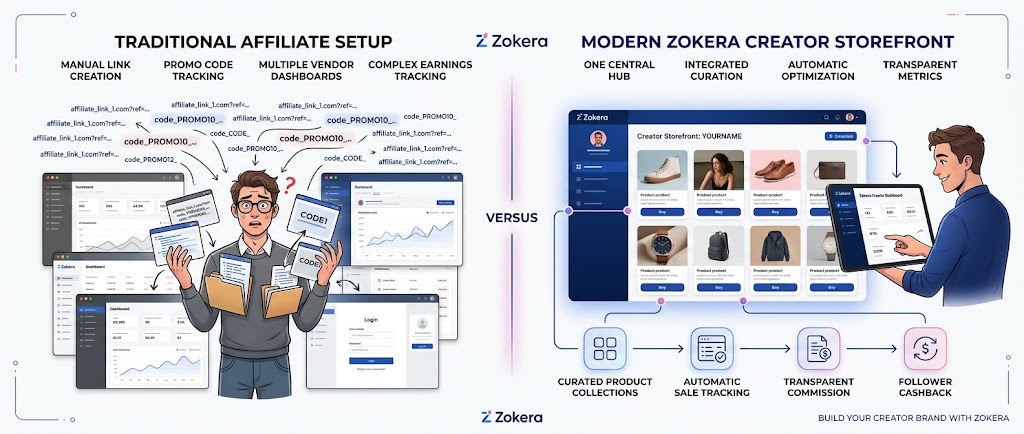
A Zokera storefront is a personal shopping page built around you, stocked with products pulled from Zokera's 1000+ brand partnerships. You don't need a separate code for every brand or a spreadsheet to track who bought what. One storefront link does the job across every product you feature, and every purchase made through it gets credited straight back to you as commission.
The part that catches most creators off guard: your followers earn something too. Anyone who buys through your storefront gets cashback on that purchase, automatically. It's not a one-sided link that only benefits you; it's a shopping loop where the person clicking has their own reason to actually buy, which is exactly why storefront links tend to convert better than a bare affiliate tag.
How the Commission Flow Actually Works
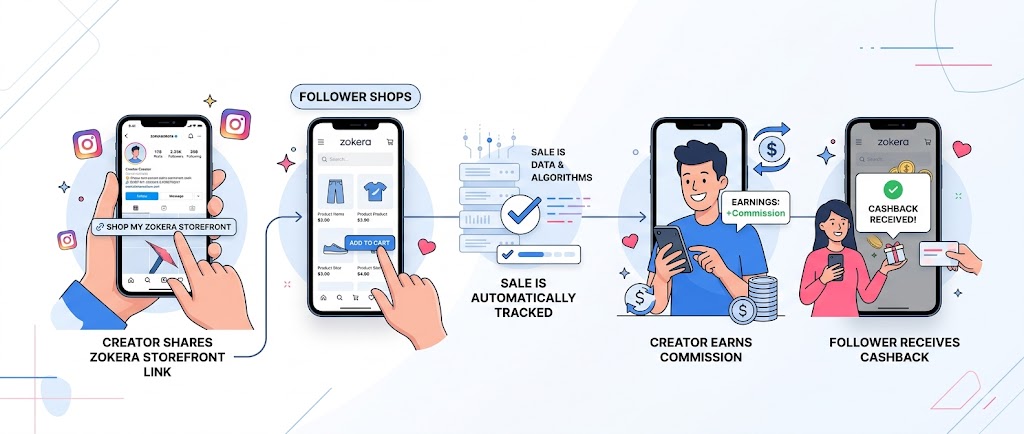
With the landscape and the model out of the way, here's the mechanic itself, laid out the way it actually plays out in your dashboard rather than in theory:
You set up your Zokera storefront and pick products from the brand catalog that genuinely fit your niche, whether that's skincare, fitness gear, home finds, or fashion. Unlike Instagram's own affiliate eligibility rules, there's no separate compliance review to clear for each brand you feature.
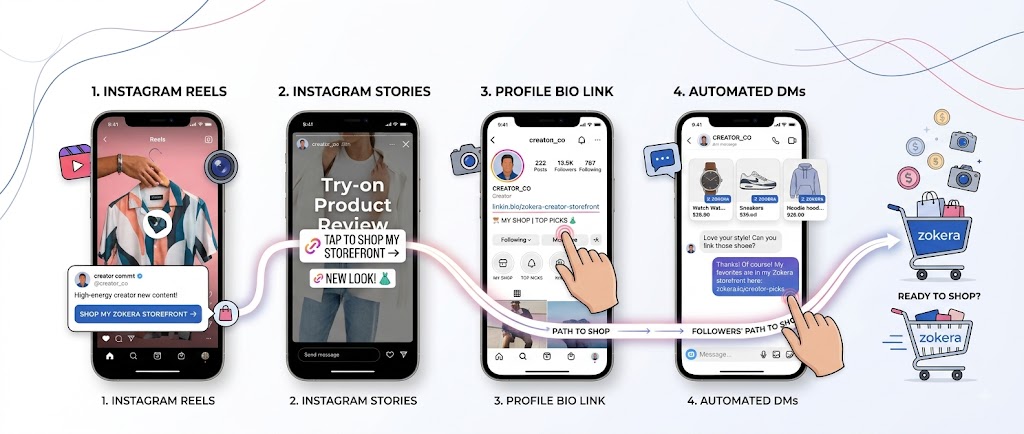
You share your storefront link wherever your audience already is: your Instagram bio, a Reel caption, a Story sticker, or through Auto-DM when someone comments asking where something's from.
A follower clicks through and shops your storefront, browsing the products you've personally curated for them.
The sale gets attributed automatically. No manual code entry, no follower typing anything in at checkout. Zokera's system tracks the click-to-purchase path on its own.
Commission lands in your dashboard, cashback lands in theirs. Both happen off the same transaction, at the same time, without you touching a spreadsheet or waiting on a brand's reporting cycle.
Where to Share Your Storefront for the Most Commission
Commission only shows up when people actually see and click your link, so placement does as much work as product selection.
Reels tend to get strong reach on Instagram right now, and pinning your storefront link in the caption or tagging it in a product moment works especially well for demo-style content
Stories with a link sticker feel immediate and casual, which suits "here's what I'm using this week" content
Bio link is your always-on placement; anyone landing on your profile should be able to shop in one tap
Auto-DM turns "where's this from" comments into a direct storefront link, without you manually replying to each one
None of this works as a single push. Buffer's posting-frequency research backs up something most creators already sense: accounts that show up consistently see steadier engagement than ones that post in bursts, and steadier engagement is what keeps a storefront link getting clicked week after week rather than just on launch day.
What Actually Affects How Much Commission You Earn
A handful of factors decide whether your commission stays a trickle or turns into something real:
Niche fit between the products on your storefront and the audience you've actually built matters more than raw follower count
Content format plays a role too; creators generally report Reels and Stories with a clear product moment converting better than a static feed post, though results vary by niche and audience
Consistency in posting and refreshing your storefront keeps the link relevant instead of going stale after one campaign
Follower trust, built through genuine recommendations rather than every post reading like an ad
This lines up with what's true across platforms, not just Instagram. Data on nano and micro-creator earnings suggests engagement and niche fit tend to outweigh follower count when it comes to converting an audience into buyers. A smaller, engaged storefront audience can often outperform a bigger, more generic one on this basis.
How to Choose Products for Your Storefront
Not every product from Zokera's catalog belongs on your storefront, and picking too broadly is one of the fastest ways to dilute your commission potential.
A useful filter: would you genuinely recommend this to a friend who follows you specifically for your content, not a random stranger? If the answer is no, it probably doesn't belong there. Products that match your existing content themes convert better than ones added purely because they carry a higher commission rate, since followers notice when a recommendation feels out of place.
It also helps to rotate in seasonal or trending items alongside your steady picks. A storefront that looks identical every time someone visits gives returning followers no reason to check back, while one that updates regularly, even with a handful of new additions, keeps giving people a reason to click through again.
Tracking Commission Without the Guesswork
One frustration I hear from creators using traditional affiliate setups is not knowing what actually converted. A code shared in a Story, a link dropped in a caption, and by the time a sale happens days later, there's no clean way to trace which post drove it.
The storefront model removes that problem by design. Every click and purchase routes through your single link, so your dashboard shows commission tied to real sales, not estimates stitched together from separate codes across separate brands. You can see which products are actually converting and put more content behind those, instead of guessing based on likes or comments.
It also means you're not maintaining a spreadsheet across five different brand deals. One dashboard covers your commission across your entire storefront, even as you swap products in and out.
Common Mistakes That Quietly Cut Into Your Commission
A few habits show up again and again in creators who feel like their storefront "isn't working," and most of them have nothing to do with the platform.
Treating the storefront as a one-time announcement. Sharing it once when you set it up, then never mentioning it again, means new followers never see it. The link needs to show up naturally across your regular content, not as a separate promotional event.
Overloading the storefront with products you don't actually use. Followers can tell the difference between a genuine recommendation and a shelf stocked for the sake of it, and it shows up directly in click-through rates.
Burying the link. A storefront link that's three taps deep in your bio, or only mentioned once in a Story that disappears in 24 hours, loses most of its potential clicks before they happen.
Ignoring which products are actually converting. Without checking your dashboard regularly, it's easy to keep pushing a product that isn't landing while a genuine winner goes unmentioned for weeks.
None of these are hard to fix once you notice them, but they're also easy to miss if you're not looking at the data behind your storefront, not just the follower count in front of it. If you're still building that audience, it's worth pairing storefront pushes with a steady content calendar so the link keeps showing up naturally instead of as an occasional ask.
Conclusion
Earning commission as an Instagram creator doesn't have to mean chasing brand deals one at a time or juggling a dozen tracking links across a dozen dashboards. With a Zokera storefront, one link carries the weight: you share it across Reels, Stories, your bio, and Auto-DM, your followers shop and earn cashback on every purchase, and you earn commission automatically, backed by 1000+ brand partnerships with nothing to negotiate and nothing to track by hand.
ALSO READ:
- How to Add Shoppable Links to Instagram Reels
- How to Make Money as an Instagram Influencer Using Zokera (2026)
- 10 Best Money-Making Games in 2026: Trusted Games to Earn Real Money on Mobile
- How to Start a Dropshipping Business in India in 2026
- How to Make Money on Instagram in 2026: 10 Easy Ways to Earn with Reels, Affiliate Marketing, and Sponsorships
- How to Make Money on Pinterest in India in 2026
Frequently Asked Questions (FAQs)
1. Does Instagram pay creators commission directly?
No. Instagram does not generally pay creators a commission simply for recommending products. Creators can earn through affiliate programs, brand partnerships, and creator-commerce platforms such as Zokera, where eligible product sales can be attributed to the creator.
2. How do creators earn commission on Instagram?
Creators can earn commission by recommending products through Instagram content and directing interested followers to an affiliate link or creator storefront. When an eligible purchase is attributed to the creator, commission is earned according to the applicable program terms.
3. How much commission can creators earn?
Commission earnings vary depending on the products promoted, applicable commission rates, purchase volume, conversion rate, and the terms of the affiliate program. Audience relevance and content quality can also influence how effectively product recommendations turn into sales.
4. Do I need a large following to earn commission on Instagram?
Not necessarily. A large following can help increase reach, but it is not the only factor that matters. A smaller, engaged audience that trusts your recommendations can generate strong buying intent when the products are relevant to the niche.
5. How do followers get cashback through Zokera?
When followers shop through a creator's eligible Zokera storefront purchase, they can receive cashback according to the applicable Zokera terms. This gives followers an additional benefit while allowing creators to earn from qualifying sales.
6. Do I need to negotiate commission rates with each brand?
Not necessarily. Zokera's creator storefront model brings products from its brand partnerships into one platform, so creators can select eligible products available to them instead of separately negotiating a partnership for every product. Applicable commission terms can vary by product or brand.
9. How is creator commission tracked on Zokera?
Eligible purchases made through a creator's storefront can be attributed to that creator through Zokera's tracking system. Creators can use the platform's available performance information to monitor sales and commission activity rather than relying on manual tracking.
Comments (0)
Be the first to comment.