
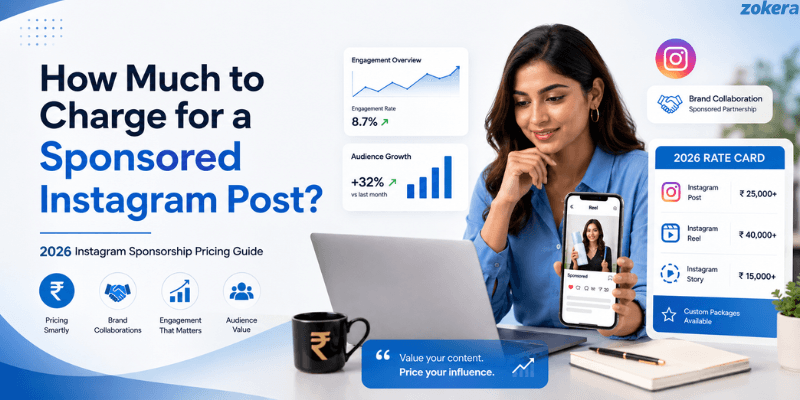
Getting a sponsored Instagram post offer can be exciting, especially when a brand reaches out to you for the first time. But one question often creates confusion: how much to charge for a sponsored Instagram post? There is no single fixed rate for every creator. Your ideal price depends on your followers, engagement rate, average reach, niche, content format, production effort, audience quality, usage rights, and campaign requirements. This 2026 guide explains Instagram sponsorship rates, practical pricing formulas, India-specific benchmarks, and how creators can negotiate confidently with brands.
How Much Should You Charge for a Sponsored Instagram Post?
A sponsored Instagram post can range from a few thousand rupees for smaller creators to several lakhs for established creators with large, highly engaged audiences.
As a general starting benchmark in India:
Creator Type | Follower Range | Sponsored Post Starting Benchmark |
|---|---|---|
Nano | 1K–10K | ₹1,000–₹5,000+ |
Micro | 10K–100K | ₹5,000–₹25,000+ |
Mid-tier | 100K–500K | ₹25,000–₹1.5 lakh+ |
Macro | 500K–1M | ₹1.5 lakh–₹5 lakh+ |
Mega | 1M+ | Custom pricing |
These figures are benchmarks rather than fixed industry rates. Two creators with the same follower count can charge very different amounts because engagement, audience location, niche, content quality, and campaign requirements can significantly affect the value of a sponsored post.
The most important rule is simple: do not price your sponsored Instagram post based only on follower count.
If you are building multiple income streams alongside sponsorships, you can also explore how to make money from your social media following in India.
Sponsored Instagram Post Rates by Follower Count
Follower count is still one of the first things brands consider when evaluating creators. However, it should be treated as a starting point rather than the final pricing factor.
Nano Creators: 1K–10K Followers
Nano creators often have smaller but highly connected communities. Their content can feel personal and authentic, which can make them valuable for local businesses, niche products, and targeted campaigns.
A starting sponsored Instagram post rate can be around ₹1,000–₹5,000, depending on engagement, audience quality, niche, and content requirements.
Micro Creators: 10K–100K Followers
Micro creators are often attractive to brands because they can combine meaningful reach with a focused audience.
A reasonable starting benchmark can be ₹5,000–₹25,000+ for a sponsored feed post. Creators with strong engagement, consistent reach, or a commercially valuable niche may be able to charge more.
If you are a smaller creator trying to attract your first partnerships, how to get brand collaborations as a small creator can help you prepare your profile and approach brands more effectively.
Mid-Tier Creators: 100K–500K Followers
At this level, creators generally have a larger reach and more established personal brands.
Sponsored Instagram post pricing can start around ₹25,000 and go significantly higher depending on audience quality, average reach, niche, content format, and campaign scope.
Macro Creators: 500K–1M Followers
Macro creators can command substantially higher rates because of their reach and established influence.
A sponsored post may start around ₹1.5 lakh, but the final quote can vary considerably based on campaign requirements, audience demographics, content quality, and usage rights.
Mega Creators: 1M+ Followers
Creators with more than one million followers typically use customized pricing instead of a standard rate card.
Brand reputation, audience demographics, campaign exclusivity, content production, usage rights, and expected reach can all influence the final quote.
How Much to Charge for an Instagram Post, Reel, and Story
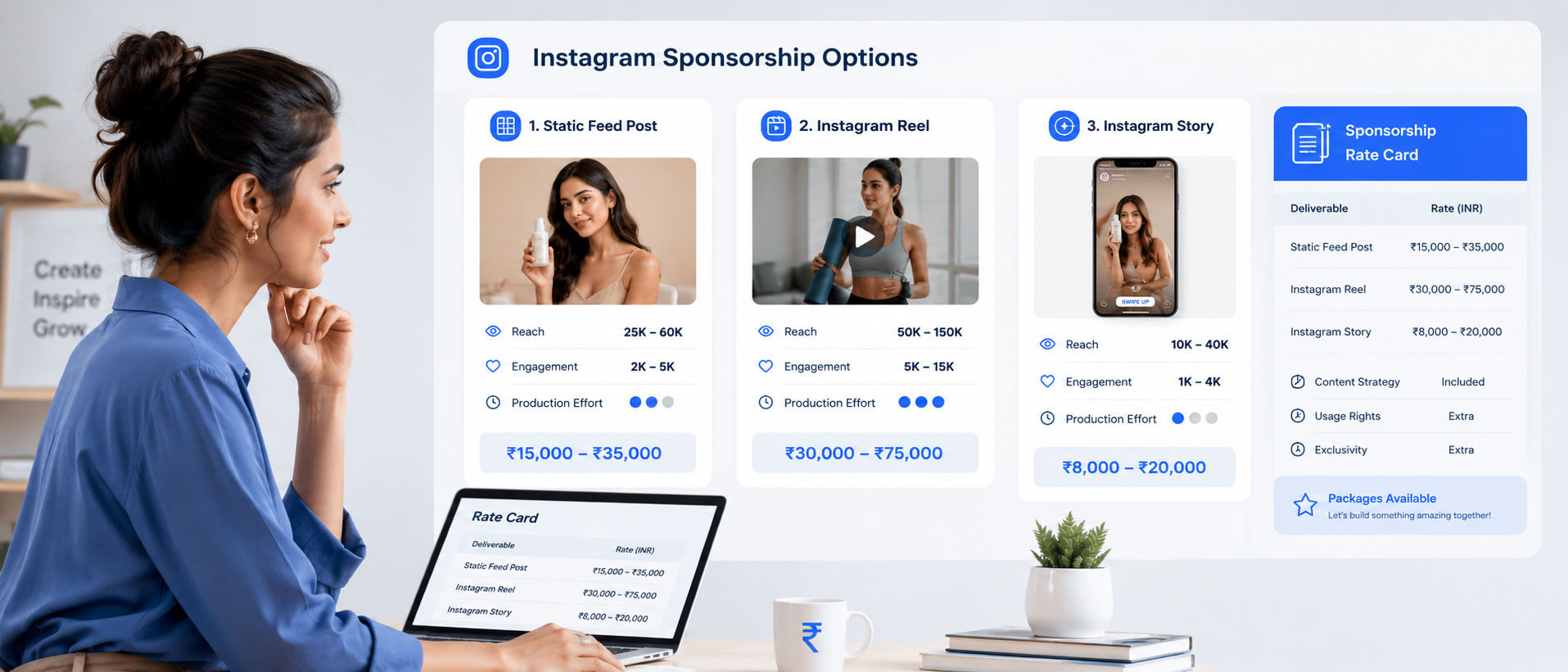
Not every Instagram deliverable should have the same price.
A static image post may require less production work than a professionally scripted and edited Reel. Similarly, a Story campaign can involve multiple frames, links, product demonstrations, or calls to action.
Consider pricing each format separately:
Instagram Deliverable | Pricing Consideration |
|---|---|
Static Feed Post | Base sponsored content rate |
Carousel | Higher if multiple creative assets are required |
Reel | Higher production and editing effort may justify a premium |
Story | Price based on number of frames and required effort |
Story + Link | Consider the additional campaign value |
Reel + Stories | Package pricing can work well |
Live Session | Price based on duration, preparation, and audience involvement |
Do not automatically use the same price for every format. Instead, consider how much time, creative work, audience attention, and brand value each deliverable requires.
For creators who also monetize products through Reels, shoppable links on Instagram Reels can be another way to turn content engagement into measurable shopping activity.
How to Calculate Your Sponsored Instagram Rate
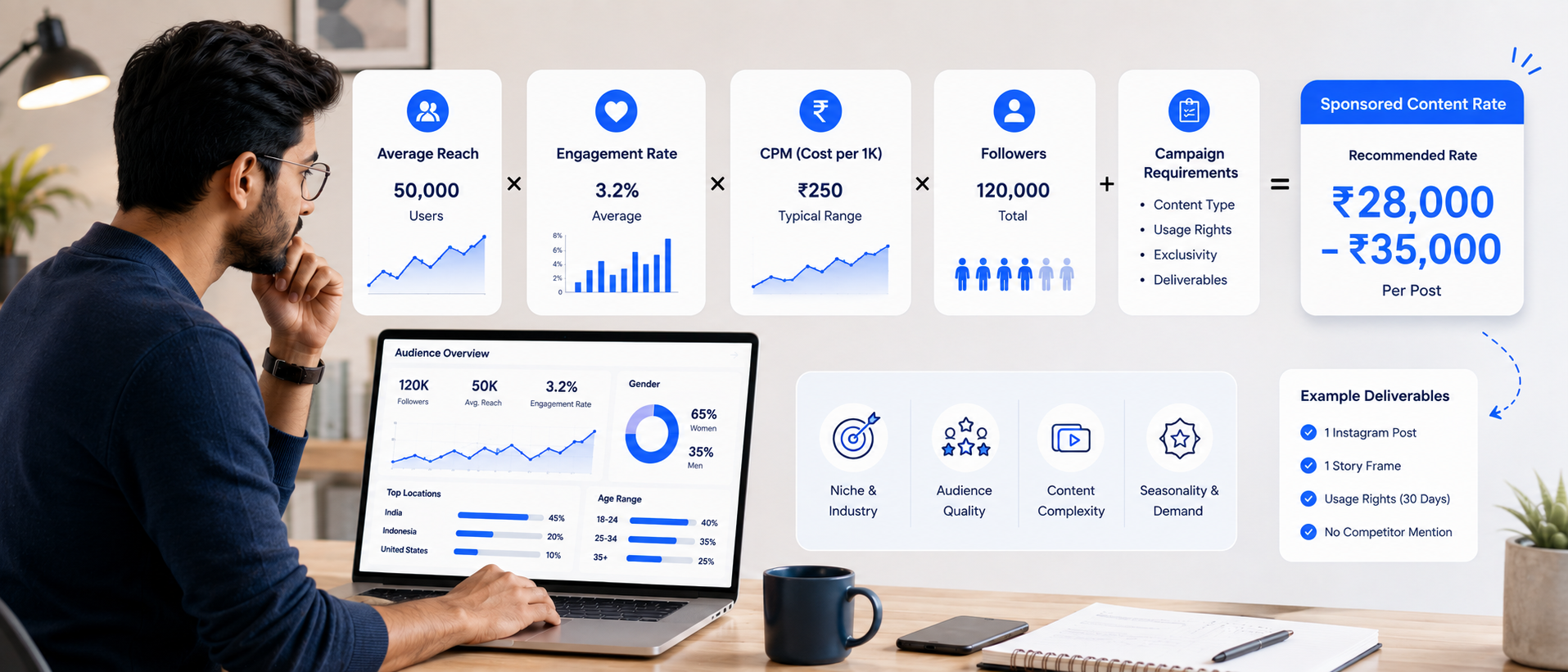
If you are unsure what number to quote, a performance-based calculation can give you a more logical starting point.
One useful approach is:
Base Rate = Average Reach ÷ 1,000 × Target CPM
For example, if your sponsored content typically reaches 20,000 people and your target CPM is ₹500:
20,000 ÷ 1,000 × ₹500 = ₹10,000
That ₹10,000 becomes a starting point rather than an automatic final quote.
You can then adjust the amount based on:
Your niche
Engagement rate
Audience location
Content format
Production effort
Campaign duration
Usage rights
Exclusivity
Number of revisions
Additional deliverables
This approach is more useful than simply saying, “I have 20,000 followers, so I charge ₹X.”
What Factors Should Affect Your Instagram Sponsorship Rate?
1. Follower Count
Followers provide an initial indication of your potential reach, but they do not tell the entire story.
A creator with 15,000 highly engaged followers may provide more value to a brand than an account with 100,000 inactive followers.
2. Engagement Rate
Engagement shows how actively your audience interacts with your content.
Likes, comments, shares, saves, Story replies, and other meaningful interactions can help demonstrate audience quality.
If your engagement is consistently strong, use it as part of your pricing argument.
3. Average Reach and Views
Brands are interested in more than your total follower count.
Your average Reel views, Story views, post reach, and previous campaign performance can help you justify your rate.
Keep screenshots or analytics reports ready when negotiating larger campaigns.
Instagram's Creator Marketplace can also help eligible professional accounts connect with brands and showcase creator portfolios. Instagram's official Creator Marketplace guide explains how the feature works.
4. Your Niche
Some niches can provide more commercial value because their audiences have strong purchasing intent.
For example, creators in finance, technology, beauty, fitness, fashion, parenting, travel, or business may attract different types of brand partnerships.
Your niche should therefore be considered when setting your rate.
5. Audience Location
A creator's audience geography can influence campaign value.
If a brand is specifically targeting Indian consumers, a creator with a strong Indian audience may be more relevant than a creator with a larger but less relevant international audience.
6. Content Quality
Professional photography, editing, scripting, product demonstrations, voiceovers, and other creative requirements can increase production time.
Your price should account for the work involved in creating the final content.
7. Previous Brand Results
If you have successfully worked with brands before, use those results to strengthen your pricing.
Examples include:
Reach
Views
Engagement
Link clicks
Saves
Shares
Product interest
Performance data can make your rate easier for a brand to understand.
How Much More Should You Charge for Usage Rights?
A sponsored Instagram post normally covers the content you create and publish according to the agreed campaign brief. It does not automatically mean a brand can use that content everywhere forever.
Ask how the brand plans to use your content.
Usage may include:
Reposting on the brand's Instagram
Posting on Facebook
Using the content on a website
Using it in paid advertisements
Using it in email marketing
Using it on product pages
Running creator ads
Keeping the content for an extended period
If a brand wants broader or longer-term usage rights, consider charging an additional fee rather than giving unlimited usage by default.
Before accepting the campaign, clarify where the content will appear, how long it can be used, and whether paid advertising is included.
If the brand wants to amplify your content through paid media, clarify whether it is asking for permission to run partnership ads on Instagram and Facebook. Meta provides separate permissions for partnership ads, so creators should understand exactly what advertising rights they are granting.
Should You Charge Extra for Exclusivity?
Yes, exclusivity can affect your pricing.
Suppose a brand asks you not to work with competing brands for 30, 60, or 90 days. That restriction can prevent you from accepting other relevant sponsorship opportunities during that period.
Therefore, exclusivity should be treated as a separate commercial requirement.
Before agreeing, ask:
Which competitors are included?
How long does the restriction last?
Does it apply to all platforms?
Does it apply only to sponsored content?
Which product categories are restricted?
The broader the restriction and the longer it lasts, the more carefully you should price the campaign.
How Much Should You Charge Based on Engagement Rate?
Engagement can make a major difference when deciding how much to charge for a sponsored Instagram post.
Consider two hypothetical creators:
Creator A
50K followers
1% engagement
5K average Reel views
Creator B
25K followers
6% engagement
20K average Reel views
Creator B has fewer followers but may provide stronger campaign value because the audience is more active and the content receives greater reach.
This is why brands increasingly look beyond follower count when evaluating creator partnerships.
When preparing your rate card, track your average:
Post reach
Reel views
Story views
Likes
Comments
Shares
Saves
Audience demographics
If you want to build a longer-term creator income strategy beyond sponsored campaigns, creator commerce vs affiliate marketing explains how different monetization models can work together.
Sponsored Instagram Post Pricing in India
Indian creators should avoid simply converting international USD rate guides into INR and treating the result as an official Indian market rate.
The Indian creator economy includes creators with very different audience sizes, niches, languages, locations, and engagement levels.
For a practical starting point, use the following benchmark:
Creator Level | Approximate Sponsored Post Starting Range |
|---|---|
1K–10K followers | ₹1,000–₹5,000+ |
10K–100K followers | ₹5,000–₹25,000+ |
100K–500K followers | ₹25,000–₹1.5 lakh+ |
500K–1M followers | ₹1.5 lakh–₹5 lakh+ |
1M+ followers | Custom quote |
These numbers should be used as starting benchmarks, not guaranteed rates.
A creator with a highly targeted Indian audience, strong engagement, or a commercially valuable niche may justify a higher price.
The same applies to creators who produce high-effort Reels, professional product photography, detailed tutorials, or multiple campaign deliverables.
How to Negotiate Your Sponsored Instagram Rate
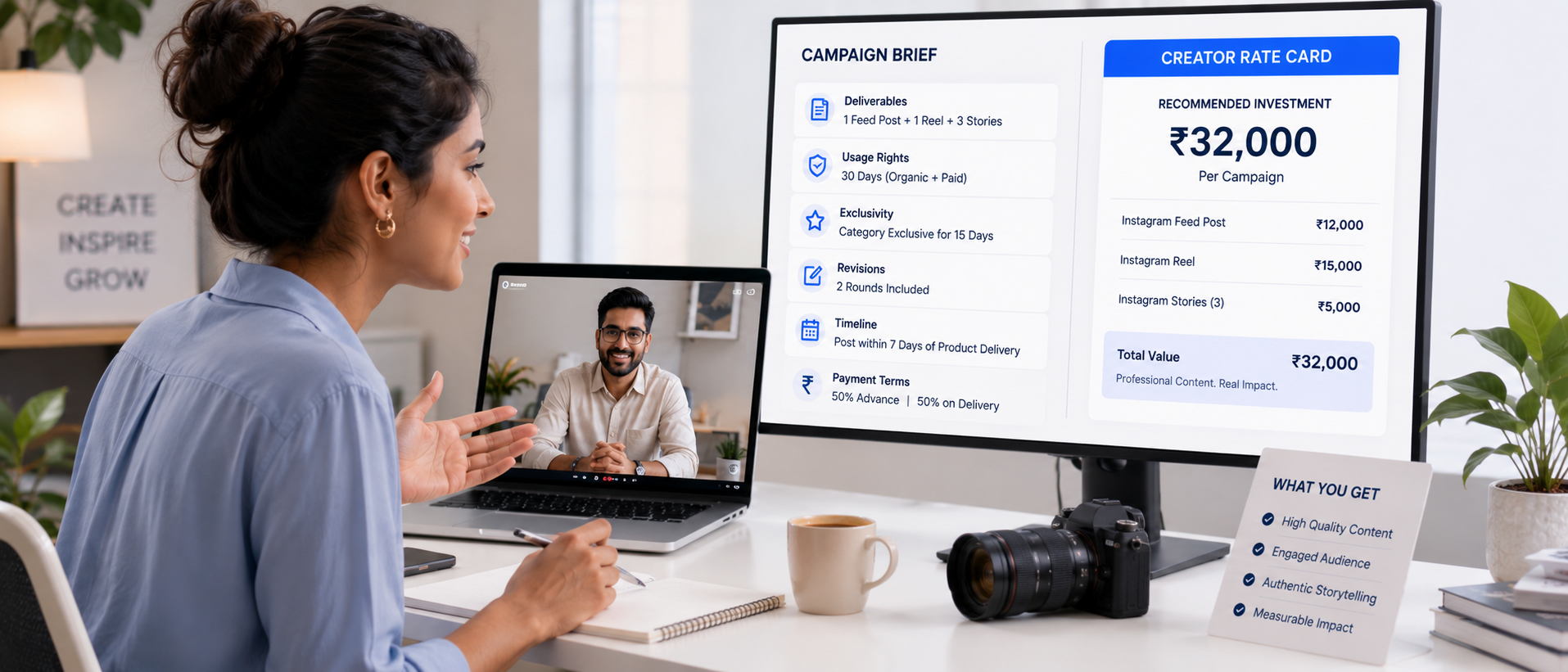
Never feel that you have to immediately accept the first number a brand offers.
Before quoting your rate, ask for the complete campaign brief.
Find out:
What content does the brand need?
Which platform will be used?
How many posts or Reels are required?
How many Stories are required?
What is the campaign deadline?
Does the brand require usage rights?
Is paid advertising included?
Is exclusivity required?
How many revisions are expected?
What is the payment timeline?
Once you have these details, calculate the total value of the campaign.
What to Say When a Brand Asks, “What Are Your Rates?”
Instead of immediately replying with one number, you can say:
“Thanks for reaching out. I’d be happy to explore the collaboration. Could you please share the campaign brief, required deliverables, timeline, usage rights, and exclusivity requirements? Once I have those details, I can share the most suitable rate or package.”
This keeps the conversation open and prevents you from accidentally underquoting before understanding the full scope.
How to Create an Instagram Creator Rate Card
A professional rate card can make brand negotiations easier.
Your rate card can include:
Creator name
Niche
Follower count
Engagement rate
Average reach
Average Reel views
Story views
Audience demographics
Top audience locations
Content formats
Sponsored post rate
Reel rate
Story package rate
Bundle pricing
Usage rights
Exclusivity terms
Contact information
You do not have to publish your complete rate card publicly.
You can keep a professional version ready and share it with brands after receiving a relevant campaign brief.
For creators who want to diversify beyond one-off sponsorships, what is creator commerce and how does it work explains how creators can use product recommendations and storefronts as another monetization model.
Sponsored Instagram Post Pricing Examples
Here are simplified examples to help you understand how pricing can work.
Example 1: 5K-Follower Lifestyle Creator
A creator has:
5K followers
Strong engagement
2K average Reel views
Indian audience
One sponsored static post
A starting quote could fall toward the lower end of the nano-creator range.
Example 2: 25K-Follower Beauty Creator
A creator has:
25K followers
Strong engagement
Consistent Reel views
Beauty-focused audience
One sponsored Reel
Because the Reel requires scripting, filming, editing, and product integration, the creator can price it above a simple static post.
Example 3: 50K-Follower Tech Creator
A creator has:
50K followers
High audience engagement
Strong product-related content
20K+ average Reel views
One sponsored Reel
30-day paid usage
The creator should not price this as an ordinary organic Reel because paid usage adds additional commercial value.
If the brand also wants to amplify the Reel as a partnership ad, that should be discussed separately because creators can provide advertisers with partnership ad permissions or codes for eligible content. Instagram's official partnership ad code guide explains how this works.
Example 4: 100K-Follower Creator
A creator with 100K followers and consistent reach can build a package rather than selling one deliverable at a time.
For example:
1 Reel + 3 Stories + defined usage period
A bundled campaign can be priced based on the total production effort and commercial value.
Common Instagram Sponsorship Pricing Mistakes
1. Charging Only Based on Followers
Follower count is only one part of your value.
2. Giving Unlimited Usage Rights
Always clarify how the brand can use your content and for how long.
3. Forgetting Production Costs
Filming, editing, travel, props, photography, scripting, and other expenses can take time and money.
4. Not Charging for Exclusivity
If a brand prevents you from working with competitors, factor that restriction into the campaign price.
5. Accepting Unlimited Revisions
Define the number of revisions included in your agreement.
6. Quoting Before Seeing the Brief
You may accidentally quote too low if you do not know the complete scope.
7. Treating Free Products as a Full Sponsorship
A gifted product and a paid campaign are not automatically equivalent. Understand whether the brand expects guaranteed content in exchange for the product.
Meta's official guidance says branded content can include content featuring products or services gifted by a business partner, and such content can require the paid partnership label. Instagram's branded content guidance explains these situations.
How Creators Can Find More Brand Collaboration Opportunities
Setting your rate is only one part of building a creator business.
You also need a reliable way to discover relevant brand opportunities and turn your audience into a longer-term revenue channel.
A creator storefront can help organize your recommended products and give your audience a simple place to discover what you genuinely recommend.
With Zokera's creator commerce platform, creators can build a shoppable storefront and access 1000+ brand partnerships. Followers can also earn cashback when they shop through a creator's storefront, which can give audiences another reason to use the creator's shopping links.
You can also learn how to set up a Zokera creator storefront if you want to organize your recommended products in one place.
This can complement sponsored collaborations rather than replacing them. A creator can earn from paid brand campaigns while also building a longer-term commerce channel around products their audience already wants.
Instagram Paid Partnership Disclosure
When a sponsored Instagram post involves an exchange of value with a brand, creators should also understand Instagram's disclosure requirements.
Instagram states that branded content should use the Paid partnership label. Its official guidance also covers certain situations involving gifted products and affiliate links. Instagram's paid partnership label requirements explain when the label is used.
Creators can use the paid partnership tool to tag organic branded content across formats such as Feed, Stories, Reels, Live, and other supported content. Instagram's guide to using the paid partnership label provides the official steps.
For creators working with brands regularly, Instagram's Creator Marketplace can also be useful for discovering partnership opportunities and presenting a creator portfolio to brands.
Conclusion
The best answer to how much to charge for a sponsored Instagram post is not one fixed number.
Start with your follower count and average reach, then consider engagement, niche, audience quality, content format, production effort, usage rights, exclusivity, and the brand's overall requirements.
For Indian creators, use market benchmarks as a starting point rather than treating them as fixed industry prices. As your audience, engagement, content quality, and brand results improve, your rates can evolve too.
Most importantly, price the complete value of the campaign, not just the number of followers on your Instagram profile.
Sponsored content can also be just one part of your overall creator business. Combining brand collaborations with creator commerce and affiliate marketing can help creators build multiple revenue streams instead of depending entirely on one-off sponsorships.
Frequently Asked Questions (FAQs)
1. How much should I charge for a sponsored Instagram post?
There is no universal rate. A practical starting benchmark in India can range from around ₹1,000 for smaller nano creators to several lakhs for larger creators. Your final rate should also consider engagement, reach, niche, content format, production effort, usage rights, and exclusivity.
2. How much should a 10K follower Instagram account charge?
A 10K-follower creator can start by looking at the nano-to-micro creator benchmark, but follower count alone should not determine the quote. Engagement, average reach, niche, audience location, and campaign requirements can justify a higher or lower rate.
3. How much should I charge for a sponsored Instagram Reel?
Reels often require more production work than static posts, so they can command a higher price. Consider filming, editing, scripting, revisions, expected views, and any additional usage rights when setting your Reel rate.
4. How do I calculate my Instagram sponsorship rate?
One practical starting formula is:
Average Reach ÷ 1,000 × Target CPM = Base Rate
Then adjust the result for niche, engagement, production effort, usage rights, exclusivity, and additional deliverables.
5. Do Instagram creators charge separately for usage rights?
They can. If a brand wants to use your content outside the original Instagram post, especially for paid advertising or an extended period, consider negotiating usage rights as a separate cost.
6. Should I charge extra for exclusivity?
Yes, exclusivity can limit your ability to work with competing brands. Consider the duration, category, and scope of the restriction when calculating your campaign price.
7. Can small Instagram creators charge for sponsored posts?
Absolutely. Brands do not only work with large influencers. Nano and micro creators can be valuable when they have a relevant niche, engaged audience, authentic content, and strong audience trust.
8. Do sponsored Instagram posts need a paid partnership label?
Instagram's official guidance says branded content should use the Paid partnership label when applicable. This can include paid content and certain gifted-product or affiliate-link situations. Read Instagram's official paid partnership guidance.
9. Can a brand use my sponsored Instagram post as an ad?
A brand may be able to use eligible creator content in a partnership ad when the appropriate permissions are provided. Before granting permission, clarify the advertising period, platforms, usage scope, and any additional fee. See Instagram's official partnership ads information.
Comments (0)
Be the first to comment.